
Throughout his career, Roberto Juárez has allowed his life experiences in time and place to inspire multi-layered paintings that are as technical as they are conceptual. His works are reflections on his life, thoughts, and memories, composed of images of popular culture from exquisite flowers to abstract interpretations of life in New York City. In this exhibition of thirty-five mostly large-scale paintings from the last fifteen years, it is interesting to follow the artist as he travels to and works in cities around the world, from his hometown of Chicago to San Francisco, Los Angeles, Miami Beach, Rome, and his present residence in New York City. He has gathered inspiration from trips to Mexico, the American Southwest, the Dominican Republic, Puerto Rico, Spain, and India. The lingering memories of his journeys to every hemisphere inform the technical collage arrangements that are the basis of his paintings. The collage is especially well suited to his method of acquiring a sample image of a subject and arranging it on the surface of a canvas. Each layer of materials, patterns, and painted images contributes to the intricacy of the surface to create extraordinary results that easily may be described as beautiful.
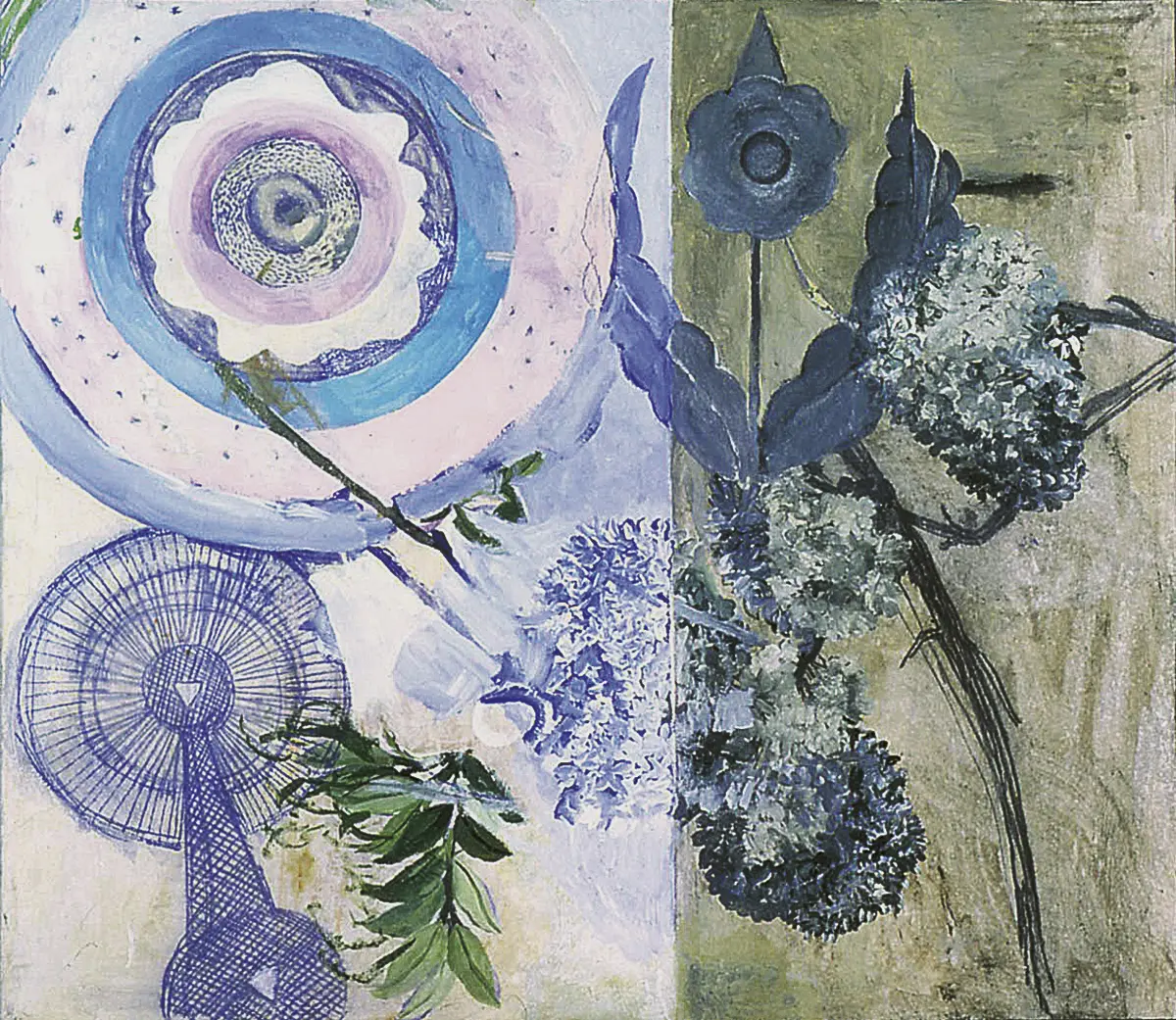
The exhibition reveals the influence that working in many different cities has had on his paintings, but it was when he kept a studio in Miami Beach in the late 1980s and early 1990s that their surface complexity became especially intense. Juárez began to incorporate sand from the beach and other natural materials into his paintings, broadening his previous interest in surface textures and giving his work new visual substance. The use of peat moss was particularly successful; he developed a technique that involved sifting the peat moss into a fine powder, which he then sprinkled over a canvas that had been prepared with a matte polymer medium, upon which he painted. Falo, 1999 combines gesso, acrylic, gouache, and rice paper mounted on linen for an elegant result. As he layers paint and rice paper, the paintings evolve into natural complements of the subjects from nature that inspired them. Orchids, leaves, sea life, fruits, and wildflowers are just some of the images that emerge from his layers. A sense of the organic evolves even when the painting is at its most abstract.
Abstraction is essential to the process of painting for Juárez, who always begins by delineating abstract forms. Whether he is inspired by the Moorish architecture of Spain, black-and-white Native American pottery designs, the azures and other blues of Biscayne Bay, Italian terra cottas, or the turmoil of New York City, the formal elements of painting always take precedence over specific references—memories and nostalgia over the actual reality. The five monumental canvases in the series They Entered the Road, originally painted for a project at the Center for the Fine Arts in Miami in 1995, are especially evocative for this local audience who shares his memories of lost friends from the time the works were first exhibited. The title was taken from the Mayans who believed that in death the soul rises to the sky and becomes part of the Milky Way. The paintings remain powerful testaments that out of death comes new life.
The year-long residency in Rome on a fellowship at the American Academy in 1995 also marked significant changes in his work. His palette changed into the richer, more saturated tones of terra cottas and other hues derived from the interiors of villas in Pompeii, and its painted walls aged by the sun and elements for hundreds of years. Medieval illuminated manuscripts also attracted his attention on visits to the Vatican Library and contributed to his own awareness of the particular effects of painting on paper. The color, frescoes, manuscripts, and the light and drama of ancient and modern on the streets of Rome are apparent sources of inspiration for Lesser Butterfly, 1996, Limitation, 1997, and Will/Leaves, 1997.
Perhaps most intriguing in this survey of his work are the large paintings of the past three years produced in his new studio in Times Square. Witness to the rapid changes in the redevelopment of the area, Juárez addresses issues of urban renewal, nostalgia, architecture, and cartoon kitsch in paintings of the city that are abstract, dynamic, and as flashy as the source of their imagery. He considers these city paintings an important breakthrough as he replaces references to nature with references to the complex network of city streets and their architecture that lie beneath his window. Only a few remnants of the old wait to be engulfed by urban progress. In Times Square Tiles, 2000, circles of energy pulse in repetitive patterns that are also reminiscent of the arrangement of tiles the artist saw in Turkish mosques. Again, memory creates a sense of place in this body of work that is equally significant for its masterful technique and elegant imagery.
CAROL DAMIAN