
The selection of Rocío García’s paintings that were recently exhibited at Galería Habana attests to a certain androgyny that permeates her poetics. The blurring of boundaries between male and female is apparent in her recourse to a physiognomic model that, in addition to being authorial, becomes a kind of asexual prototype: slanted, cunning eyes; shaved head; aquiline nose; pointed chin; “racial.”
The morbid bodies of the “weaker sex” and the muscular bodies of the “stronger” one both tend to adopt the violent postures of nature often designated as male. There are also permutations of roles, not as much in the fact of males leaning toward what “should” be the “natural” preference of females, that is, men, but because the distinction between one or the other as victim or victimizer is blurred.
In Rocío García’s work such violence, whether latent or manifest, is usually expressed in a narrative discourse. This is explicit in the exhibition title, El domador y otros cuentos. But this narrative quality is elliptic. It makes use of psychological projections and certain physical actions that are carried out in the immediate past or are verifiable in the immediate future. The viewer is stricken or apprehensive, sees what has happened or what will happen, and is unable to intervene but remains merely a more-or-less sensitive witness.
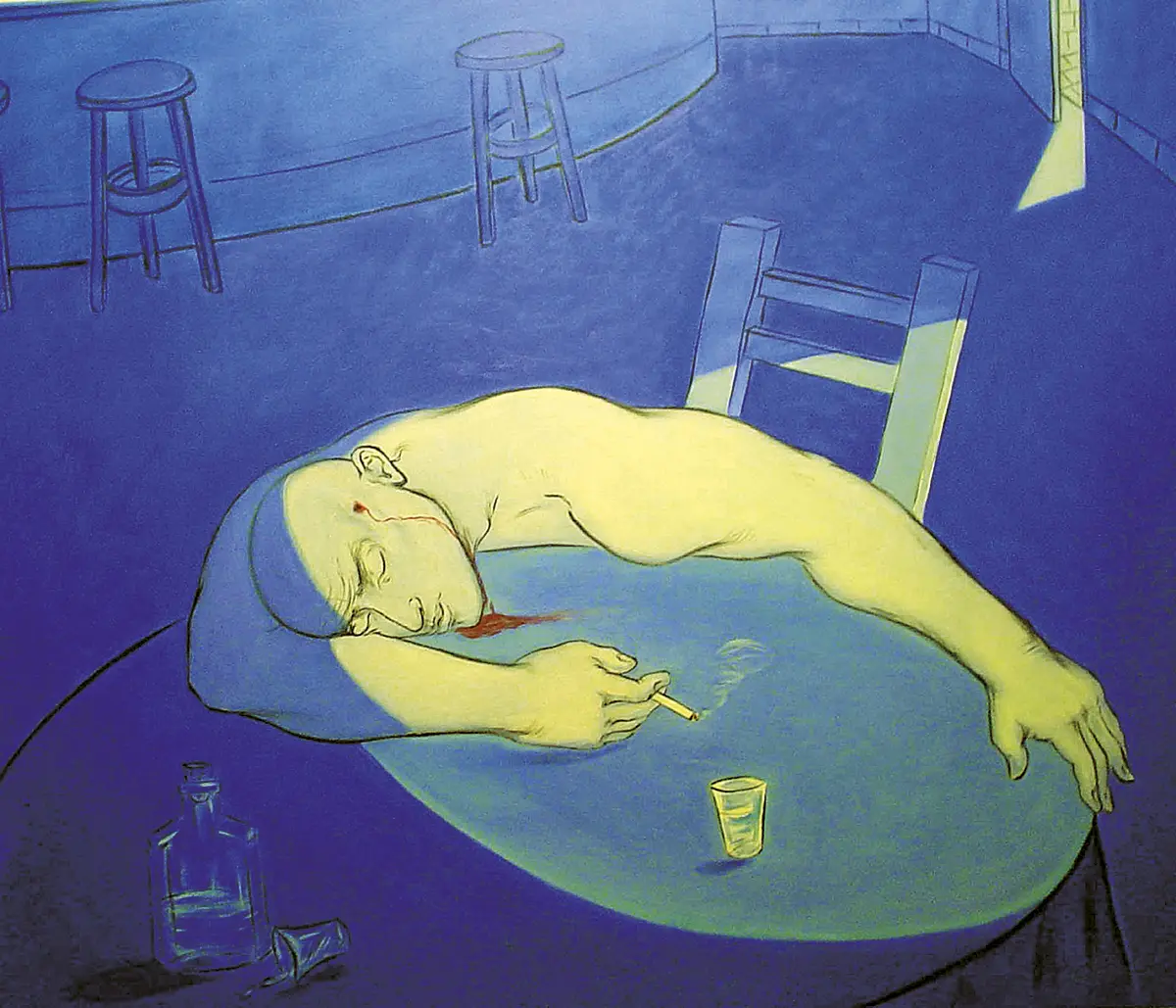
Fragments of body parts; the presence of instruments of aggression; mutilating framings; and oblique glances between the characters, or from her subjects to the viewer are the visual resources that intensify the charge of violence, even as one of García’s most powerful devices —the contrast of complementary colors— is avoided here.
Through gradations of a single color —generally a cold one— the artist is able, on this occasion, to better concentrate and shade focal points and display the technical acumen implied by her Master of Fine Arts degree from Russia’s prestigious and demanding Repin Academy in St. Petersburg. In these oil-on-linen pieces, light is not contrasted by means of chromatic divergence, but by distinction in shade. Yet such strong, focused illumination preserves a sense of mise-en-scène, a theatricality supported by its dislocation in closed, angular interiors, such as bathrooms and bedrooms.
These works are similarly indefinable as either painting or drawing by virtue of their most essential elements, namely, color and line, respectively. García’s “drawings” delineate shapes that are saturated with pigment, and her “paintings” are segmented by color and generate a straight, linear axis. The latter, along with the interplay of different planes, imparts tension and movement to the compositions.
In previous shows, García presented women (as geishas and lesbians, for example) and men (macho types, sailors, or gays) separated from each other; in this work, she brings them together. They are one but divided, like Greek mythology’s Hermaphroditus. They are complementary poles that attract each other and remain separate. They are One and the Other converging on their alterity.
The current exhibition also includes images of “men-beasts” (fauns?) and “female” cannibals, as well as unidentified animals that, despite the intimation of zoophilia, seem to allegorize savage instincts and behaviors that are present in some human beings. Pleasure, violence, and death emerge completely. As it has for several years, this Cuban painter’s artistic discourse revolves around the traumatic relationship between Eros and Thanatos.
ISRAEL CASTELLANOS LEÓN