
Trampas de viento, Rosario López’s most recent exhibition at Bogotá’s Galería Diners (September 4–October 4), is the artist’s second project on the perception of wind, the vacuum it traverses, and the trajectory it describes when trapped. This exploration started a little more than five years ago with the placement and recording of wind traps in different landscapes and contexts (first in northern Europe, later in Colombia). López sought to identify the mobility that exists in a vacuum and the potential therein for formal configurations or expressions. The idea has been to understand that which alters the open landscape, not only on the basis of what we impose on it, however fragile that is, but on the basis of the changes propitiated by invisible but active forces in it.
The earliest results of López’s exploration, shown as part of the Alianza Colombo-Francesa’s “Young Talents” program, record, various types of strategies to trace the vacuum decisively, without the definitive intention of establishing a clear divide or of implanting oneself on a site. On the contrary, these images do not locate their center in the issue of the site or on the issue of the photographic; instead, they take their time capturing precarious constructions, trickìand contrivances that provide us with a view of the transit and the subsequent fate of that which is invisible and incorporeal.
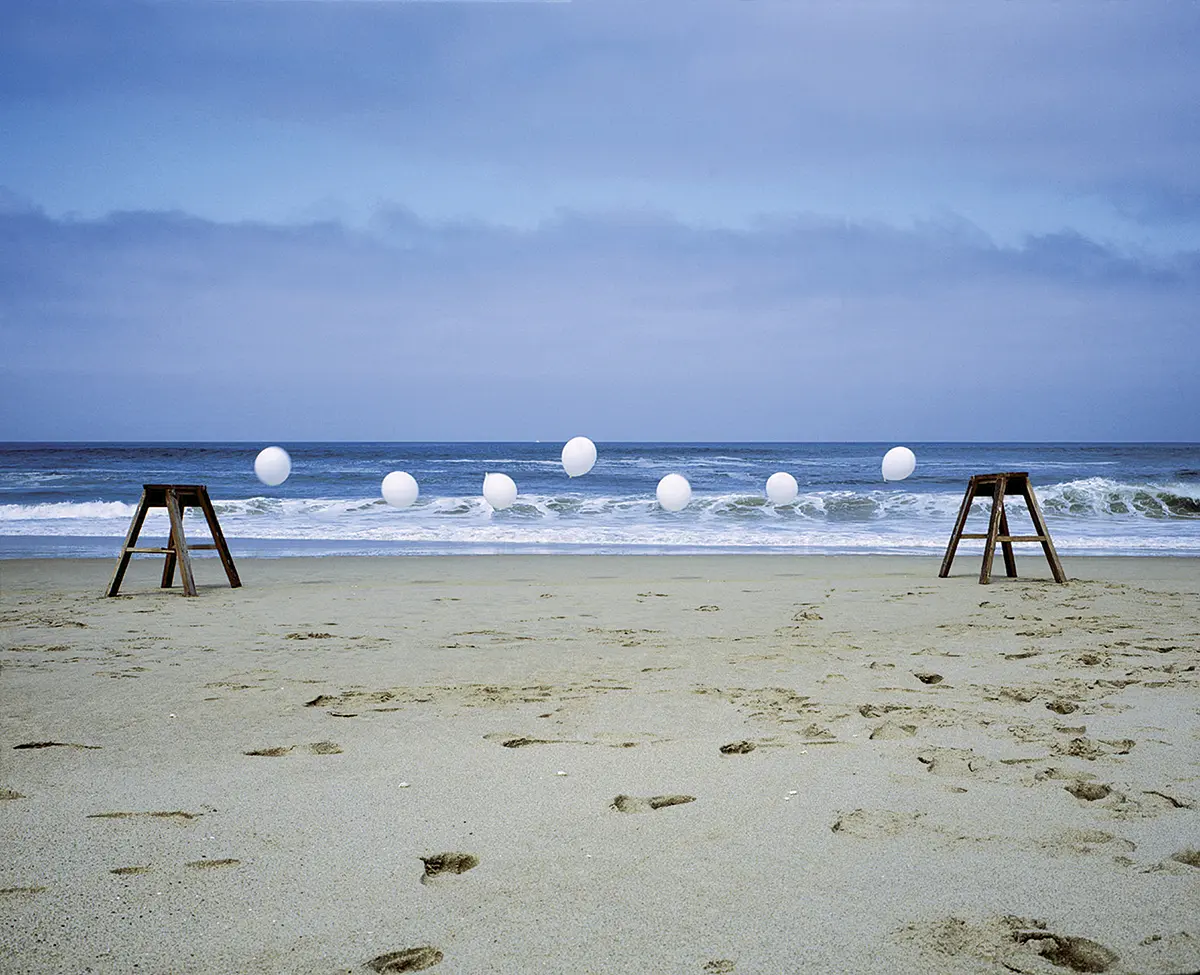
This reflection on non-form, on what can’t be apprehended, on fragility and mutability, built on the artist’s education as a sculptor, should by necessity give us an entry into the genesis and the meaning of form as it is understood in the works presented at Galería Diners.
In these more recent works, besides building her “wind traps,” Rosario López insists on the relevance of her behavior on a specific landscape. This is to say, in these pieces, the artist links the issue of form, or of formation, with the coming of the moment in a given context. This is expressed clearly in the weak line she extends at a distance of several kilometers from the cordillera, which, replicates the cordillera’s shape when moved by the wind that comes from the mountains.
The artist makes a similar point with a blanket installed next to a beach: the wind replicates the impulse of the waves on the blanket, but in a rather complex way, since in the weaving we identify currents that come from many points and not from a single direction as those that generate the notion of objectuality.
Seen in this way, what is emphasized is our difficulty in discerning what it is that brings about the visible. What is built with a passing, momentary gesture is the multiple circumstances, given that such multiplicity of events is acknowledged as in a permanent state of change, in unverifiable but unstoppable flux. Also, what propitiates materiality is the aleatory but decided encounter of the immaterial. The strategy designed by the artist reveals, with flexibility and with a minimum of resources, the issue of form in correspondence with its environment, and the issue of the variability that can occur according to the gyrations of currents that generate movement, and thus form.
It becomes clear that, despite the becalmed appearance of the selected landscapes, the indeterminable elements that run through them are tempestuous, contradictory, and conflicted. The seeming objectivity derives from our gaze on what is found in a precise place and a precise moment, from what crashes into this place and moment before continuing with its journey, and in that way, the beautiful form originated supports a chaotic coexistence of elements of various origins. Thus, the recognizable can in a way be understood as a generic element, but always beyond the pattern or independently of the formal generation that can be proposed by a matrix, despite the imprint this matrix leaves. And in the same sense, the very notion of a matrix is blurred, since its logic is equally understood as linked to an indeterminable formal origin.
We discover also in this proposal a leap of conceptual complexity in Rosario López’s work from her earliest “wind traps” to the present. Her first photographic registers detected a single impulse, a single fate since her attention was focused on the location of the simplest trap: the one that signaled the trend of the moment. Whereas in the current traps elaborated by the artist, capable as they are of gathering diverse impulses, there emerges the possibility of materializing the element of wind and the winds that are its air pumps, in order to parody the act of representation that immobilizes a variable and an event-related gesture and to fill it with a signifying charge.
This is why in an independent space inside the gallery, after exhibiting a perception of aerial conduction in photographic images, the artist spread on the floor a series of solid bodies conceptually representing that very idea of the circumstantial in the world of reification. In such a world, postulates drive us, as understood in Rosario López’s work, not to the construction of permanent values in the material, but to the indication of the events that originate them, which are the same that destabilized the solutions formed. This argumentation also clarifies an interest in approaching the landscape without wounding it or imposing on it. On the contrary, the artist’s attitude reveals and respects Nature’s feminine creativity, which exists despite its hidden conflicts and hangs in this conceptualization a problematic so unattended to in the present as the expressive essence of the form itself.
MARÍA A. IOVINO