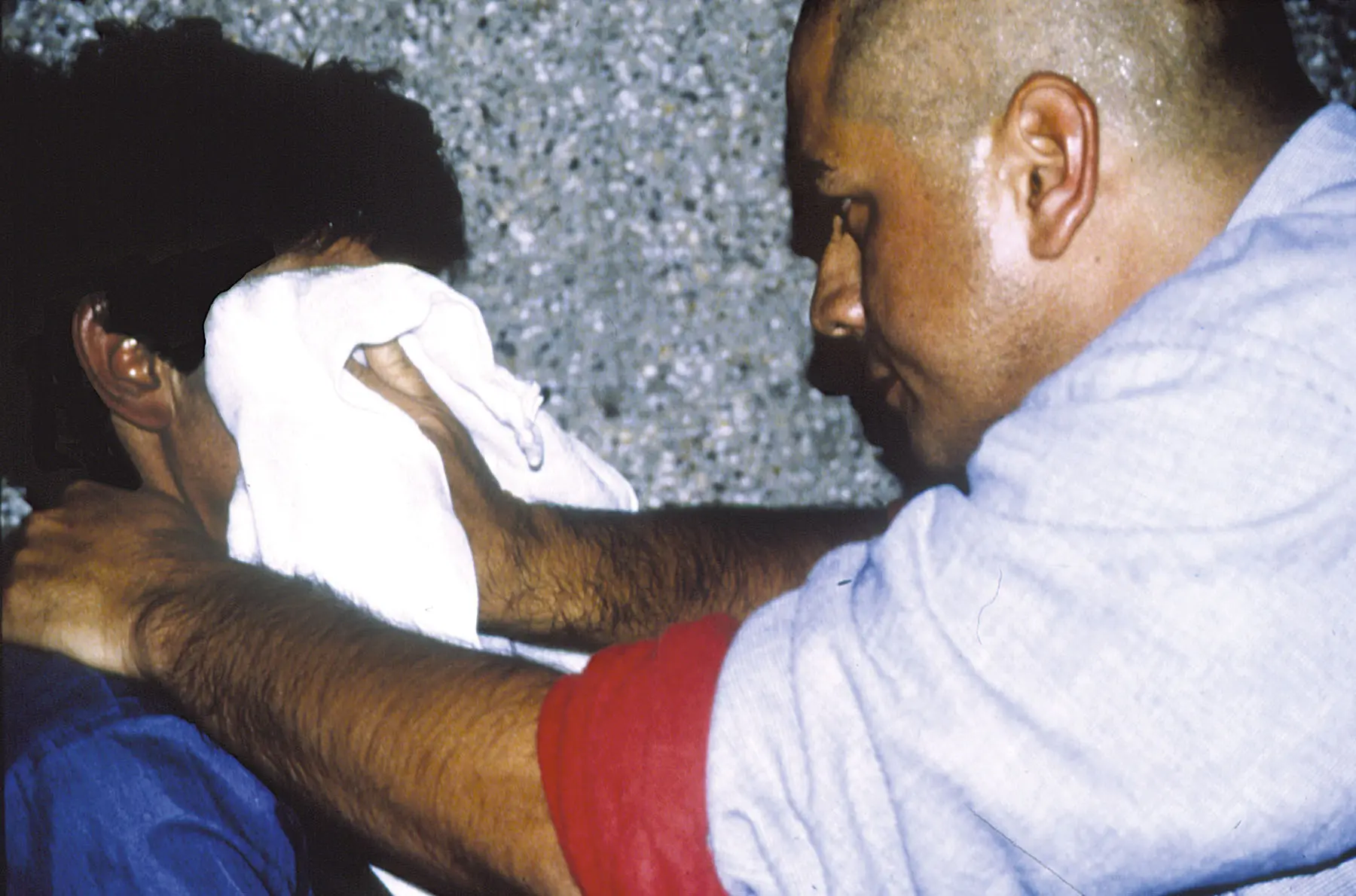
During the summer of 2002, the Museo Ex Teresa in Mexico City presented a Rosemberg Sandoval (Cartago, Colombia, 1959) retrospective, which originated at La Tertulia Modern Art Museum in Cali in September 2001. The event in the Mexican capital was prompted by the artist’s participation in the Ninth International Performance Festival in 2000, also at Ex-Teresa, where Sandoval presented three works. In Baby Street, 1998–1999, the main character cleans a street urchin of the grime that has accumulated on him and mounts the dirt-impregnated gauze like a frieze. In Mugre (Dirt, 1999–2000), a homeless person is used as a human brush to paint on a sheet of paper. And the artist described Eu-ropa, 1999–2000 as “a moral and convivial action produced by the construction of a blurry, permeable net of grime on a pauper. Or, better yet, a kind of broken, sickly map inspired by and made of used clothes on an indigent person.” These three events, each lasting fifteen or twenty minutes, are situated along the edge of political incorrectness and express the artist’s interest in states of want, marginality, deterioration, agony, violence, and death, the principal motifs of his career, which began in the 1980s.
Rosemberg Sandoval’s first works were shown at the Eighth Atenas Salon that the Bogotá Modern Art Museum installed in the National Museum in 1981. The five works exhibited were all created with bed sheets, catheters that contained urine, pubic hair, Merthiolate, newspapers, and the residue of personal acts. His intention was to emphasize a corporeal presence, an ineluctable element in his creations, which are also characterized by blunt verticality and raw sincerity, while at the same time couched in a peculiar tenderness and rough poetry.
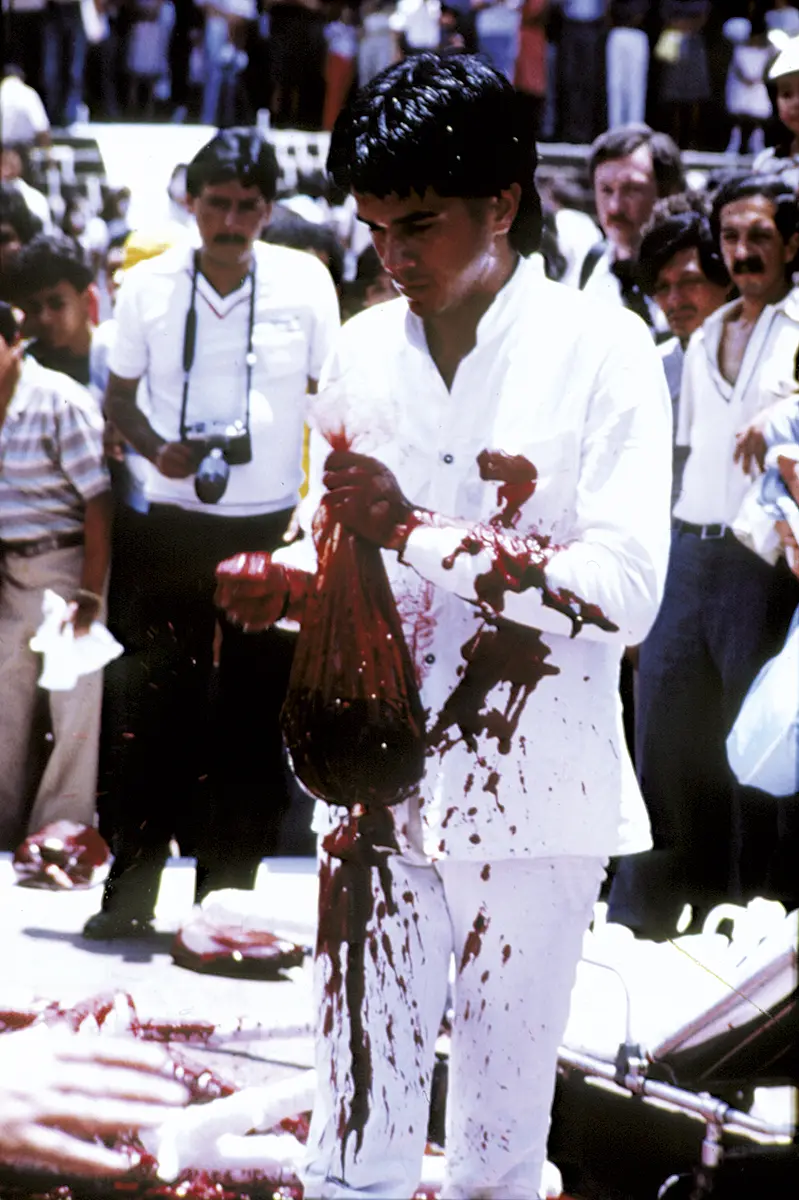
In the 1980s, Rosemberg Sandoval was constantly and intensely active. On March 10 and 12, 1982, two performances he presented at Bogotá’s Galería San Diego used animal and human viscera, and blood-stained newspapers dated the days of the events. The next year, at the Cartagena Museum of Modern Art, he wrote the plots for sixteen performances using human hair taken from corpses. In 1984 he presented Acciones corporales at Guayaquil’s Museo Antropológico y Pinacoteca where he wrote texts on the museum walls using a patch of human skin dipped in blood. Later, in the Plaza de San Francisco in Cali, he presented his first Caquetá: dressed entirely in white, he walked through a path marked by pieces of wood covered with gauze, carrying in the hands blood-filled bags that he popped as he walked. In 1985, in the Plaza Bolivar in Bogotá, he created Bolívar ahora. Again dressed in white —a uniform he adopted for all his subsequent events— he became an antiseptic executer as well as an executioner, torturer, torture victim, justice-seeker, and martyr in search of redemption. Blood, bandages, and a ladder covered with protective pieces were signs and approximations of a public act, which according to the artist sought to depict “representation as power, the expansion of political structure and the re-displacement of history.”
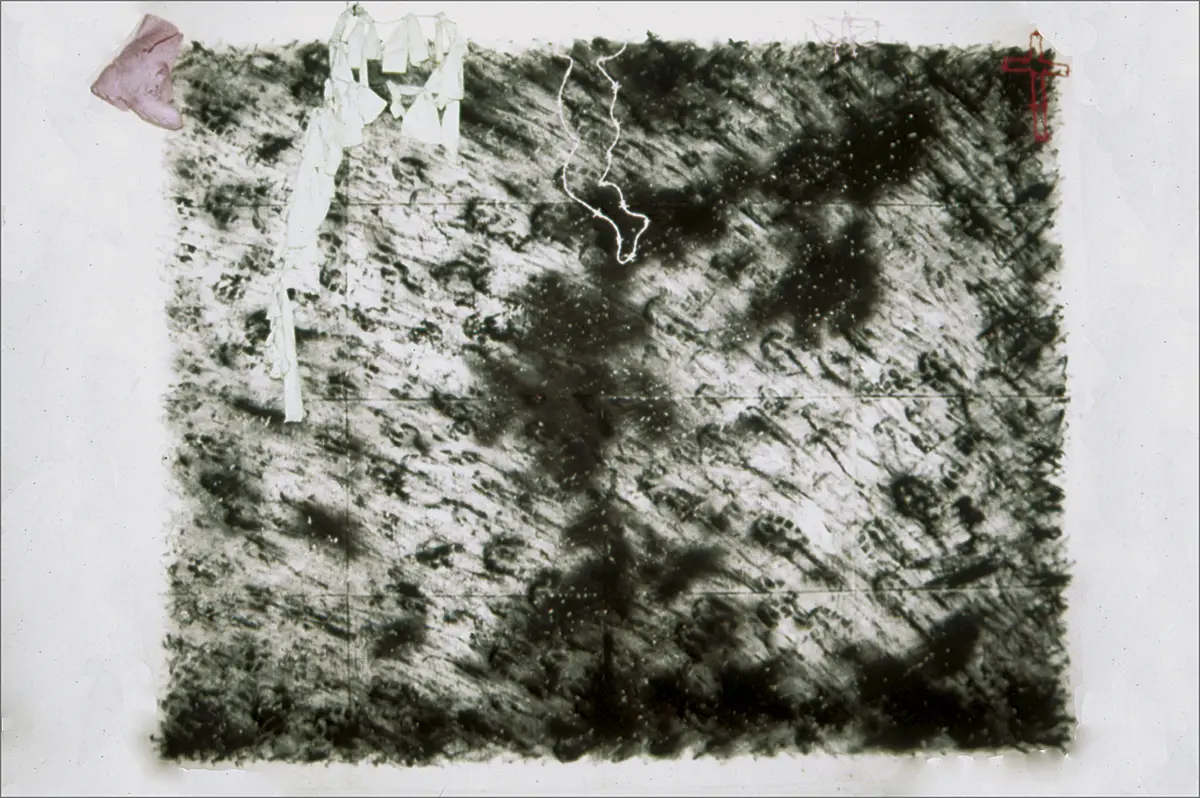
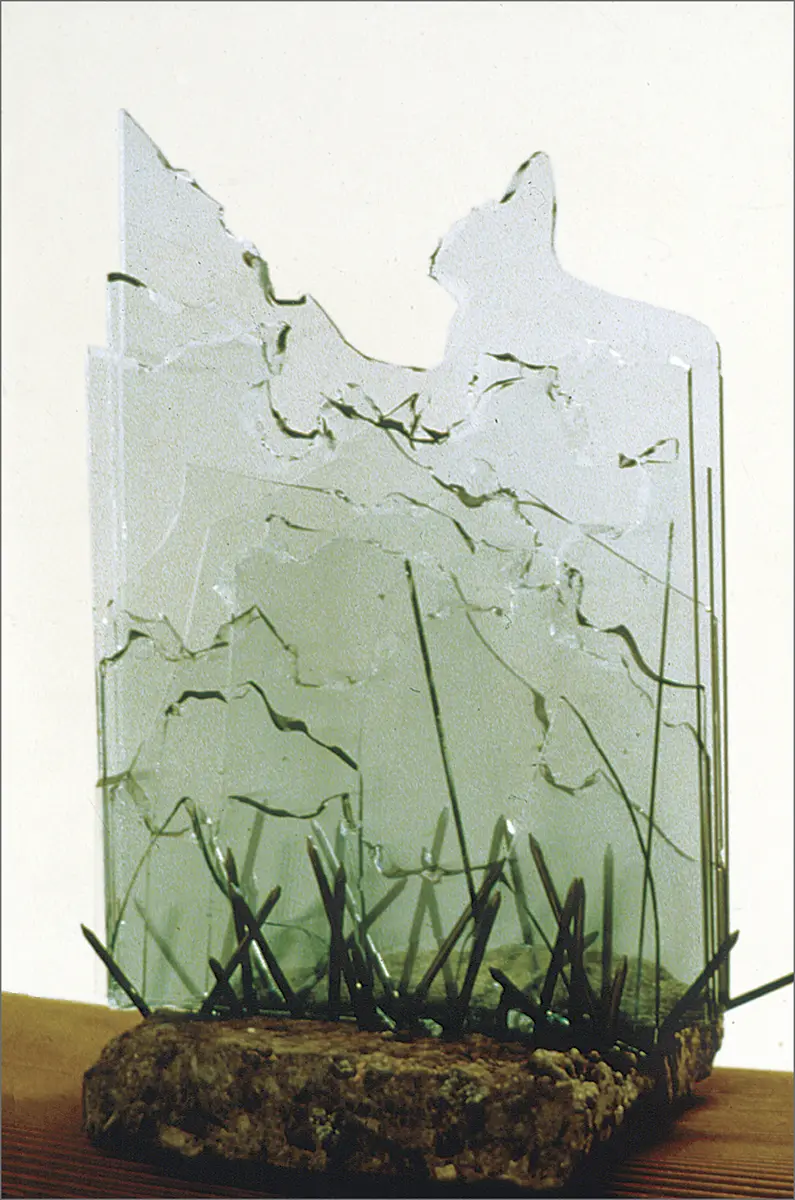
In the second half of the 1980s, Sandoval created installations of childhood objects made of barbed wire and painted pink, which he presented both at the Thirtieth National Salon in the Museo Nacional and the Centro de Arte y Comunicación CAYC of Buenos Aires. He later recreated these installations titled Children’s room and Diana, for the 1999 exhibition Art and Violence in Colombia Since 1948, at the Modern Art Museum in Bogotá. He also created drawings in charcoal pencil, using a military coat, carbon pigment, and surfaces such as black plastic and used polyethylene as supports. He used heliography and fax machines as persuasive media, and, after a group of six drawings titled Ceniza, 1989 was destroyed in a terrorist act at the Medellin Museum of Modern Art in the IX Ravinovich Salon, he began to use the residue from such attacks (glass, nails, tree branches) to create objects and sculptures. Works like A manera de emergencia (In an Emergency Fashion, 1985), Ecce Homo, 1986, and Caribe, 1989 belong to this series.
In 1989 Sandoval presented his Geo-Grafía installation; in his initial project, he created a group of islands made of rusted nails that represented piles of dynamite sticks. Later these were part of the exhibition of Colombian artists of the 1980s at the Buenos Aires Instituto de Cooperación Ibereoamericana, ICI.
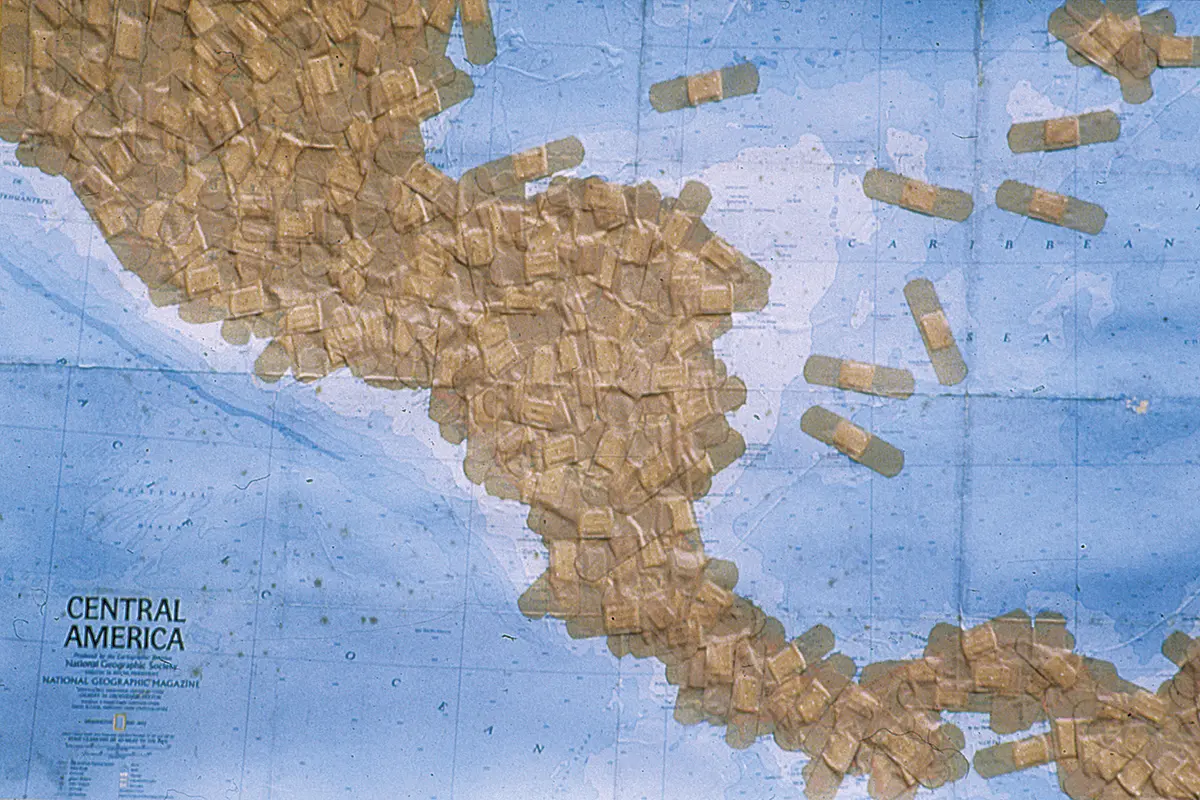
In the last decade of the twentieth century, Rosemberg Sandoval radicalized his ideas and intentions. His work was built on an excess of want with materials that were always decomposing, and his language was articulated from this perspective. His resulting reflections are frankly social, anthropological, and inevitably political. They are fed by the entrails of poverty, anxiety, hopelessness, and despair; the elements of war; the paradox of life; and the evidence of planned and provoked deaths.
In 1991, Sandoval reclaimed street elements and mounted objects in an urban installation. The use of grime as a moral category became the referent for a project titled Alcalde Popular. The artist went to streets where a series of killings of homeless people had taken place, and in episodes of so-called social cleansing, picked up objects like shoes that he later placed on five iron bars. As Sandoval has said, “In order for an object to be part of my work, it needs to have been used rigorously and have a previous history, because I am passionate about history, be it official or personal.”
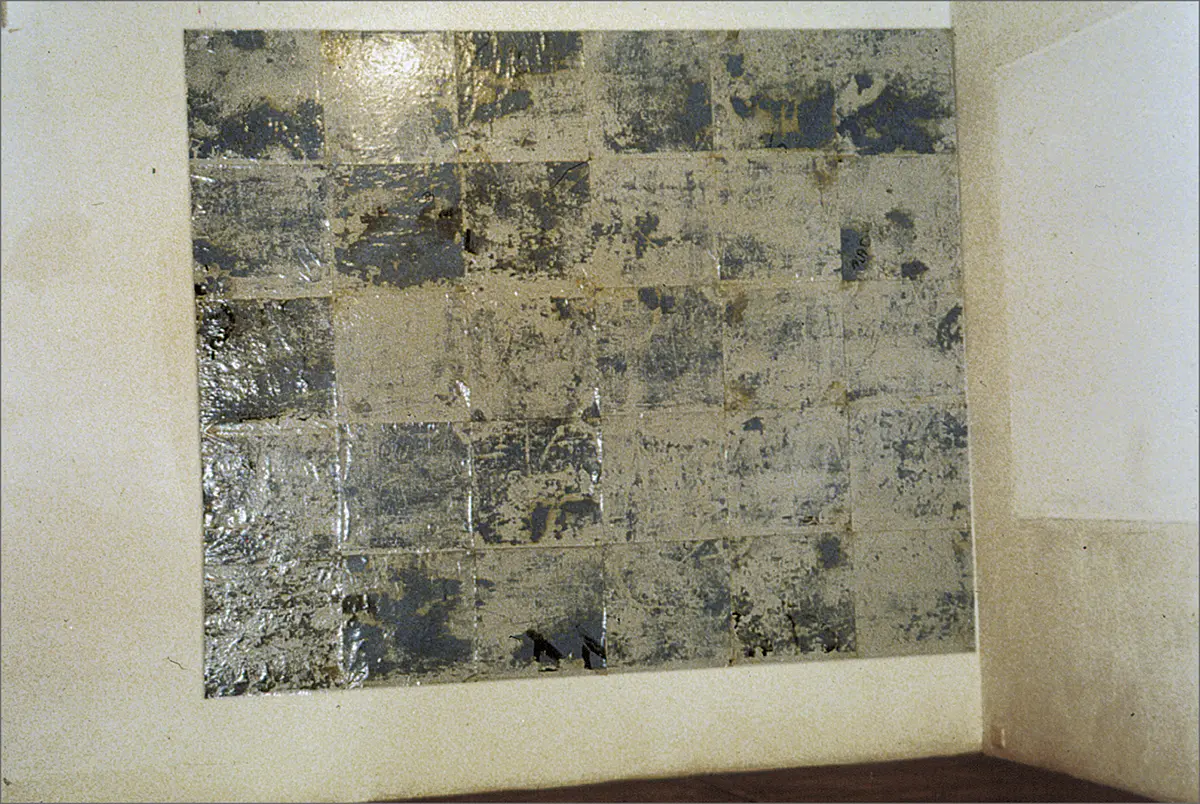
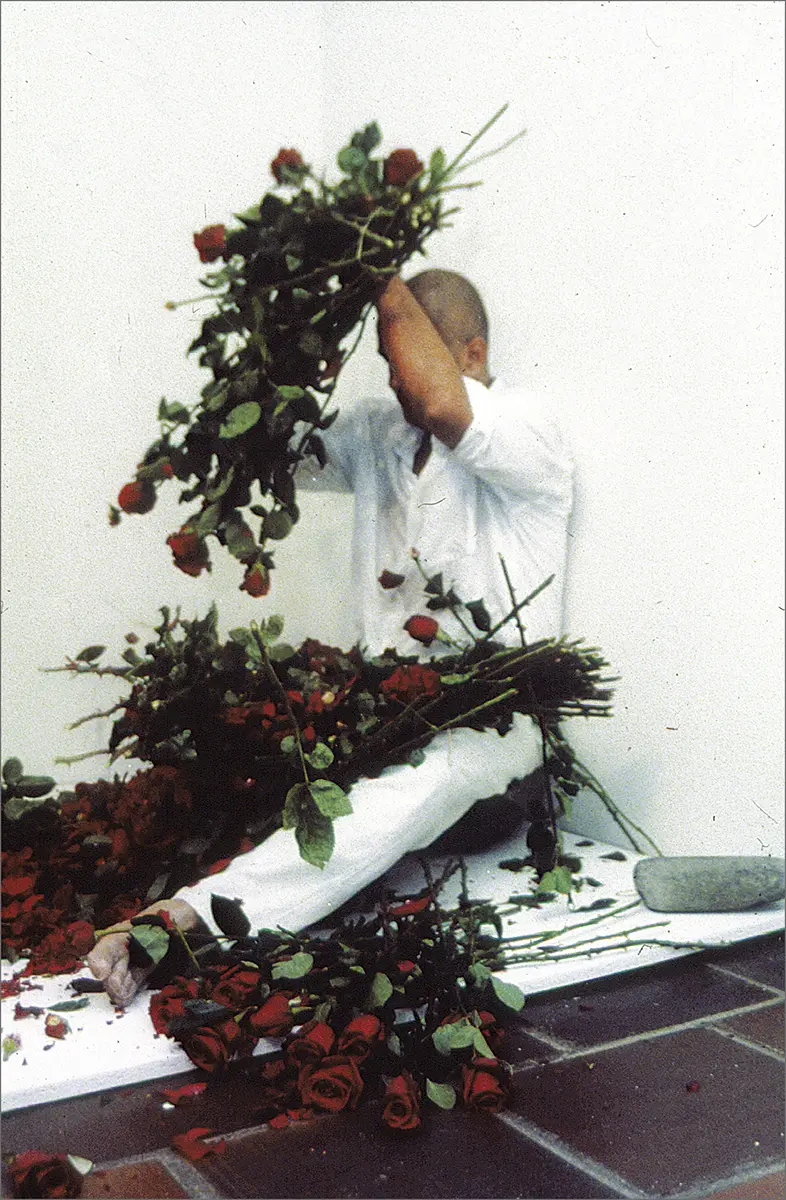
Self-flagellation is explicitly manifest in two performances: Yagé, 1992, and Rose-Rose, 2001. The former, presented in Bogotá’s National Salon, alludes to the Yagé, a sacred ritual in the middle of a circle of fire. A glass triangle is a weapon that wounds his hands, which are intent on cutting themselves and drawing their own blood. At the same time, he holds an image of the crucified Christ like a weapon, as though to commit suicide with it. He also cuts himself near the abdomen, reads a text by Cortázar, and drinks his own blood. In the 2001 performance, the thorns of several dozen red roses hurt his hands, which bled and turned the color of the petals. It is at once a lyrical and dramatic ritual, defined by the artist as “the art of performance with its character of salvation and sensibility of the orphan: the only thing it allows us to do is to share our life with poverty, with madness, and with death.”
During this decade he created installations such as Villa pum-pum (Pum-Pum Town, 1997) with glass, dirt, wood splinters, and bunches of the castor-oil plant, which is poisonous and urticant. Mami tengo miedo, 1996 includes two tubs filled with formaldehyde and a dirty, malodorous plastic placenta, and was presented as part of the Margen exhibition at the Universidad del Valle along with other pieces made with quilts, frottage on used diapers, and a long confessional text that was both autobiographical and aesthetic, and included paragraphs that read: “To make art has been and is for me a challenge against everything: against money, against taste, against the myth of art and the obligatory trips to North America and Europe. Only through books and other resources have I been able to build for myself a large quipu resembling the Milky Way in expansion, which I tie in knots in my burrow, traveling through my own being, discovering myself. In nearly two decades I have confronted and continue to confront the parochialism of art armed with a dense explosion of genres and media managed on a patch of tolerance that is replenished by the power of marginality marked by negation, and with my intuition handled as an act of superior barbarism rearticulating my place and connecting me with an open line of research, development, and sensation.”
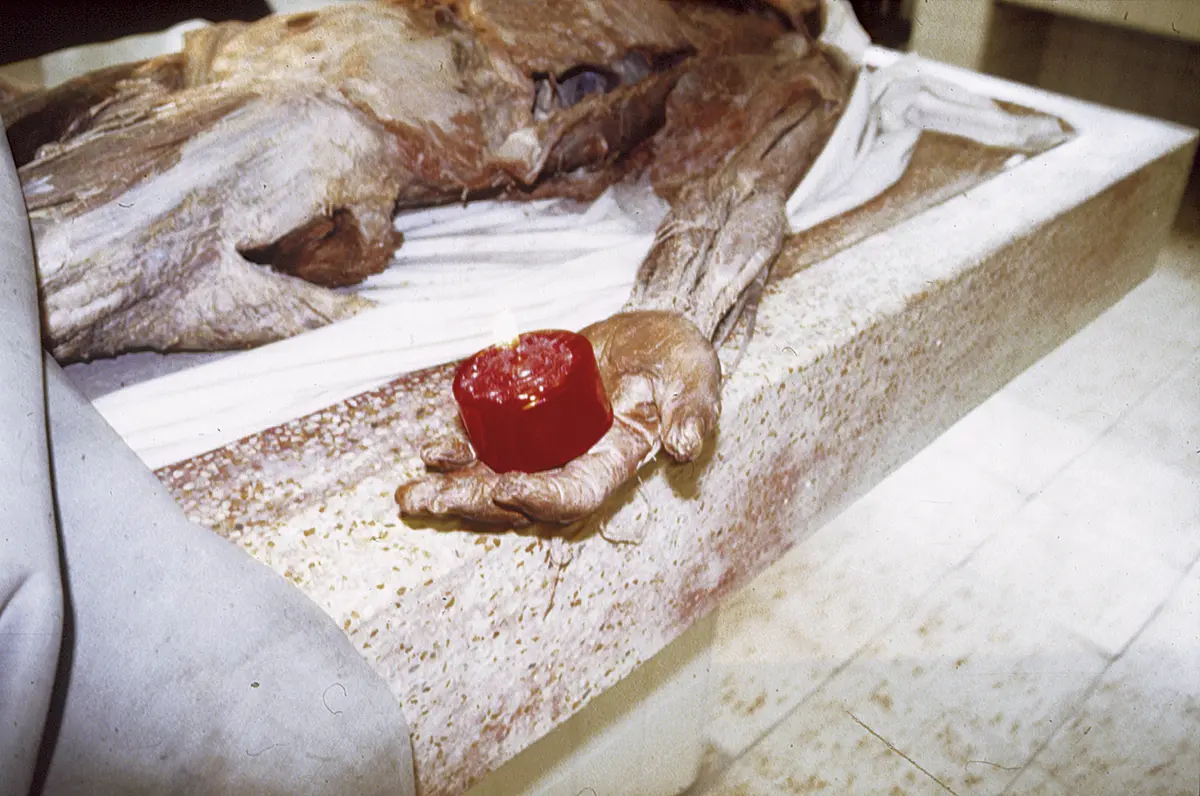
The art of performance has remained the axis of his artistic practice, but he has not limited himself to the previously mentioned public acts that make him a very prominent practitioner of the genre; he also creates private performances. An example of this is his work Morgue, 1999, created in an amphitheater with cadavers covered with black plastic sheets that were lifted to place a lighted candle in one of the corpses’ hands. This action was recorded in photographs and in a way it completes a project titled Situándome, 1981–1982, in which the artist wanted to work with the corpses of people who had a political background. On top of them, Sandoval created drawings, some horizontal and some vertical that were, in his own words, “like anonymous maps of pain.”
In moving away from hierarchical spaces as the basis of his art, Rosemberg Sandoval becomes an inhabitant of the margins who have been able to explore both his interior self and his environment in ways that are direct, sincere, bold, penetrating, and opportune. The persistence of his work has been effective in illuminating and recording the most despicable characteristics of our corrupt and cruel society. The artist has been able to portray his ataxia with imagination, and a magnificent sense of contemporary, and hermetic poetry. At the same time, by recording its precarious elements with photography and video his body of work is almost ephemeral.
MIGUEL GONZÁLEZ
Art critic and curator at the Museo de Arte Moderno La Tertulia, Cali. Professor of art history in Colombia and other countries of Latin America.