
Panamanian artist Susana Arias could very well describe her trajectory as one “from this life to the next,” given the way in which both her professional life and her family life have taken hold in California, where she has spent already more than two decades without loosening her ties to her country of origin. In fact, she was among the first Panamanian artists to devote themselves to sculpture, a field in which she explored many techniques and materials with unstoppable perseverance. Since 1976, when she graduated with a B.F.A. in New Orleans after studying under Jules Struppeck, Susana Arias has participated in a large number of exhibitions, both in the United States and in Latin America. Fifteen of these exhibitions have been solo shows, and the first of them was presented in Panama.
Arias’ early 1970s works in stone, wood, bronze, and ceramics echoed, in semi-abstract sculptures, shapes found in the natural world, emphasizing the curved profiles the artist used to represent birds, fish, or seals, works of organic contours that reflected a great admiration for sculptors like Brancusi and Noguchi. Arias went for the essence of these shapes, not for a direct reproduction of nature; she would keep this approach throughout her career. Equally constant in her work has been the desire to achieve a contrast between weakness and strength, and to capture what she has described as “the metamorphosis that is part of all form.”
Later, Arias worked on a series of sculptures based on the shapes of cacti, nature’s paradigm of verticality. Created in clay and organic burning methods instead of traditional ovens, Arias’ cacti are abstract representations of human beings, symbols of humanity both in their more profound and in their surface irregularities. While still working with bronze, marble, and iron, in the early 1980s Arias incorporated innovative materials such as plastic, aluminum, and in some cases glass. In 1984 she presented her fragmented cylinder-cacti, tubular shapes on a bed of grass arranged on the floor at the Museo de Arte Contemporáneo —one of the first-ever installations exhibited in Panama.
Over the following years, Susana Arias has worked on several sculpture series, including Referencias urbanas, inspired by architecture (which, according to the artist, offers a referent to the people who inhabit it). In this series, she used pressed dirt as her primary material, and she built site-specific pieces using original materials such as quincha for walls, the rough material employed for construction in the country’s interior. In contrast to the arid, neutral-colored cacti, these new sculptures introduced the use of color, in shades that became very vivid and reflected the activities of daily life in the city.
Alongside her vast small-format oeuvre, including her masks, bowls, and horses, Susana Arias has devoted a sizable portion of her artistic efforts to the creation of large-scale works for public spaces, showing an early interest in the insertion of art into the urban space. In California, Arias has created bas-relief murals for parks, rotundas, bridges, and government offices, with support from the National Endowment for the Arts; she has received California’s Environs Enhancement Award. The city of Santa Cruz recently named Arias Artist of the Year, after she created a public-art piece located on a Santa Cruz expressway: two large sculptural walls representing an archeological site, in reference to the old Olhone Indian settlement in the area. Built with a combination of pressed dirt, cement, coal, and other organic materials, this work’s style is described by the artists as “contemporary primitivism.”
Arias’ new show is a continuation of such “contemporary primitivism.” Its title, “de esta vida y otra,” seems to refer at once to the present and the past. The show includes 28 pieces combining drawing, painting, sculpture, hand-made paper, and ceramics. The communicating thread among the individual pieces is the way in which they all seem to speak of salvaged stories, while at the same time incorporating contemporary artistic elements. Only some recent sculptures break this continuity, with their elongated and melodramatic human figures —or vertical shapes that display anatomical features— in clay and bright varnish, which somewhat clash with the rest of the show in terms of their execution, their theme, and their aesthetic direction.
In the creation of her beautiful and sensual “papers,” Arias uses natural elements such as banana-leaf fiber, palm, and bamboo, as well as cotton and thread that, along with the natural colors, give the work an organic quality. She creates large folds in a process that is almost sculptural in that it methodically achieves depth on the paper, through layers of cloth and pulp. Between the strata, Arias encrusts small ceramic pieces, which multiply the archaeological effect of her work. Lastly, once the paper with all its strata and all its textures and meanings has been finalized, Arias uses pencils, pastels, and acrylic to paint on the surface. Her colors tend to be warm and subtle, and she has a preference for varieties of ochre, salmon, cream, white, and black, as well as for the sporadic use of metallic pigments.
La bolsa del chamán is an evocative work, a large piece of paper hanging and crouching as if under the weight of its years. A thick layer of gauze sticks out of its irregular borders, peeking out from the background as a veil or a spider’s web. Old rose, burnt ore, and white pigments have been applied to the rough surface, in a labor of elegant lyrical abstraction that induces, despite the absence of figurative elements, a romantic sensation. The subtlety of color and the rough-hewn texture of the paper generates an interesting contrast in many of the works shown. In Bolsa Musical, Arias goes one step forward by incorporating three-dimensional elements into the paper. This work consists of horizontal strips of small black ceramic flaps hanging over a dark, richly woven piece of handcrafted paper. On the exterior margins we see a somber silk, and inside the fold there is a grid-like pattern on a shiny gray cloth, a contrasting industrial element. To complete the piece, the artist has painted a few delicate white lines on the active surface.
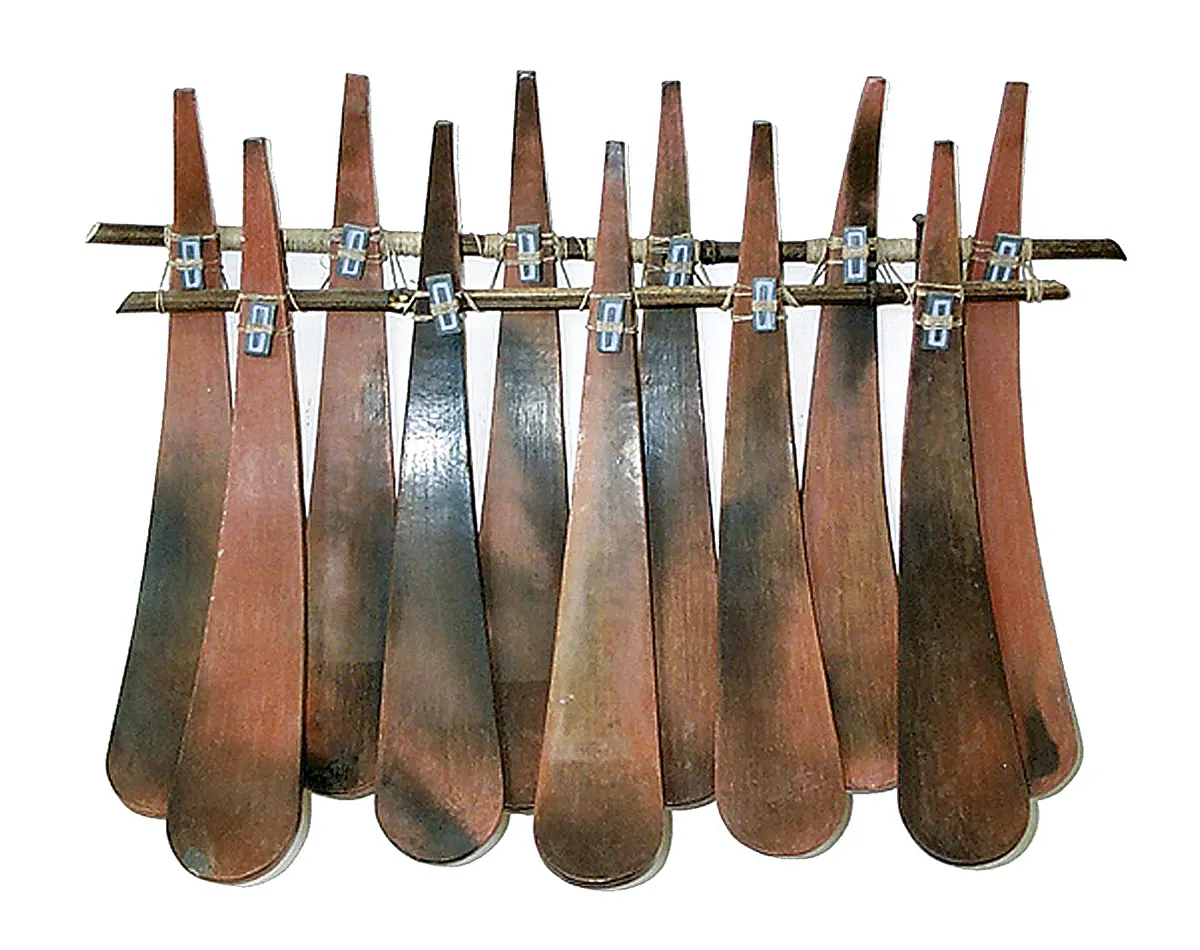
Even more striking than these paper works are Arias’ sculptures representing ancient musical instruments. In Teclas, the ceramic flaps resemble components of a pre-historic marimba. Each of these keys —individually handcrafted, painted, and burnt— is given a personality by its variations of black and brown against a reddish background. Held together by threads and bamboo sticks, these pieces form a rhythmic unit visually as well as in their imagined musicality. Something similar occurs in Samba de una nota, an extraordinary work of art in the form of an archaic violin and its bow —which does produce sound— the latter created by a series of elongated and semi-elliptical shapes held by thread and wood. Thanks to its exquisite profile, its abstract values, and its lyrical quality, Samba de una nota transcends any insinuation of objective utility. In Susana Arias’ sculptor-musical world, there are also ceramic-and-skin drums that produce sound upon being hit with the earthen stones that the artist includes in the piece. In an impressive way, Susana Arias has created a kind of new archaeology, both musical and sculptural.
MÓNICA E. KUPFER