
Teresa Margolles (Culiacán, Sinaloa, México, 1963) is an interesting and controversial artist. Her work deals with death in the widest and the narrowest sense. Crematorio is an audio and video installation featuring the flames produced by the cremation of unidentified corpses, very likely the victims of street violence. With the simplicity of its elements and the absence of direct evidence of corpses or fragments of corpses, Crematorio is a somewhat unusual piece in Margolles’ oeuvre. Over more than a decade, Margolles has investigated by herself, or with the SEMEFO group, the life of corpses and their transformation into works of art, infusing them with a new life, albeit one where —given the characteristics of the material and the conservation methods— they are no longer perishable, a primordial condition of being alive. Margolles’ works range from the plastification of a pierced human tongue (acquired after negotiating with the family of the deceased adolescent and finally covering the cost of the coffin in exchange for the tongue;) to a block of concrete containing a fetus inside; to a bench made with a mixture of cement and water used to wash corpses; to an impressive collection of prison tattoos done by the prisoners themselves, with rudimentary techniques, and later taken from their corpses; etc. Given Margolles’ trajectory, Crematorio derives its power and intensity from the text presented in the hall that precedes the projection room, which reads: “Hundreds of human bodies are incinerated in this place throughout the year, most of them having suffered a violent death. Fire results from the combustion of flesh and bones, and it is kept burning for two whole days, after which everything is reduced to ashes.”
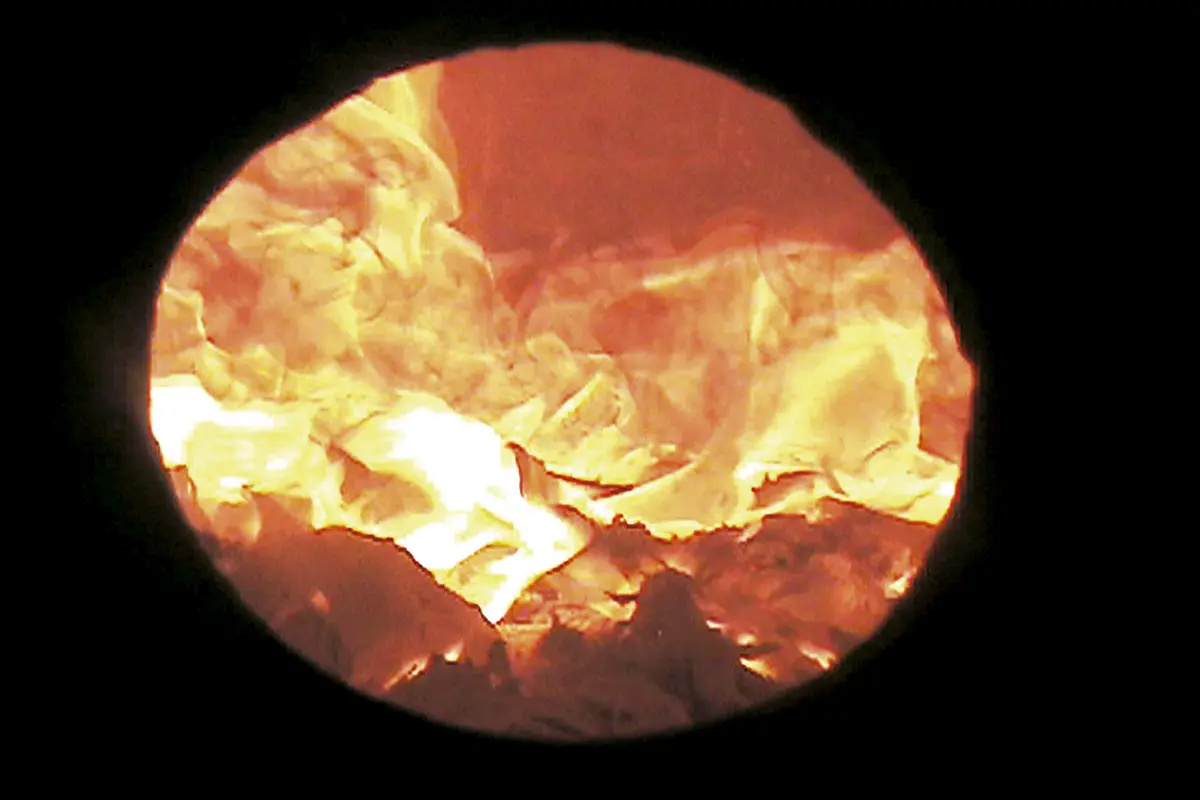
The installation’s images and sounds are just that, a loop projection of incandescent flames and the corresponding sounds. Without reading the introductory text, the piece could be construed as an aesthetic vision of fire, a kind of literal rendering of matter transformed through combustion. The text, however, makes all the difference. In just a few words it confronts viewers with their own mortality, with their own fragility, and with the inner voice of a consciousness that repeats the old Christian dictum: Ashes to ashes, dust to dust.
Teresa Margolles does not speak of individuals but of a generic human being. There are no names, dates, or circumstances of death: only bodies in flames. Bodies in combustion give life to the flames. Anonymous bodies are forgotten by society or by luck. Bodies for whom there will be no grave, but whose last farewell is to be seen, with different eyes, in galleries and museums.
In her essay accompanying Margolles’s exhibition, Todos los fuegos, el fuego (the title is taken from a story by Julio Cortázar,) Itala Schmelz writes: “A certain condition of contemporary art could be symbolized by the images of the crematorium shown by Margolles. The artist has turned the Guerrero gallery into a passage to hell, where we can reflect on our own condition. The condition of art that has reduced to the minimum is its representational character in order to amplify to the maximum its power to amaze. As we let ourselves be bedazzled by the fascinating flames, our consciousness is overexposed to the perplexing irruption of an amoral aesthetics.”
Crematorio is, thus, a powerful work of art, one that in order to be understood in its full complexity needs to be seen within the framework of Margolles’s oeuvre. Without the context provided by previous works, built with processes that are at the limit of artistic concepts and of what is socially and politically permissible, Crematorio could seem rather weak; understood as part of that process, however, it becomes a work that allows the artist to continue talking about death and about the life of death, now in a more suggestive way. And all of this is thanks to the identity she has carved through her strong work over the years.
FRANCISCA RIVERO-LAKE