
Williams Carmona (Cuba, l967) is an extraordinary and controversial young artist, who challenged the political structure of Castro’s Cuba in the late 1980s. He continued to be very controversial when he arrived in Puerto Rico in l99l as an iconoclastic creator and critic. Today, twelve years later, and after developing an honest, mature, and provocative, post-modern surrealist discourse, he is still quite controversial. His art can be seen as an intense and original chronicle of the Caribbean, as a challenge to those who believe in justice, and as a threat to many mediocre “philosophers” who use present-day artistic avenues to communicate their wretched emptiness. What has made Carmona’s art exceptional during each of his major creative periods is the fact that it contains the essence of what defines us in this twentieth-century mare nostrum. As we know, part of what Columbus described in his journals is pure surrealism. The mermaids, descriptions of the flora, and visions of the “other” is fantastic literature that opened the door for many of our writers and plastic artists. If there is a place where surrealism —its intensities, its mysteries, and its magic— is magnified, it is the Caribbean: this eternal carnival of carnal pleasures, brutal injustices, unbelievable pain, and magnificent dreams. Many artists have tried to capture, interpret, and invent these timeless scenarios that even Hieronymus Bosch could not have imagined, and some artists have succeeded during the last five centuries in making this parallel “history” an important gift, an intense voyage, and a necessary existential experience.
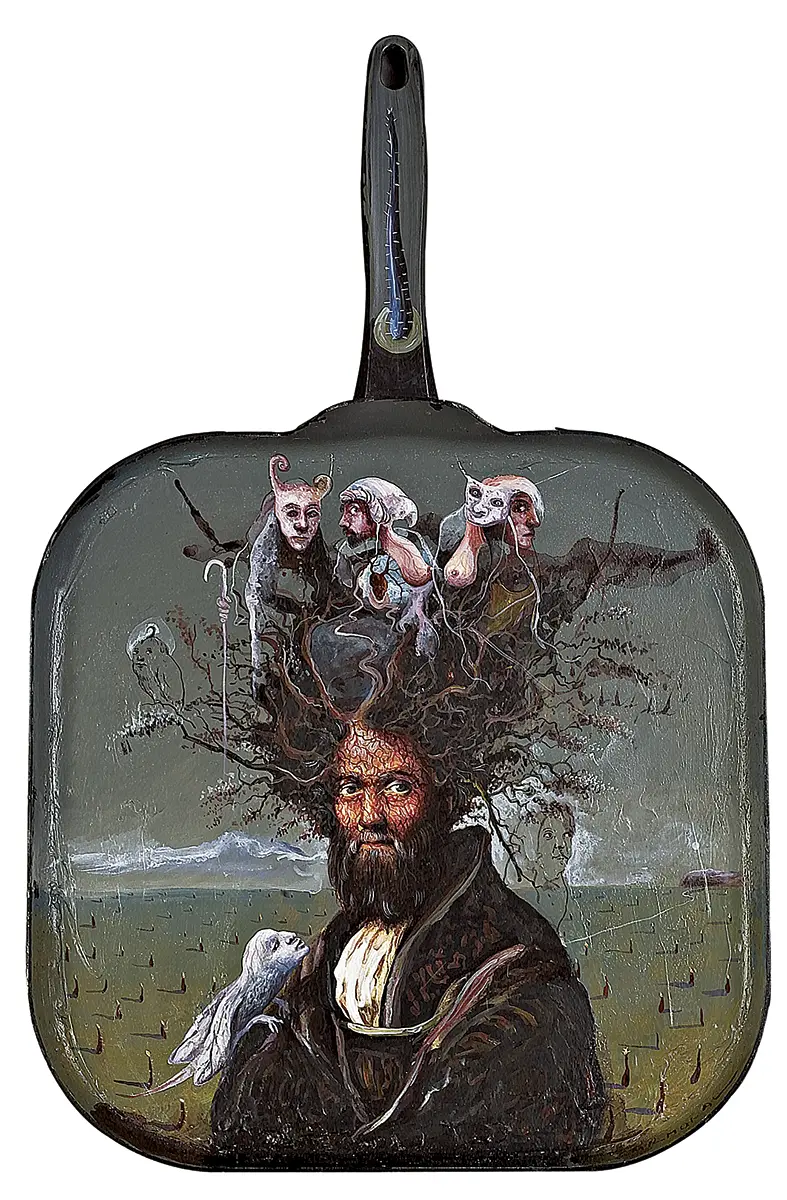
Among these is Williams Carmona, who with his dramatic surrealist discourse has become one of the most interesting and intelligent voices to narrate flight and survival in our many Macondos. From the time that he was an art student in Cuba (San Alejandro, Escuela Nacional del Arte, and Instituto Superior del Arte), his work was marked by true originality and genuine professionalism. During his very successful career, he has impressed art lovers with his minimalist existential topographies, baroque political scenarios, and complex and hallucinogenic portraits. Now, after a painful but fruitful period of introspection, Carmona again surprises us with the recent works of art presented in November at Viota Gallery. With the title of Historias cocidas or El sarten por el mango, the artist who turned fried eggs into protagonists in the paintings that related to a period of his life in Cuba presents a group of three-dimensional works of art that can be best described as “mirrors” or “snapshots” that reflect and reveal our many faces in the midst of today’s globalized world where cloning and the Crusades occur simultaneously.
What I have just defined as “mirrors/snapshots” are really frying pans used by Carmona to narrate moments that have helped him, and by extension, us, to understand this comedy called life. In his sartenes, Carmona successfully combines Duchamp’s daring aesthetic proposal, which redefined art forever; Warhol’s brilliant concept of repetition, which turned post-industrial order into powerful poetry; a Caribbean culinary reality, (the frying pans in daily use since we fry everything in the Caribbean); and his daring surrealistic metaphors to produce awesome cantos.
Carmona’s “sculptures” are true visual impacts that combine the relatively unaesthetic frying pan with enigmatic stories that may include recognizable historical characters from the Renaissance to figures from our own twentieth century. The artist got his sartenes —marked by years of use, of course— from many people who love and respect him: from his mother who sent him one from Cuba, to his neighbors (Nery and Cari), close friends (Mamita Cristina, one of his godmothers in santeria, Norca, Roxana Matienzo, Nilda, and Lola), and some of his collectors who trust him completely. In his circle scenarios, which he has dedicated to the beauty, strength, generosity, intelligence, and magic of women who have touched him and have helped him come closer to peace and happiness, he constructs dialogues where the protagonists —the Cuban revolution; the wars in the Middle East; the traumas of globalization; the glorious mysteries of sex; and our enormous need for love, recognition and any kind immortality— talk freely, and convincingly invite us to become vulnerable. In these courageous compositions the artist not only dares to capture, with his incisive eye, the lust that defines many of us, but he also gives life to Van Gogh and reveals Dali’s pleasure in living, as well as the sainthood of the ordinary, but good people that surround him. There is no question that this is a significant moment in his artistic career. With his sartenes Williams Carmona again entices us to join him on an unforgettable journey that takes us to unimaginable but real and necessary ports that will help us defy the long pettiness of life.
MANUEL ÁLVAREZ LEZAMA