Fulfilling its goal of salvaging the country’s visual memory, the National Center for Photography inaugurated late last year an important exhibition of works by Carlos Germán Rojas, titled Imágenes de La Ceibita (Images from La Ceibita). The exhibition presented a series of photographs taken between 1976 and 1983 in which the author portrays his environment, his friends, and his loved ones.
In this recent exhibition, as in 1984 when he showed these works for the first time at the Museo Francisco Narváez in Porlamar and at the Los Espacios Cálidos gallery at the Caracas Ateneo, Rojas surprises us with his freshness and naturalness. The public encountered images from a marginal area in Caracas’ southeast side, captured from inside, revealing the human, sensitive side of a reality that is generally overlooked due to its high degrees of violence and insecurity.
The perspective assumed by the photographer is the first salient element in these images. Belonging to the photographed environment, to be one of them, gives the assumed point of view a much greater depth. There is no distance between the photographer and his characters. Their mutual affection is evident, and the acceptance and stability in the exchange of gazes. The poses are not conditioned. We see people just as they are in their daily lives and enjoyments.
Rojas’ vision of the neighborhood and its marginal social condition is not the product of effectism, and it hasn’t been forced to make it fit into a preconceived image of national reality. It is not an icon to be reiterated in discourse for that purpose. It is just one photographer taking pictures of his reality and his people. It is precisely this freshness that earned Rojas Second Prize at the CONAC Photography Awards in 1981. The reality was always there, but, as Tulio Hernández wrote, “the novelty was seeing it depicted.”
Carlos Germán is a photographer who belongs to Venezuela’s cultural space. His career is widely known locally, as part of it has been devoted to photographing works of art from important collections such as the Galería de Arte Nacional and the Cisneros Foundation, among others. As an author, his work is embedded in the everyday. His attachment to reality derives not only from the fact that it corresponds to a context that is his and affects him directly; it also comes from the education he received. At 17, he started working at Torre La Prensa. There he met news photographer Héctor Rondón, who taught him the basics of handling a camera and lab work. Later he became familiar with the equipment in a photography store and attended several photography workshops at CONAC. He worked as a society photographer for the magazine Venezuela Gráfica and finally, thanks to his incorporation into Fototeca, he entered into contact with a photographic movement that carried him beyond news reporting and society pages. Despite his participation in Fototeca for six or seven years, he disagreed with several other members of the group with respect to the criteria current at the time for documentary photography, since for Carlos Germán the latter doesn’t need to have a specific ideological character or be oriented towards social protest.
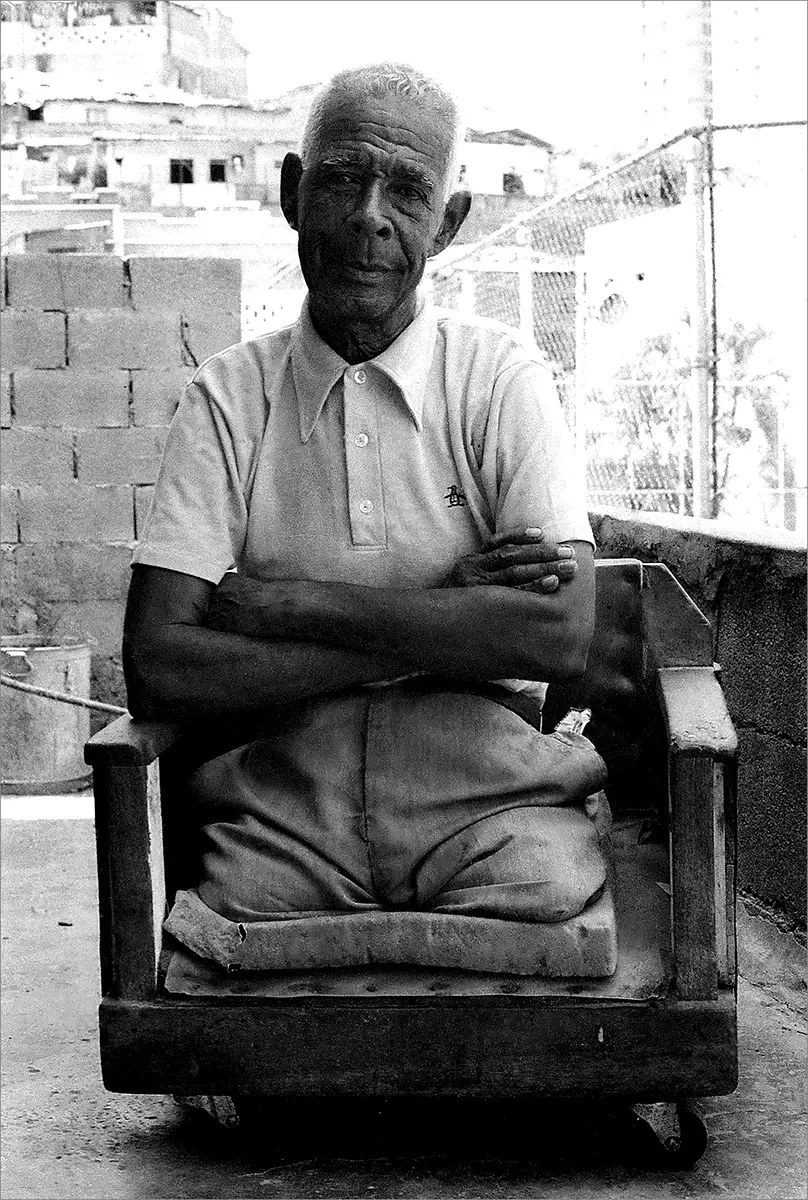
On the contrary, his reality is optimistic, humane, sensitive, and loving. There is great enjoyment in photographing his people, revealing the richness of their lives. Such is the case in Crisanto, the earliest photograph in the series, taken at the character’s own request. The warmth in the old man’s face, and the calm expressed in his eyes, places tragedy (the loss of his lower limbs to cancer) in the background. What we first see is his soul, candid and affectionate, more than a grotesque interpretation of his existence. Intentionally, the photographer has avoided exploiting tragic images. It is not part of his conception of a lie. His is a kind of photography of vital optimism, of his people’s customs. Definitely, a photograph of conviviality.
All the images from La Ceibita show comradeship, a couple’s embrace, a game of dominos, a group of friends relaxing in the street, a ball game, and a neighborhood celebration. All at this in Salsa time, with Ismael Rivera, Eddie Palmieri, or Rubén Blades playing in the background. Because in the neighborhood culture is enjoyed with Salsa rhythms, and it revolves, according to this protagonist, around knowing how to dance.
SUSANA BENKO