
The topic of the landscape has had a long presence in the history of art. The term was linked to the bucolic, to nature as a spectacle; it was consolidated as genre painting and became independent as a Romantic conquest in the late eighteenth and early nineteenth centuries. In our times, a widened view has been achieved, one in which artists seek correspondence with social, political, or cultural facts, and in this framework, the art of landscape painting acquires new meanings.
Consuelo Gómez deploys in her recent work a particular conception of the landscape and of the use of her materials. Regarding landscape, there is an intention to relate urban and rural landscapes to one another. Both are altered by the intervention of Man and in her conception, a landscape is something built, something artificial, which distances her from any nostalgic urban view of the countryside. There Man uses elements taken from Nature, in this case, for instance, eucalyptus trees, in order to set boundaries and fix notions of territoriality. Gómez wants to make the viewer aware of the way in which Nature provides information that can’t be entirely controlled by the observer. The gaze is dependent on circumstances, in a process of constant transformation, so our relationship with Nature is different than our relationship with Man.
In this return of the gaze to the landscape there is an invitation to acknowledge the possibilities of a place, of a space that even if familiar admits multiple readings.
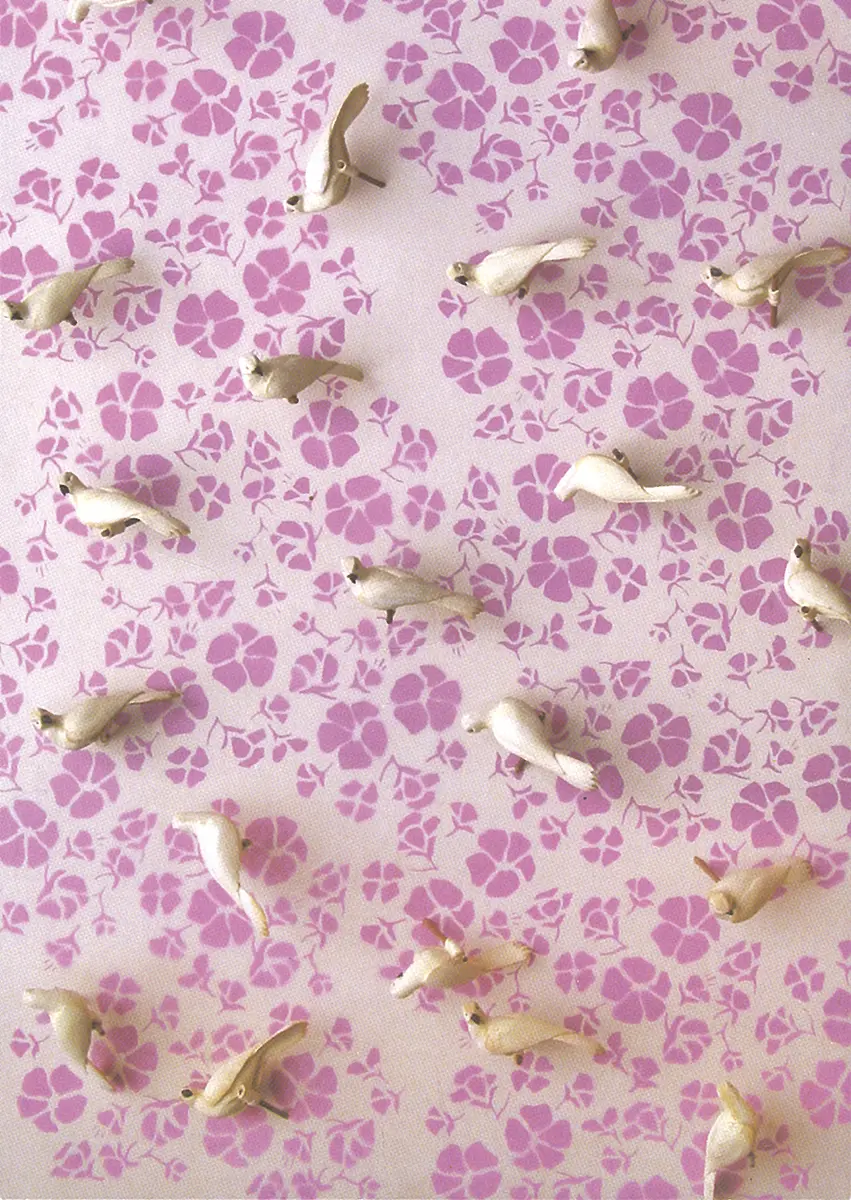
This reflection is accompanied by a singular use of the materials: their original industrial format is maintained without modification, as in the case of the hardwood sheet used to build Oteo. On the original sheet, the artist painted a peach flower using stencils and industrial paint. On this support, she has placed numerous parrots created serially in a light material common in massive industrial production: plastic. But these white parrots have bronze beaks and glass eyes, which highlights the relationship between the hand-crafted and the industrial. The serial character of the parrots links the infinitude of the landscape to serial production, but it also accounts, in the beaks and eyes, for a recuperation of the traditional concept of sculpture.
Gómez also insists on keeping her materials in a natural state, respectfully intervening only at the level of design, bringing landscape into the home space through objects, without abandoning the dual action between the urban and the rural, the industrial and the hand-crafted.
The constant reference to eucalyptus, which can appear in a natural state or with its leaves transformed into exquisite aluminum pieces, reveals the artist’s admiring attitude towards Nature, a disordered Nature that Man modifies with its interventions and its organizing attempts.
Gómez’s pieces announce the possibility of handling different conceptions of the landscape, putting into practice eclectic systems that restitute, in a symbolic plane, a unity that gives meaning to everyday experiences, sometimes fragmentary and contradictory.
As usual in Gómez’s pieces, the design craft is impeccable. It changes reality in such a way as to have everyday objects allow unexpected approximations to that concept of the landscape so singularly explored.
IVONNE PINI