Abstract art has had excellent practitioners in Colombia during the second half of the twentieth century, names such as Edgar Negret, Eduardo Ramírez Villamizar, Omar Rayo, and Carlos Rojas, among others. The work of Fanny Sanín emerged from this context in the late 1960s and gained momentum after the artist moved to New York where she has lived since 1971. Sanín’s art has been presented in many individual shows, among which the highlights are her 1986 retrospective at the Bogotá Museum of Modern Art curated by John Stringer, and her 2000 show Color y Simetría, curated by Germán Rubiano Caballero at the Luis Ángel Arango Library. The latter focused on Sanín’s works of the last decade and presented, as a novelty, a complete series of her Estudios —small-format, sketch-like works on paper— which allowed the viewer to penetrate the slow and difficult process of composition found in her “finished” works.
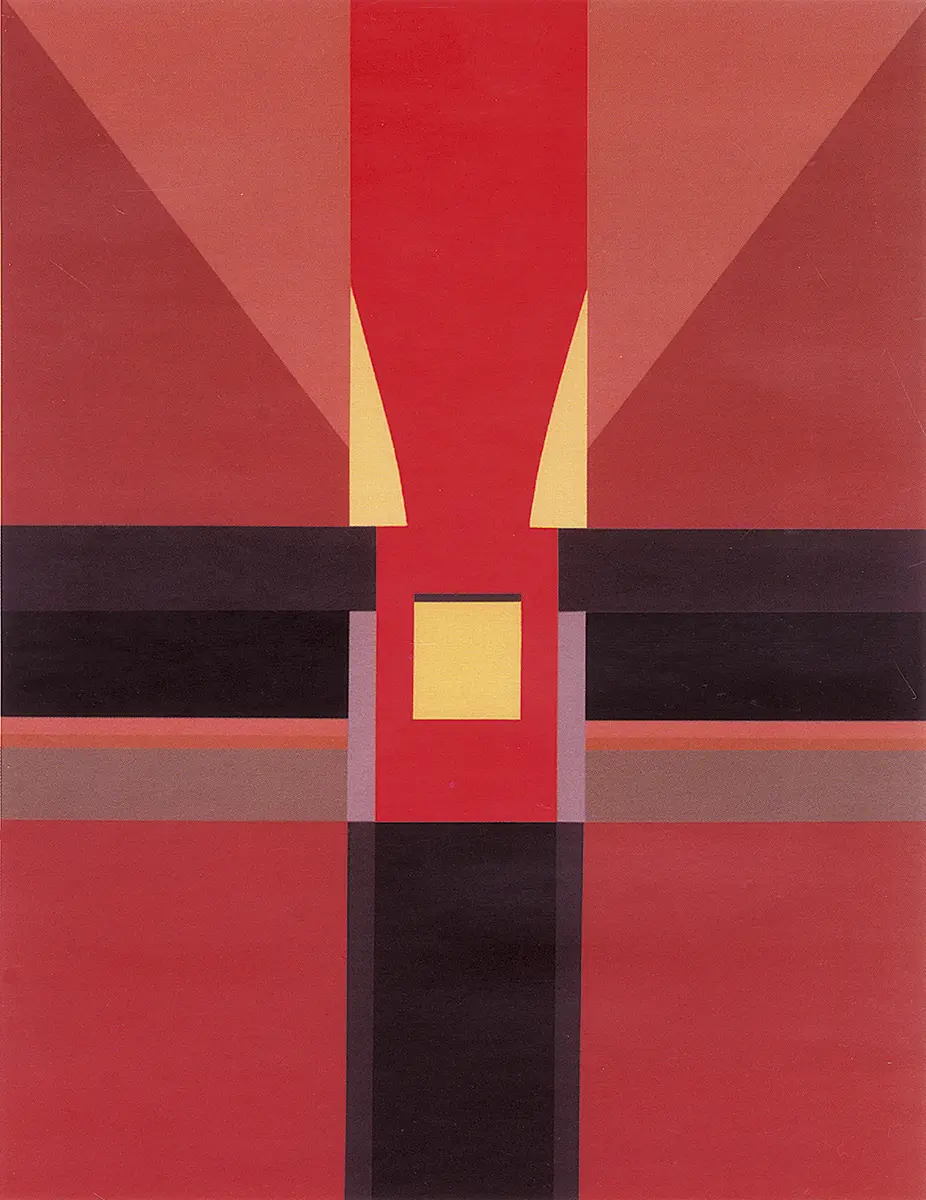
Sanín has continued to carry out her personal exploration, and some of the results were exhibited recently at the Gomez Gallery in Baltimore, a beautiful space in a converted grain mill located on the city’s outskirts (September 6-October 4, 2003). The show comprised an important series of Acrílicos (works on canvas) and Composiciones (acrylic and pencil on paper,) most of them created in the last three years. As is characteristic of Sanín’s work, a fascinating process of trials and variations results in works that appear at first sight to be compositional exercises, but which under patient and dedicated observation open themselves up to significant aesthetic experience. Indeed, Sanín’s works possess a transcendental character that invites contemplation, a visual and emotional depth achieved through color that, in a sense, contradicts the hard-edge flatness of her pictorial proposition.
Faithful to a compositional line that has remained constant for more than three decades, most of Sanín’s pieces are structured around a focal element —a square or a band of contrasting color— that marks the horizontal axis and balances the composition. A new element, for a repertoire that has consisted almost exclusively of horizontal, vertical, and diagonal bands, appears in one of her most recent works, Composición No. 1 (2003): the formal interplay between curves with different radio, some of which carry forward the piece’s vertical lines and give the composition a subtly sensual dynamic. Another new element is Sanín’s pencil lines brought in as active parts of the composition, traversing color fields and altering them with the diagonal tensions they generate as in Acrílico No. 2 (2001). As critics such as Rubiano Caballero and Clayton Kirking have already pointed out, there are two key elements in Sanín’s work, color and composition, and it is through their interaction that the particular effect of depth is achieved. According to Kirking, “as in Albers, [in Sanín’s work] the ‘finished’ painting is created by the interaction between color and composition. In truth, painting cannot exist without both elements. At the same time, these highly organized qualities lend themselves to an ambiguity that leaves ample room for individual, subjective interpretation.” The paintings shown in Baltimore are characteristic of Sanín’s mature work, but they also signal new lines of action, and new paths to follow; it will be most interesting to see what their impact will be on the future development of this important artist.
JOSÉ ROCA