Throughout the years, Gabriela Morawetz has developed a language characterized by the creation of dream-like atmospheres increasingly more intriguing and suggestive. The artist builds a discourse that moves between the real and the mysterious, where vegetal nature acquires a protagonistic role within a thematic that has evolved slowly through the fantastic, the cosmic, and the ecological. This was attested by her recent exhibition, titled Miradas Dobles, at Galería 39. Already in her creations of the 1970s, Morawetz mastered a figurative genre with its roots in Surrealism. Her initial works of that early period depict metamorphosed men and animals enclosed in dark, dislocated spaces, and have a certain tenebrous character. In the 1980s, space and light acquire increasing importance in this figurative proposition; these are compositions where a new dimension begins to take shape and establish its presence. This is also the case in Morawetz’s work of the 1990s, in which the artist creates a whole cosmogony where men and nature, figures and trees, exist within a cosmos of unknown latitudes. An ecosystem of vertiginous whirlwinds where shapes and the space that contains it, describe a new genesis of the universe. Morawetz takes off from reality and brings us deep into those landscapes of the subconscious where our dreams, intuitions, and anxieties nest; she presents us with a kind of paradox of creation: the creation of man within the creation of the cosmos, and vice versa.
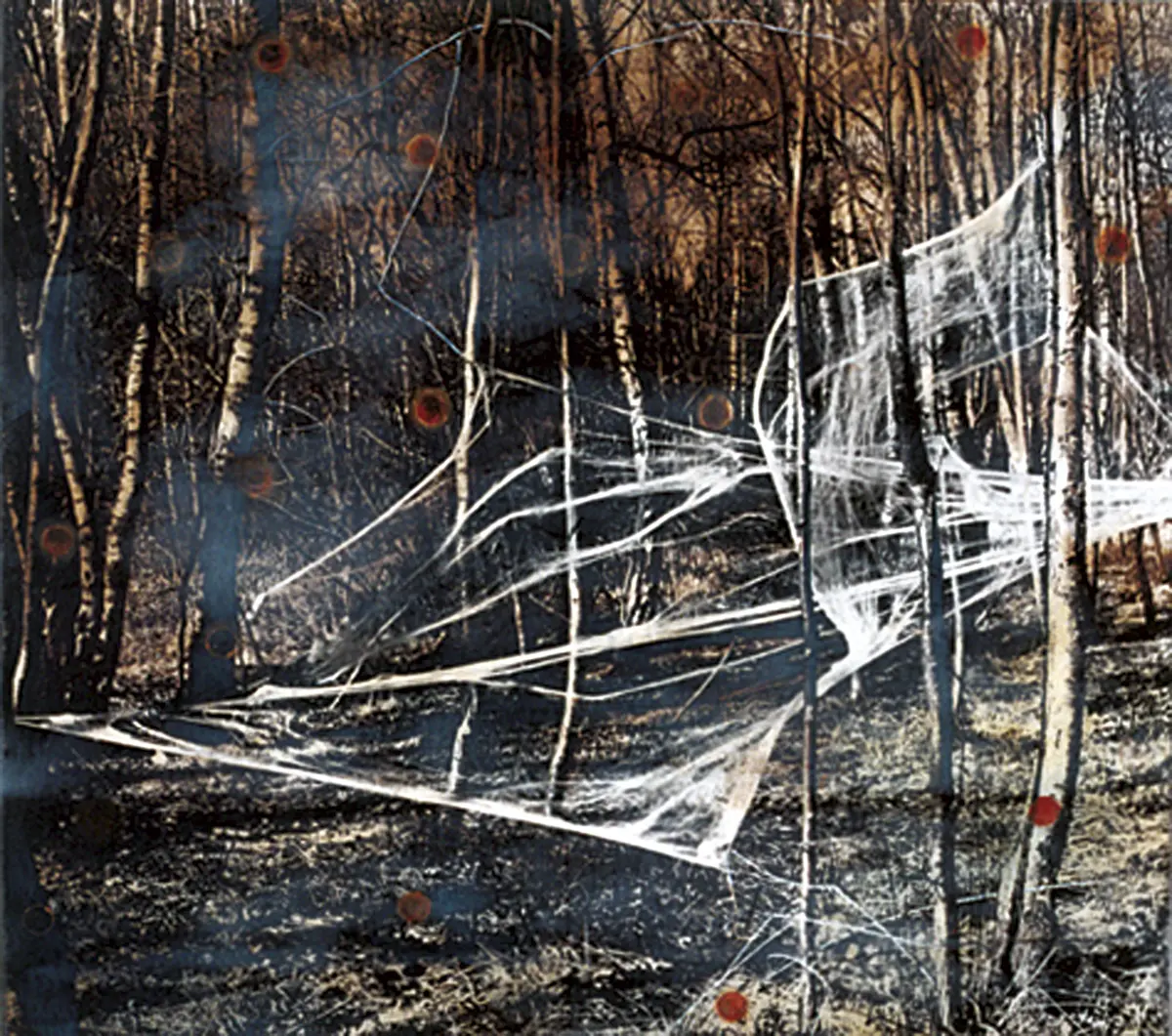
Miradas Dobles poses the eternal dichotomies at the essence of artistic creation, which we can identify as visions located between dreams and reality, between the outside world and the inner world, and between the perceptual and the intuitive. Through the duplicity of images, attained by way of photographic technique, the artist brings us to the privilege of the visual image’s double meaning, on the one hand, the reference to reality, and on the other the symbolic charge it contains. In pieces like Lo que no es, o Variación sobre el doble, Morawetz recreates the landscape taking trees as her point of reference, as well as scenes of abandoned forests pregnant with ghostly presences such as cobwebs, clouds, and spores that describe periods of time which only traces of abandonment and dejection are left. In the Multitude series, the artists bring to the large format work extracts taken from that vegetal world, such as stems, sprigs, and roots, accompanied by phrases that give such seemingly insignificant branchings a mythic and symbolic meaning. Morawetz uses mixed techniques and combines materials such as wax, paint, and graphite on photographs transferred to canvas, thus obtaining a kind of veiling that accentuates the dream-like dimension that she has assiduously cultivated throughout her career. This theme which explores the problem of the deterioration of the natural world does not exclude human beings. Indeed, the artist executes two small pieces, Sin título, that introduce a female figure, almost imperceptible, on a landscape of dried trees. For its part, a disconcerting sculpture, also in small format, titled Suspiro, seems to summarize the spirit of the whole exhibition. It is a mask/effigy that holds a cone in its mouth opening, ending in a glass sphere. The composition seems to denounce the asphyxiating environment in which today’s humanity finds itself due to the exploitation of natural resources, pollution, and the inexorable destruction of humankind. This interest in ecology reveals the dramatic content of Morawetz’s proposal, which always alludes to deep meanings related to the fate of humanity and its fragile conditions of existence.
GLADYS YUNES