
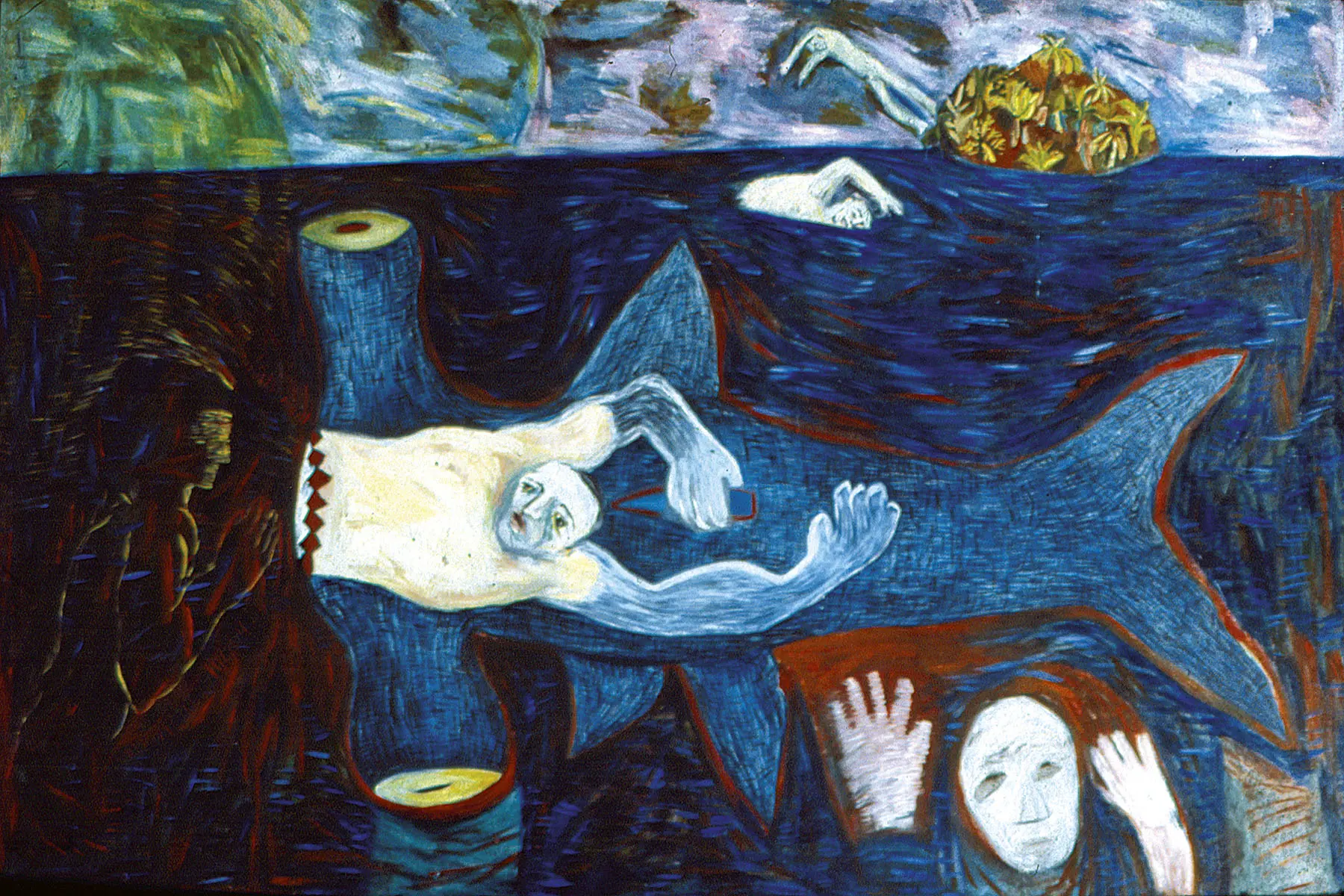
During the political crisis that preceded the United States invasion of Panama in December of 1989, the well-known Panamanian painter Isabel De Obaldía —educated at l’Ecole de Beaux Arts in Paris and at the Rhode Island School of Design— took part in public protests and helped build street barricades in the city. The country’s political situation not only marked the artist’s life but was also reflected in her works, such as those presented at Panama’s Museum of Contemporary Art in November of that same year as part of a show titled ManiObras (ManOeuvres). With titles such as Manjar de ogros (Ogres’ Feast), Aguas turbias (Murky waters), and Radio bemba (Bigmouth Radio), these paintings of tormented figures and mutilated bodies made reference to the situation around her, at the risk of having her none-too-subtle language be understood by those in power. A few months later, with Panama’s military government already deposed, De Obaldía took part in a show titled Panamá: Iconografía de una larga pesadilla (Panama: Iconography of a Long Nightmare). There she showed a series of drawings and pastels alluding to the country’s military forces, torture, and repression —works which, had they been presented prematurely, could have put her life in danger.
The 1990s were years of greater political peace, but also of increasing artistic intensity and multiple achievements for De Obaldía. In 1992 she won the First Prize at the First Panama Biennial for her painting Reina hormiga (Queen Ant), a large oil painting that explored gender and ecological issues in her characteristic neo-figurative style. In the following years, De Obaldía held two solo painting exhibitions in Panama, where she had begun her career as a painter with her first show in 1977. Most notably, during the 1990s, De Obaldía started and successfully developed a parallel career as a glass artist, showing her sculptures in Panama, Miami, and New York.
De Obaldía had long been attracted to glass. In 1987, out of sheer curiosity, she signed up for a glass blowing class at the Pilchuck Glass School in Washington State in the U.S. It would be the first of many pilgrimages to that center, founded in 1971 by artist Dale Chihuly, a major figure in the Studio Art Glass Movement that developed in the early 1960s after Harvey Littleton invented a glass oven small enough to fit in an artist’s studio. Although the roots of glass art hark back to Ancient Rome, its transition from the realm of crafts to that of Fine Arts is of recent vintage.
At Pilchuck, De Obaldía studied with Czech masters Jiří Harcuba and Jan Mares, promptly discovering her passion for the processes of glass cutting and engraving. A few years later, she was invited to an international Glass Symposium in Novy Bor, Czech Republic, which put her in contact with glass specialists from all over the world. She worked with European glass engravers in a large factory with specialized workshops for the design, blowing, engraving, and painting of glass. De Obaldía had become immersed in a whole new world.
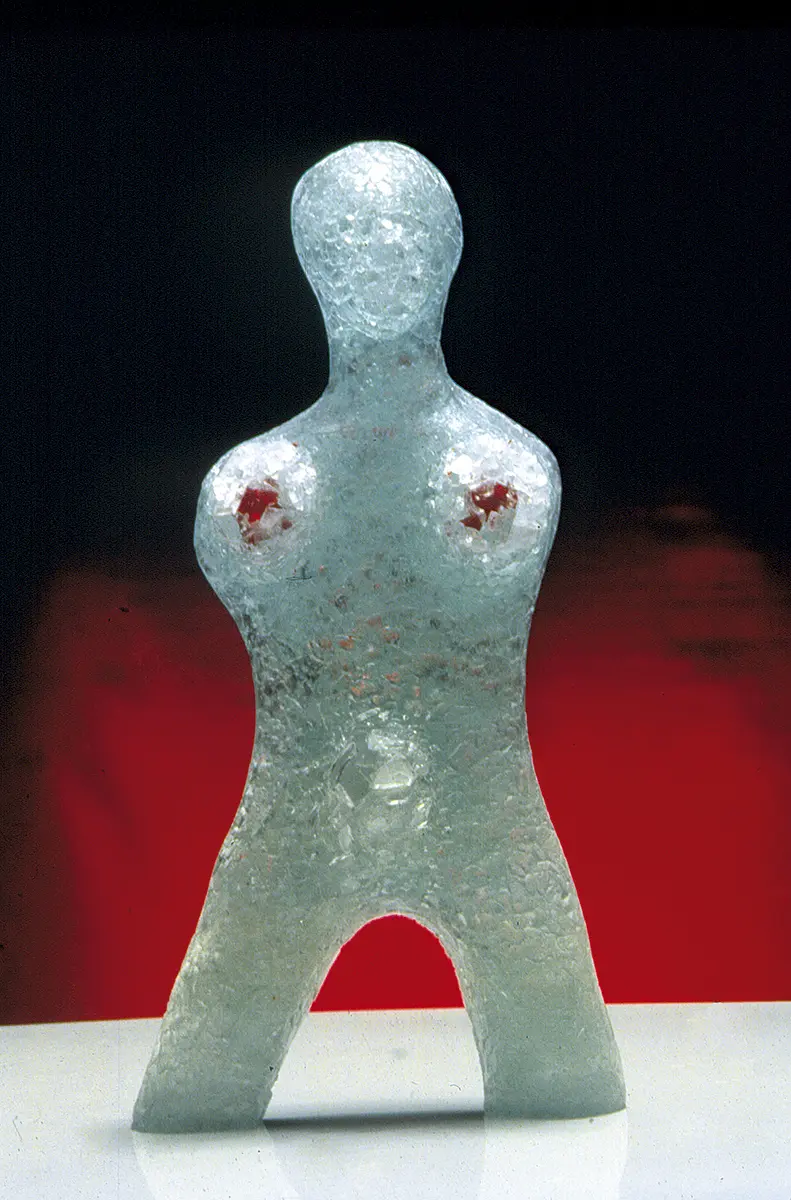
In 1993, De Obaldía presented her first glass art exhibition in Panama. It was a showcase of the techniques she had experimented with up to that point and included engraved, painted, and cast glass works, as well as pieces in “pate de verre” ( a technique that fuses small fragments of glass or glass dust into molds). De Obaldía showed vessels and vases, sculptures based on human forms, as well as representations of sharks and sting rays. Her first cast glass sculpture, Big Mamma, a small statue with red protrusions in the place of breasts (or, alternately, of blunted arms), foreshadowed the path her work was to follow in the subsequent years, focusing on the human figure.
In the catalog for that show in Panama, the artist described her relationship with glass as a fever. She worked obsessively and, three years later, her first US show gave evidence of a great qualitative leap, both technically and thematically, in her exploration of sculpture, a field with very few practitioners in Panama. Her works from that time, which she called “warriors”, were austere forms with rustic surfaces, in colors evocative of the earth and the sea, engraved in a manner reminiscent of Expressionist etchings. In some cases, human faces emerged from the chests of these provocative figures, like visual representations of their souls. The anthropomorphic sculptures in the shape of ancient metates (grinding stones) —with engraved figures of men held captive by their static poses— the effigies, and almost abstract totems in her oeuvre from that time evoked the forms of pre-Columbian art.
By the mid-1990s, De Obaldía’s name was becoming known in international glass art circles. She was invited to the contemporary glass art exhibition World Glass Now in Sapporo, Japan, and also to Venice’s Aperto Vetro, the first international glass Biennial. In both cases, she was the only Latin American representative. In Japan, she showed two circular pieces of engraved glass, positive and negative versions of images that resembled her paintings both in their thematic intensity and the strokes employed to represent men with the souls of trees. In Venice, she presented Triunvirato (Triumvirate), which consisted of two manly figures flanking a king on his throne. The iconic central figure, in milky yet translucent glass, was impressive for its solemnity and luminescence, as well as for the contrast between the blue tones of its base and the opaque, bloody red of its stumped head.
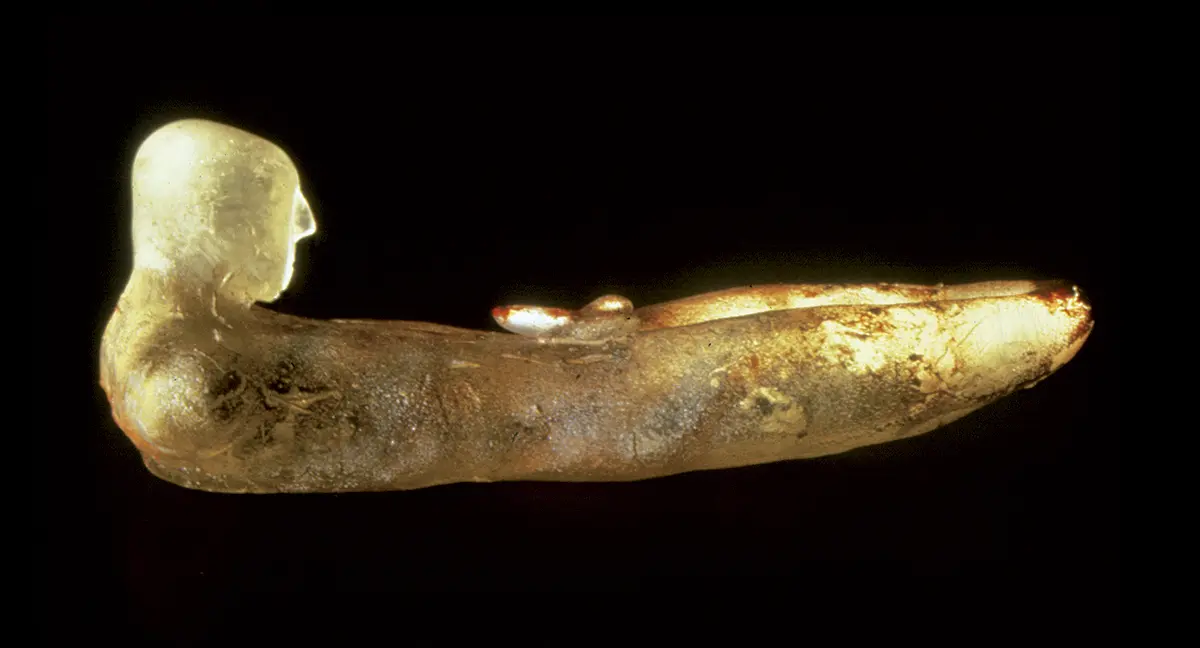
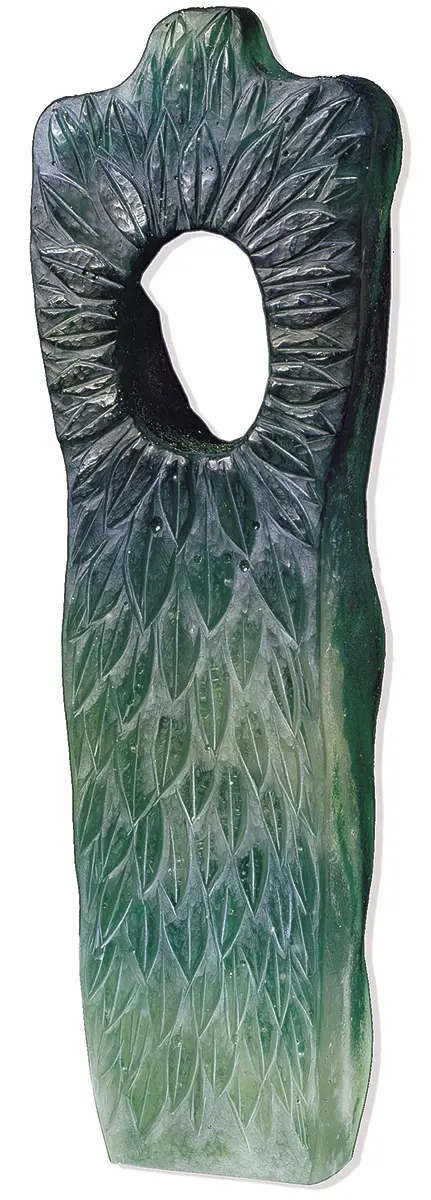
De Obaldía’s ascent continued. In 1997, she held her first New York exhibition. Titled Bestias y hombres (Beasts and Men), the show included 16 glass sculptures representing men and animals, stoic headless bodies, and reclined human figures. Especially remarkable was her use of organic forms, the anatomical volumes of her animals, and the carefully engraved designs such as the green leaves emanating from the empty space in the chest of the figure named Juan Caliente. The new pieces were striking as much for their surface textures as for their sheer volume, as they expressed a monumentality that is unusual in glass art. Each image is unique, and while they are not part of narrative plots, they most certainly stimulate the imagination. For instance, Despertar (Awakening) depicts an elongated, phallus-shaped man in flesh tones with a metallic finish, who stretches his neck to observe his own erection.
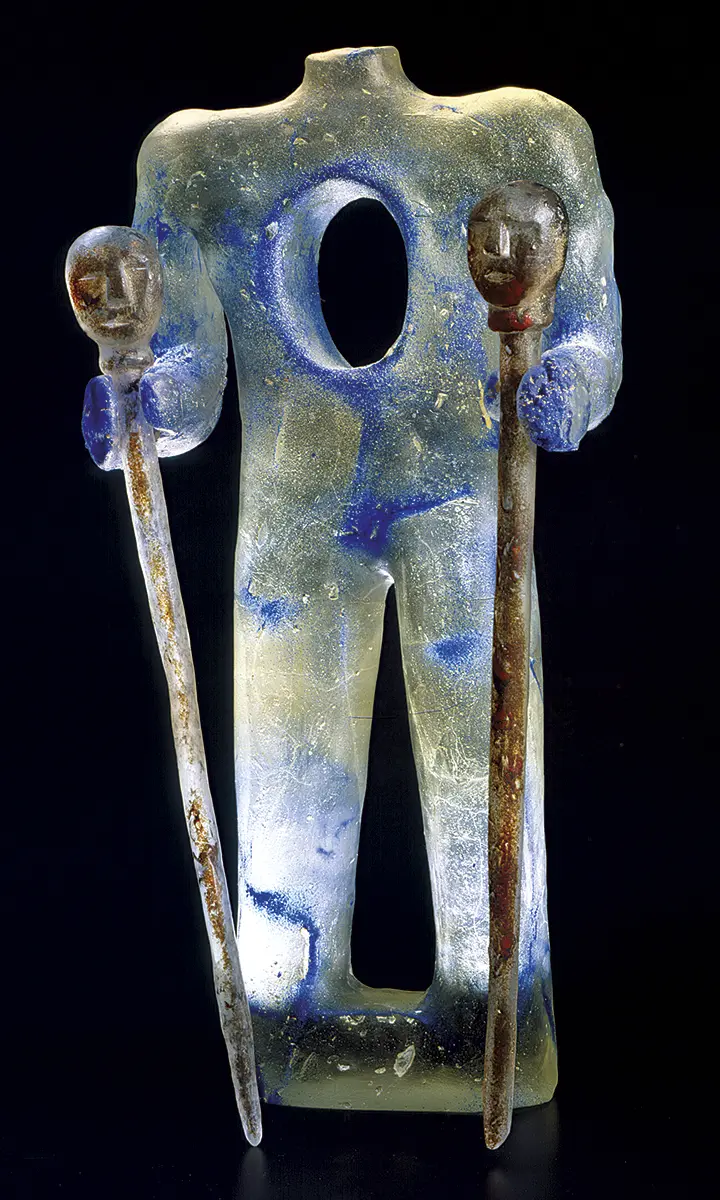
De Obaldía’s handling of the shapes and colors of glass had reached new levels of refinement. In Cazador (Hunter), where tones move fluidly from transparent backgrounds to crystalline blues, the torso is pierced by a large hole —both a sculptural vacuum and a spectral space— and the neck appears truncated. In his hands, the man holds two staffs topped with human heads, like emblems of power or spoils of war. These works, while small, reveal an implicit power that foreshadowed the life-size bodies De Obaldía would focus on at the beginning of the new millennium. Critics reacted positively to her themes and her originality, and also to her skill in the handling of so fragile a material as glass, with the many dangers inherent in its production. It is a highly physical kind of work, which De Obaldía carries out with the strength of an athlete for, besides being an artist, she holds a black belt in Karate and regularly competes in triathlons.
Athletic, muscular, male bodies have always been a central theme in De Obaldía’s work. The solitary man in a warrior-like pose holding spears or trophy heads shows up constantly, in ever larger and bolder sizes. Her handling of glass has continued to become more sophisticated, in such a way that many of her pieces offer a striking transparency while others, increasingly more numerous, display an unusual opacity and wealth of colors as well as brilliant, metallic, and even rust-like finishes.
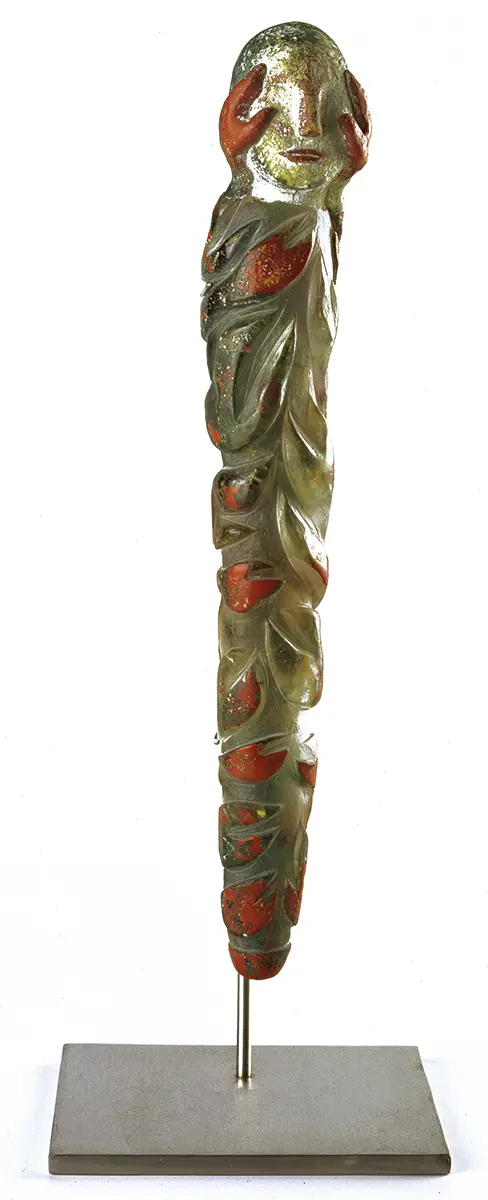
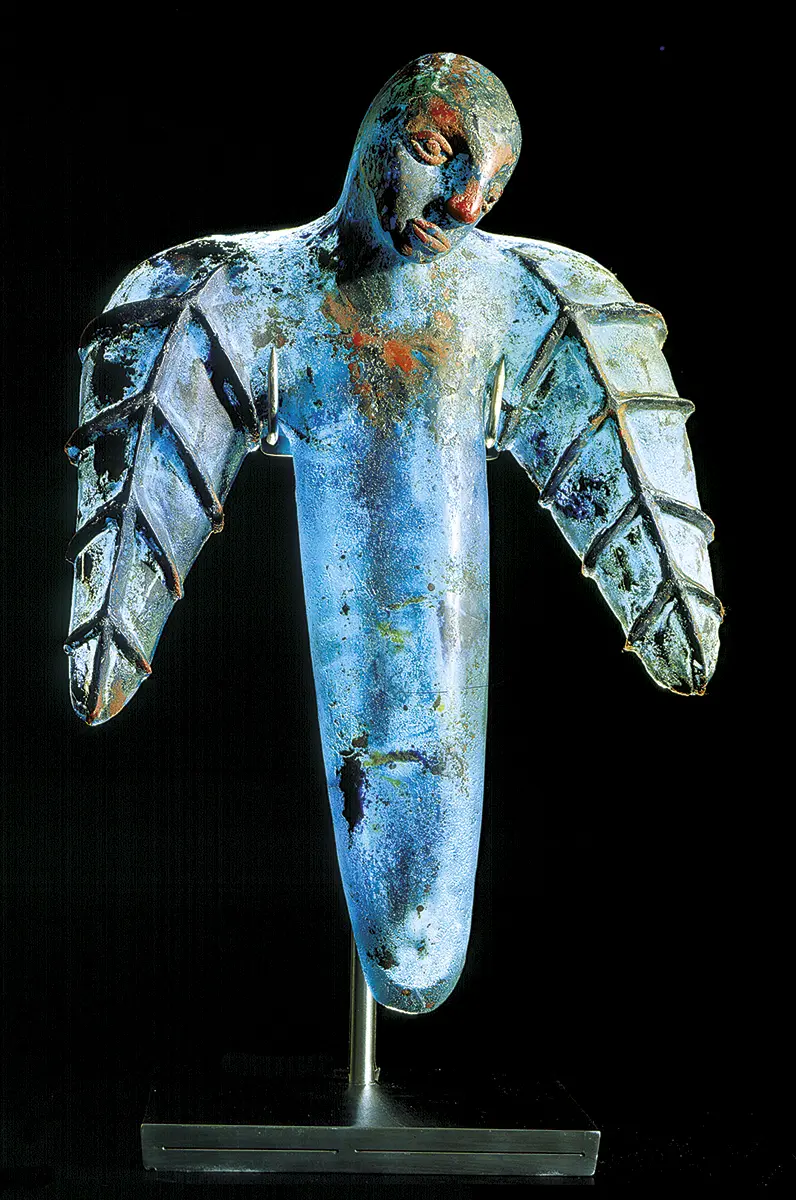
Espíritus cautivos (Captive Spirits), her 1999 show, was dominated by figures with wings, a particularly ethereal quality in the handling of glass, and a renewed encounter with natural elements. The staffs of earlier years were reinterpreted as vertical creatures whose sole human element is the head and whose elongated bodies are covered by botanical shapes. Beautiful vertical sculptures such as En hojado, where the figure is enveloped by a green vine with crimson blossoms, resemble magical fertility talismans, ritual objects from an ancient civilization. In the intensely blue figure of Nazareno (Nazarene), the arms sprout wings like huge articulated leaves, creating a transmutation between the celestial and the botanical, the mythical and the natural. The overwhelming volume of the wings and their downward tilt deny the possibility of flight and, combined with the figure’s taciturn gaze, evoke feelings of melancholy.
Starting in 2000, De Obaldía took a bold step by radically increasing the scale of her cast glass sculptures, creating a series of human torsos of great physical mass that usually appear headless, armless, but powerfully muscled. Once the challenge of the large-format figure and the sculpture’s great weight had been met, De Obaldía concentrated on exploring the many possible surface variations. In Torso marino (Marine Torso), light-blue algae ascend over a pale body; in Armadura de hojas (Armor of Leaves), a profusion of green leaves coats a man’s chest; and in Flecha (Arrow), a large, erect red arrow imprints itself on an emerald torso with obvious sexual connotations, an ever-present element in De Obaldía’s work. Turning surface decoration into a sensual game, the artist covered some of the bodies with a variety of three-dimensional elements such as green peaks, ropes resembling large spider webs, and blatant red tongues, mutations that once again make evident the enormous creativity De Obaldía brings to her work in glass. Of the whole series, however, perhaps the most remarkable figure was her San Sebastián (Saint Sebastian), a smooth, colorless torso that shows the paradoxical stains of oxidation, as well as the patina of age one might discover on a Greek kouros.
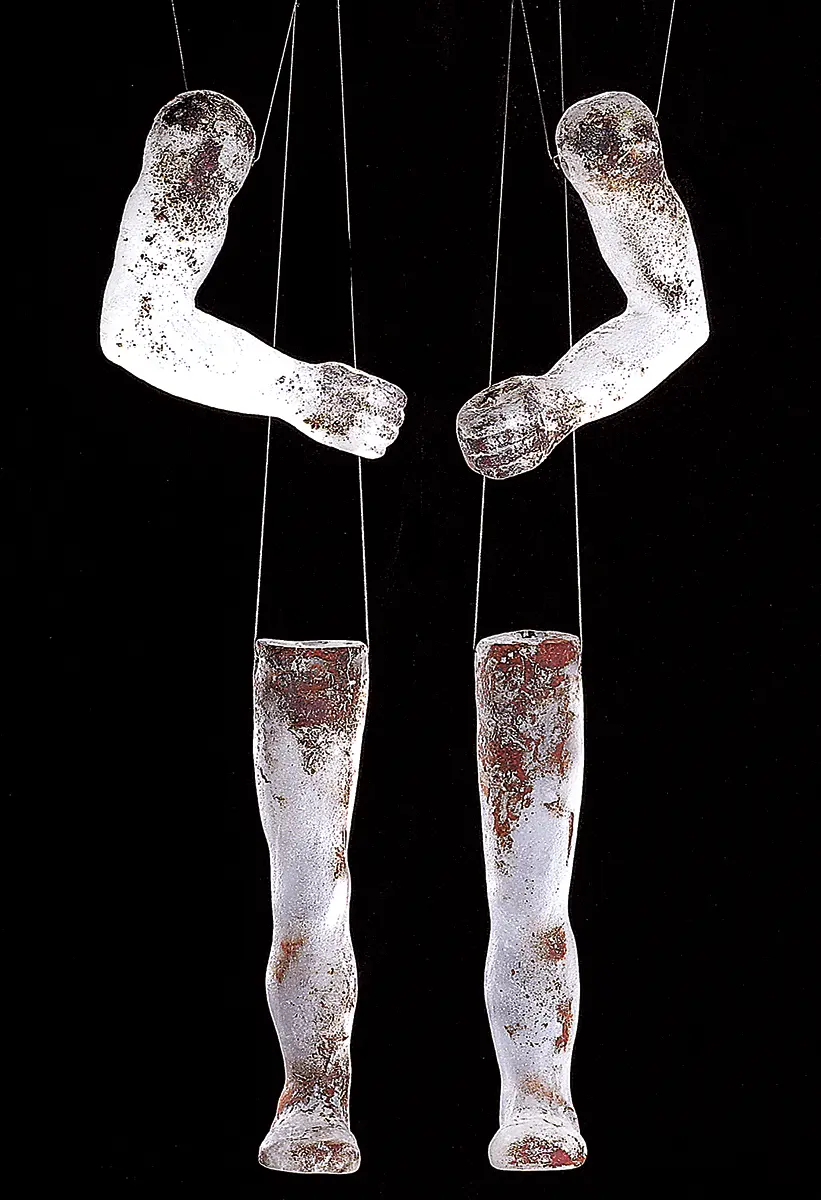
From these large figures, De Obaldía moved on to searching for a way of representing life-size men, a process that implied creating individual body parts: torsos, heads, arms, and legs. Shortly before the attacks on the World Trade Center in New York, De Obaldía had finished Ausente (Absent), a work comprised of human fragments for an exhibition slated to take place in that city in November of 2001. She put the series aside for some time, but by 2002, had returned to it, creating her first installations using body parts, initially for the Panama Art Biennial and then for Art Basel. The latter was a montage of unconnected legs and arms that, hanging from the ceiling by invisible threads, resembled bodies floating in empty space.
Isabel De Obaldía’s glass works possess a portentous intensity. There is contained energy in her forms, a forceful three-dimensional presence in her volumes, and a splendid opulence and vitality in her colors. De Obaldía’s cast-glass pieces work on two levels, which the viewer’s gaze brings together. On the one hand, there is a prodigious internal fusion of colorful glass and vivid oxides that come to life most dramatically when illuminated, and, simultaneously, one perceives the exterior surfaces dominated by pigments, metals, and textures, covering a spectrum that goes from rawness to elegance.
Through the years, De Obaldía has developed what began as mere curiosity into an artistic language of notable technical proficiency and great spiritual depth. She has been able to infuse her glass figures with both monumentality and pictorial qualities that hark back to her years as a painter, incorporating into them the expressivity and the sense of humanity that pervades her entire oeuvre. Her sculptures are figurative, but they carry with them a variety of abstract values, which make them seem at once primitive and contemporary. They possess evident solidity and physical strength, yet their vitreous quality makes them vulnerable, like the human beings they depict.
*All images illustrating this article are courtesy of Mary-Anne Martin/Fine Art.
MÓNICA E. KUPFER
Ph.D. in Art History, curator, and critic of contemporary Latin American art. President of the Art & Culture Foundation and Director of the Panama Art Biennials.