The small but very carefully selected exhibition of Julio Alpuy at Cecilia de Torres, Ltd. emphasizes a seminal period in the artist’s career and artistic production. Curated by José Ignacio Roca, of the Biblioteca Luis Ángel Arango in Bogotá, the show goes a long way toward illuminating Alpuy’s development following his move from Bogotá to New York in 1961. The well-designed catalog published to accompany the exhibition —and to celebrate the tenth anniversary of the gallery— makes an important contribution to the documentation of Alpuy’s life and art.
Alpuy is quoted as saying that the period of time he lived in Colombia was “So important. . . that I consider my career in terms of before and after Bogotá."1 However, this exhibition makes it clear that it was the decade that followed his move to New York City that further defined his style and set him on a course of refinement in his work. That process continues today. When Alpuy joined Augusto Torres and Gonzalo Fonseca in New York City he seems to have experienced a kind of emotional isolation that propelled him into an extended period of introspection and self-examination. The sense of alienation that the city can engender coupled, almost certainly, with a lack of familiarity with the new environment, pushed the artist to explore and question everything he had experienced in his artistic and professional development. “Alpuy explained that he felt as if he had plunged into an abyss —like Faust, loneliness was leading him towards an unexplored path."2
During the winter of 1962, he had the use of the studio of Gonzalo Fonseca in East Hampton. The desolate winter deepened Alpuy’s solitude. He found himself “. . . in the studio all by myself attempting to bring forth all that was inside me. Instead of looking outwards, to the city, for example, I turned introspective."3 He realized that the act of painting led him back to earlier work and decided to attempt to manipulate a new medium. Fonseca’s studio was well stocked with wood left over from past projects, and there Alpuy found a new vocabulary for the expression of his efforts to move forward. The physical manifestation of that process was a group of works on and of wood.
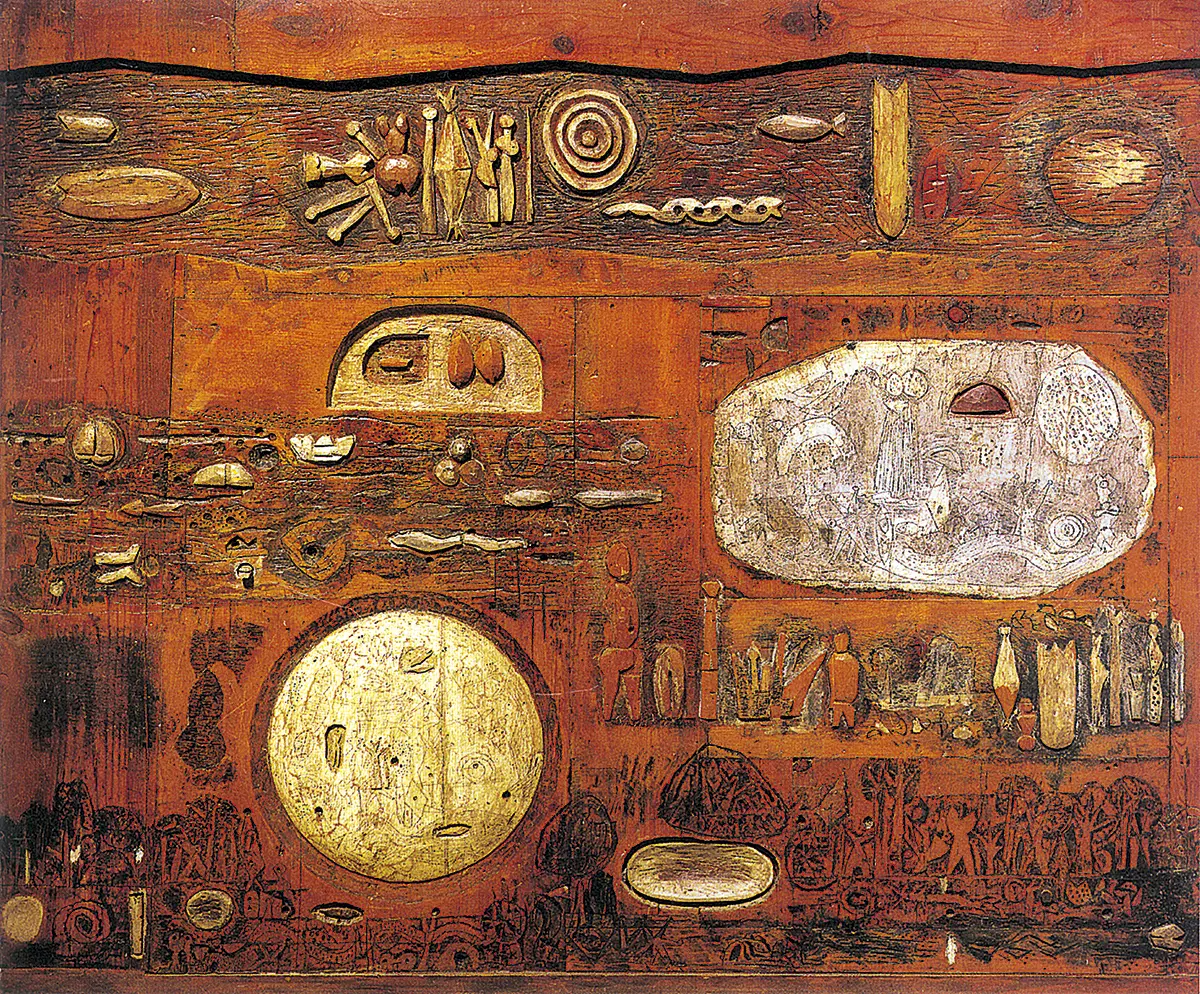
Working in this way with “found” or reclaimed wood, often from the streets of the city, the artist constructed a matrix that not only supported the work of art but also became the work itself. In some pieces, the act of assembling disparate pieces of lumber also suggested a geometrical structure. And while Alpuy was, by the 1960s, on a path leading away from the dogma of the Torres-García Workshop, this subliminal geometry contributed a stability that is referential to Torres-García and the School of the South. Alpuy built upon that stability, pushing it, and filling it with his own iconography. The current exhibition features several of the most significant pieces from this period. Génesis I is the most important of these.
Completed in 1964, Génesis I is a monumental work. Composed of thick planks joined together, it measures more than six feet in height. The implied narrative reads like a summation of everything Alpuy had learned and assimilated to that point. It incorporates the symbols and iconographic vocabulary that have remained his basic tools of expression. Beyond genesis, birth, life, death, regeneration, and man’s connection to the earth and return to it are all here. The techniques used are similarly inclusive of those that he still uses today. The surface of the wood is carved away in deep relief and delicately, but decisively incised. These elements are engaged with drawings on the planed face of the wood. Overall, a restrained use of color emphasizes the graphic quality of the work. In the current show, the place of Génesis I cannot be mistaken: it is a masterpiece of the period.
Much as Génesis I is emblematic of Alpuy’s production up until 1964, the later works chosen by Roca briefly trace the artist’s continued growth toward “maturity” since that time. In particular Pez, from 2003, rendered in an extremely subtle and sophisticated manner, sums up a great deal of what Alpuy has mastered in his long and productive career. Only twenty inches long and eighteen inches high, this highly reductive sculpture captures the essence of all the works included here. A fish of simply carved, unpainted wood, the piece elevates this potent symbol to the status of a totem. Looking at it in the gallery surrounded by earlier work, it becomes a three-dimensional representation of the artist’s career —the cipher that is the key to Julio Alpuy’s creative vision.
It is important to note that this is the third exhibition of Alpuy that has been organized by the Gallery of Cecilia de Torres. Previous exhibits were mounted in 1994 and 1997. The gallery’s dedication to art and artists with direct lines of influence from Torres-Garcia has been reinforced by the sustained growth of interest in both Torres-Garcia and El Taller Torres-García since the 1992 watershed exhibition El Taller Torres-García: The School of the South and Its Legacy. Also noteworthy is the book that accompanies the current exhibit. More than a catalog, the book includes not only an essay by Roca but also an extensive, bilingual chronology, which provides valuable biographical and contextual information.
NOTES
1. Alpuy, 1960s–2003: Works of Wood and Drawings (New York: Cecilia de Torres, Ltd., 2003) p. 100.
2. Ibid.
3. Ibid., p. 101.
CLAYTON KIRKING