Two shows in New York, one at MoMA’s P.S.1 Center for Contemporary Art and the other at Exit Art address or force us to address issues of identity surrounding whatever constitutes a Spanish connection. The Real Royal Trip, at P.S.1, where the title refers to Columbus’s fourth and last voyage, is a highly unsatisfying exhibition.1 The "L" Factor at Exit Art is interesting and challenging and, in addressing the issue of Latinos in the United States, does not fall into the messy stereotypes that so often ruin other exhibits of its kind.
The Real Royal Trip was curated by Harald Szeemann and includes twenty artists, of whom sixteen are from Spain and four from Latin America (if one counts Spanish/Mexican artist Santiago Sierra as Mexican, something about which Spain seems to have mixed feelings). The show is particularly frustrating because, while some of the art is good, it is difficult to discover its precise thesis or reason for being. Even after reading the many prefaces and forewords in the catalog, whose authors range from Ana Palacio (the Spanish Minister for Foreign Affairs) to Szeemann himself, one is still uncertain of the agenda beyond a vague wish to exhibit new Spanish artists and to expand the concept of “Spain” into one of “greater Spain."2 There is a hint here of establishing a cultural version of the British Commonwealth for Spain, but not much more than that. In his surprisingly brief text (three paragraphs), Szeemann suggests that the Latin American artists in the exhibit are a symbolic answer to the voyage of Columbus, a “return trip” so to speak.3 Most of the writings in the catalog cite, in one way or another, the honor of having Szeemann curate the show. My guess is that Szeemann was presented with a list of artists, that he picked the ones he liked, and that he then added some Latin American artists he happened to know.
The "L" Factor, where “L” stands for Latino,4 was organized by circulating a call for entries among Latino artists that asked them to take a Latino icon and to produce a “conceptual portrait.” From the 300 applications submitted, of mostly young and unknown artists, Exit Art accepted thirty-one.
These two shows are not comparable. The one organized by Spain is of younger but relatively known and established artists (some of them have already been shown in both the Venice Biennial and Documenta). They have the professional slickness of much of the art that is normally seen in the art circuit. The Exit Art show, on the other hand, has something of the look of a graduate art school exhibition. It has some rough edges, but also a wonderful feeling of discovery and potential.
Beyond any evaluation of quality, the exhibits are interesting for the ideological issues they reveal. The Spanish show seems to be politically aggressive and consistent with the new self-image Aznar’s policies seek to project, including Spain’s status as U. S. ally on the world stage. The Exit Art exhibition, on the other hand, is a defensive show.
“Latino” (the "L" factor) is a term rooted specifically in U.S. social reality and reflects U.S. patterns of social discrimination and U.S. ways of dealing with social inequality. Not all language groups derived from Latin are incorporated—only Spanish speakers, and not all Spanish speakers—only those originating in places “south of the border” of the United States. And not, it seems, all Spanish speakers from south of the border were included, but rather those who are visually recognizable and thus with a claim of discrimination, which circles back to race. Holland Cotter’s review of the exhibit at Exit Art exemplifies the fuzziness in thinking about “Latino” identity.5 Cotter, the respected and open-minded art critic of The New York Times, responsible for covering non-mainstream art, expresses surprise that among the Latino artists exhibited at Exit Art he found “names like Joskowicz, Kostianovsky, and Schneider,” something not much stranger than encountering those same names in a group of Anglo artists.

One could say that the Spanish exhibition in P.S.1 addresses primarily an external audience (even if the show will also be seen in Spain) and that the “L” show is directed to an internal audience and possibly, more specifically, to a “Latino” audience. The P.S.1 show is open; there is no artistic program beyond fitting a decent and competitive slot within the international art scene. The objective, sycophancy towards Szeemann aside, is to assert national cultural pride. The Exit Art show, in contrast, is highly programmatic; the message is not so much about “how good we are” but “who we are.” The objective is cultural survival. But the question “who we are” raises another: who defines who we are?
Many years ago my College had to report how many “minority” persons served on the faculty. We were asked to classify ourselves, and I listed myself in the category of Hispanic (a term coined by the Nixon administration to deal more easily with this messy conglomerate of people that was used until political correctness brought in “Latino”). Though I was raised in Uruguay from the age of fifteen months and Spanish is my first language, I was immediately criticized by some of my colleagues on the grounds that by putting myself in that category I was inflating the “minority” statistics and diminishing the pressure on the College to hire a “true” Hispanic. As a Caucasian and a Jew, it seems I didn’t qualify for the category. I was caught in a conundrum. Though racist, the argument had some merit since I probably suffered less discrimination than any colleagues of mine who were darker-skinned. Yet, it was painful to have to sacrifice my own cultural identity for the sake of achieving some social justice within a racist system. I had to observe how the victims of that racism were forced to play the game according to the same racist rules that were oppressing them.

Fortunately, The "L" Factor recognizes and embraces the diversity of the Latino population as well as the right of self-identification, and it further makes the point that the whole issue is meaningful only within North American art, and not a foreign import. Further elaboration is needed, however, since “foreign” is a label that obscures more than illuminates. As curator Papo Colo states in the text for the exhibition:
“Most immigrants surrender their language, but Latinos have not, because Latinos are not “foreigners,” we are just coming from the South of the Americas. Spanish is the language that has the most influence on English and it is rooted in the United States... Latinos discovered the Americas and then were outlawed in the North. Latin America has remained the North’s colony. This produced a mirage feeling of not belonging. This condition rules Latinos life and art. We are accepted or tolerated if we imitate. This kind of creativity is measured by the likeness to the dominant culture and its vision of others.”
The Latino population in the United States has grown by fifty-eight percent in the last ten years and by 2020 it is estimated that it will reach 55.1 million out of 332 million inhabitants. The impact will not only be felt culturally but also economically, and Exit Art is not the only institution picking up on this fact. Nash Finch Co. has started a supermarket chain (Avanza stores) addressing the changing demographics, with bilingual signage and “culturally appropriate design” inspired by the work of architect Luis Barragán. As if having a revelation, Brian Numainville, director of research at Nash Finch, says: “We take Hispanic cookies and put them right next to Nabisco."6
One could say that ultimately both exhibitions reviewed here are trying to put the Hispanic cookies next to Nabisco. In the realm of common sense, one might ask where else would one put cookies if not next to each other, but we are in a world organized by separate nations and ghettos. Thus, while the motivations may be different, breaking away from the ethnic food section seems as enlightening as abolishing racism and eroding the category of cultural foreignness. In this context, the Spanish exhibition at P.S.1 seems to espouse a separate-but-equal position for “national” art, while the Exit Art show is more about equal but for the moment still separate, which places these two exhibitions apart by roughly one century of historical thinking.
These considerations ultimately don’t affect the art being exhibited. In both exhibitions, the artists share ironic and critical approaches that escape curatorial constraints, particularly the artists in the P.S.1 exhibit. Pilar Albarracín shows a spectacular video piece, Prohibido cantar (Singing Prohibited), 2000, in which she follows flamenco guitar sounds with semi-orgasmic whimpers. Eventually, she climaxes by cutting into her chest and pulling out “her” heart with a flood of blood. Cristina García Rodero, in two cycles of photographs revealingly counterposes bloody rituals from Spanish Catholic and Haitian Voodoo ceremonies. What could be an anthropological study here becomes a powerful study in drama. In the tradition of Joan Brossa, Mateo Maté follows the poetry of objects. The crumpled sheet on a bed is seen as a mountainous landscape. A little too obviously, a video shows him climbing the peaks of the fabric. More mysterious and successful is a deadpan orographic map of the sheet that makes the same point in a perfect presentation.

Santiago Sierra is the link between Spain and Latin America. Born in Madrid, he developed his art mostly in Mexico and both countries now claim Sierra as theirs. For one of his pieces (20 Workers in the Hold of a Ship, 2001) he hired twenty marginalized immigrants to spend three hours in the belly of a ship under torrid temperatures. They were paid 20 Euros each for their suffering. In a pointed comment in the catalog, Jimena Blázquez compares this work with the crew of Columbus’s fourth trip, which was composed of convicts who promised a pardon in exchange for their participation. Sierra exhibits documentation of several of his projects, including photographs of the recent with which he represented Spain at the Venice Biennial. To enter the Spanish Pavilion one had to show a Spanish passport, and without it, one was prevented from entering the (empty) space.
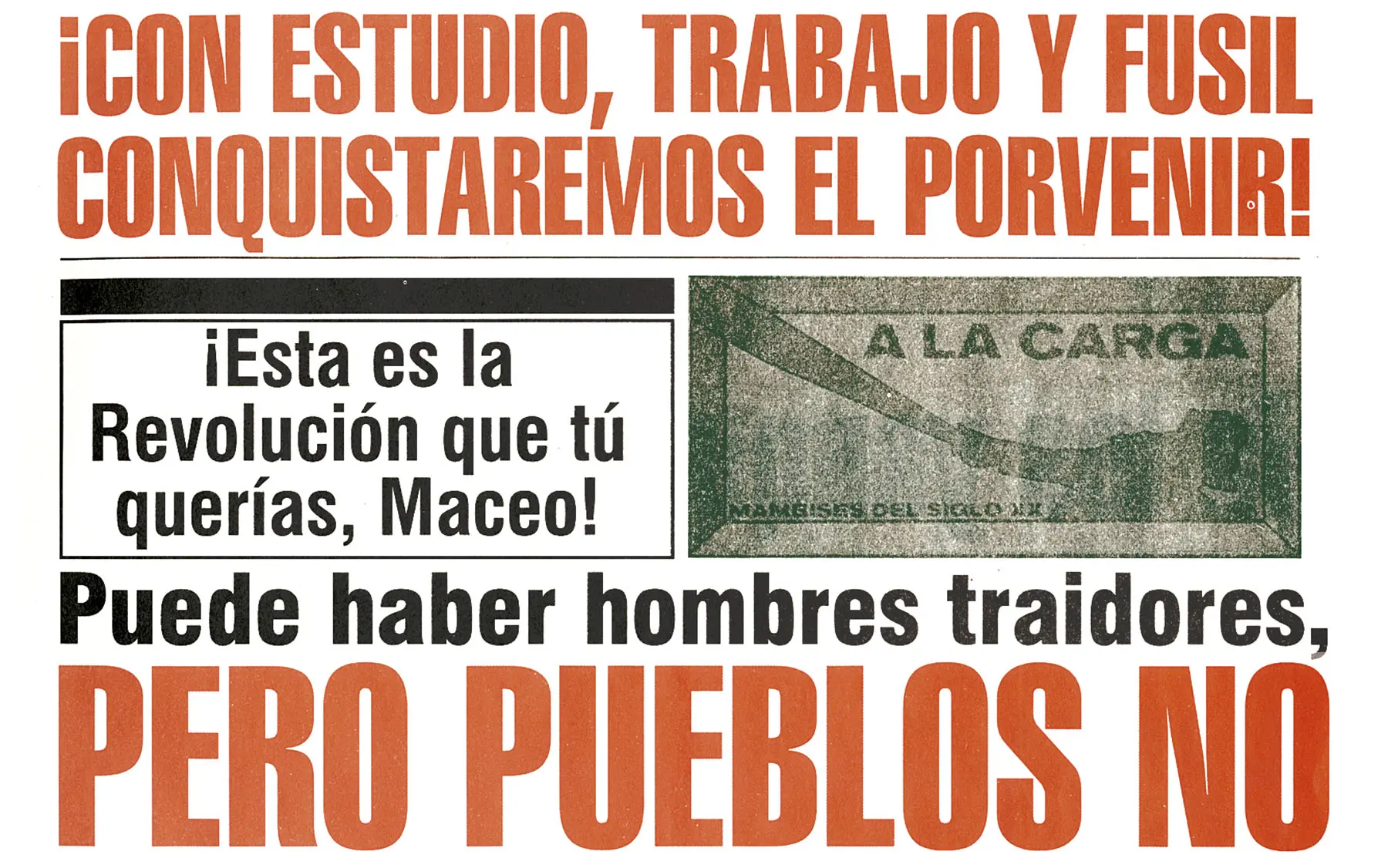
The other Latin American guests in the P.S.1 exhibition are Ernesto Neto (Brazil), Tania Bruguera (Cuba), and Priscilla Monge (Costa Rica). The inclusion of Neto is one more oddity in this show, and to be interpreted as a possible sign of nostalgia towards the lost, undivided Hispania of Roman Empire times. Neto’s piece is from the series of hanging spice bags for which he is famous, reminding us of one of the reasons for Columbus’s trips. Priscilla Monge plays with quotes from Shakespeare’s Tempest, which she takes out of context and carves into tombstone-like plaques. Phrases like “Let me lick thy shoe” or “Ha ha ha” acquire a humorous presence. The finality of dogma and death presented with both triviality and pomposity produces a perfect cemetery of sarcasm. Not so far from this approach is that of Tania Bruguera, who creates an environment that literally vibrates with the revolutionary paroles she listened to growing up in Cuba. Monge detaches Shakespeare by means of tombstones; Bruguera detaches slogans through overwhelming loudness and repetition. Both bring texts to the level of meaninglessness and show what happens when life and context are left out of the equation.
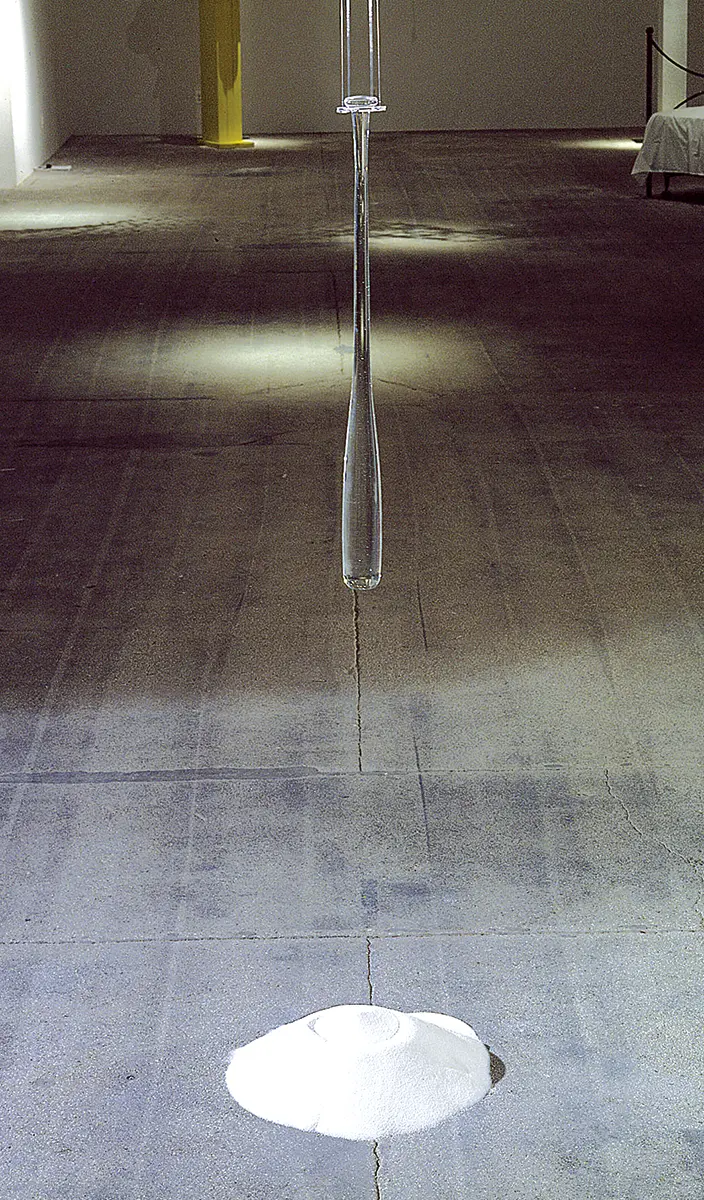
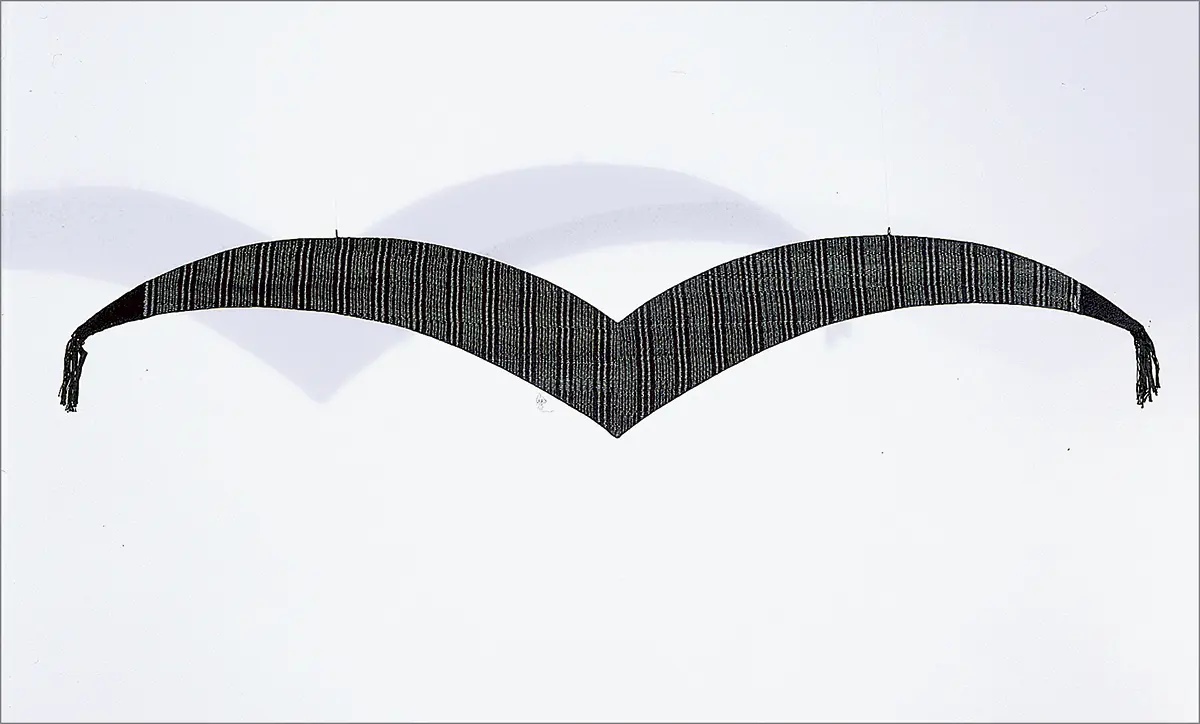
Lacking the help of national Ministries and MoMA, the displays at Exit Art are much more modest, but by no means less pointed. This is so partly because the dice were loaded from the beginning, which is a way of saying that the exhibition was actually curated. In that sense, one can perceive a general cohesion or atmosphere even before one gets close to particular pieces. Coincidentally, the exhibition space is separated from the entrance area by a chain link fence topped with barbed wire, reminding one of the Guantanamo base camps for enemy combatants. Entering, one finds a life-size soccer goal filled with a projection screen on which Alex Villar dribbles, Pelé-like, backward on a New York sidewalk. Milton Rosa-Ortiz reconstructs the Versace gown Jennifer López wore at the Grammy Awards using pieces of broken glass found on the beaches of Ponce in Puerto Rico. The green shards hang from the ceiling and bring to mind a flying Victory of Samothrace. The asking price for the work is $24,000, the same price as the dress worn by López. Karin Schneider offers The Banana Factor, yellow cigarette paper booklets imprinted with “Bananas is my business,” attached to a yellow striped column. The installation is in honor of Carmen Miranda, and the column, a target for graffiti, bears, among other anonymous contributions, a No bananas for oil. Tamara Kostianovsky distributed portraits of Latin American icons around the gallery. Carlos Gardel, Frida Kahlo, and other faces are rendered with hair glued on glass and cast perfect shadows of their likenesses on the walls of the gallery. Andrea Arroyo sums up Kahlo in a more synthetic portrait, an object in the shape of her trademark eyebrows, lined with fabric from a rebozo (shawl) like the one she used to wear. Freddy Rodríguez creates a glass baseball bat in honor of Sammy Sosa—the player who recently was accused of using cork-filled bats in his games, thus resolving issues of suspicion. It hangs suspended over a little pile of sugar, recalling the reasons for slavery in the Caribbean. In perhaps the most complex piece in the exhibition, Ricardo Miranda Zuñiga built a wheeled video game console that uses Cantinflas as the character. With three levels of complexity, the player begins with a “culture of poverty,” continues with a “culture of assimilation” and ends with the third and most difficult level of a “culture of prosperity.” In the first board, Cantinflas is walking in a dilapidated neighborhood in front of a liquor store and the player has to make him bend over to avoid being hit by hurled bottles.
Leaving aside the matter of curatorial depth of thought (or the lack thereof) in these two shows, it is comforting to see that the artists, even when perilously close to being confined to an “identity program” such as in The "L" Factor, manage to escape the limits. When concrete topics appear, they ultimately address them with irony and detachment rather than with the triteness that would result from wanting to submit to a willful fabrication of identity. Seeing both shows, one might conclude that in establishing a Latino identity pushing the envelope is more effective than honoring boundaries and that mixing the cookies may be more subversive than keeping them separate.
Edited by Selby Hickey.
NOTES
1. October 12, 2003, through January 5, 2004. The exhibition then will be at the Museo Patio Herreriano de Arte Contemporáneo Español de Valladolid, February–April 2004.
2. The Real Royal Trip/El real viaje real, (New York: P.S.1 Center for Contemporary Art, 2003).
3. The only mention of the art project in Szeemann’s text, besides an expression of gratitude to the artists, is: “Christianization decimated indigenous people. The Royal Trip brought disasters; we artists will make The Real Royal Trip on Columbus Day 2003.” Szeemann, The Royal Trip.
4. November 22, 2003–February 15, 2004. See the virtual catalog at www.exitart.org.
5. Holland Cotter, “A New Latino Essence Remixed and Redistilled,” The New York Times, November 28, 2003: 41, 48.
6. Brian Numainville, quoted in Nancy Nachman-Hunt, “Avanza! Nash Finch immerses customers in culture,” Natural Grocery Buyer, August/September 2003. The newsletter is distributed via e-mail by info@unoonline.com. Nash Finch estimates that 50% of the growth will come from Mexican origin.
LUIS CAMNITZER
Emeritus professor at the SUNY College, Old Westbury.