
When André Malraux, the creator of the Imaginary Museum, visited Buenos Aires, he declared it "the capital of an empire that never existed." Lucio Dorr’s most recent show attempts to recreate an experience similar to that which prompted the French writer and minister’s comment. Buenos Aires is a collective, atomized, and imperfect translation of other cities—thus its dreamlike character. In an uninterrupted frieze of façades of 8.66 m. (the lot’s original measurement) where various styles exiled from their original referent pile up, the interior always returns a scheme —and a reality— that remains the same in all the homes in those former outer suburbs, today’s barrios.
This recourse to style is the necessary differentiating feature that each house -and its inhabitants —has when confronted with the monotony of the city’s grid and, even beyond, with the metaphysical abyss of the Pampas. Historically, the need for stylistic gestures— indefinable allusions to the fragments of an absent Europe —had the function of providing our immigrant forefathers with an identity in a young, strange country where everyone is an "other". Lucio Dorr walked through the city’s neighborhoods, photographed the decadence of that pretension to an identity, and extracted from Buenos Aires’ own development its perverse stylistic methodology.
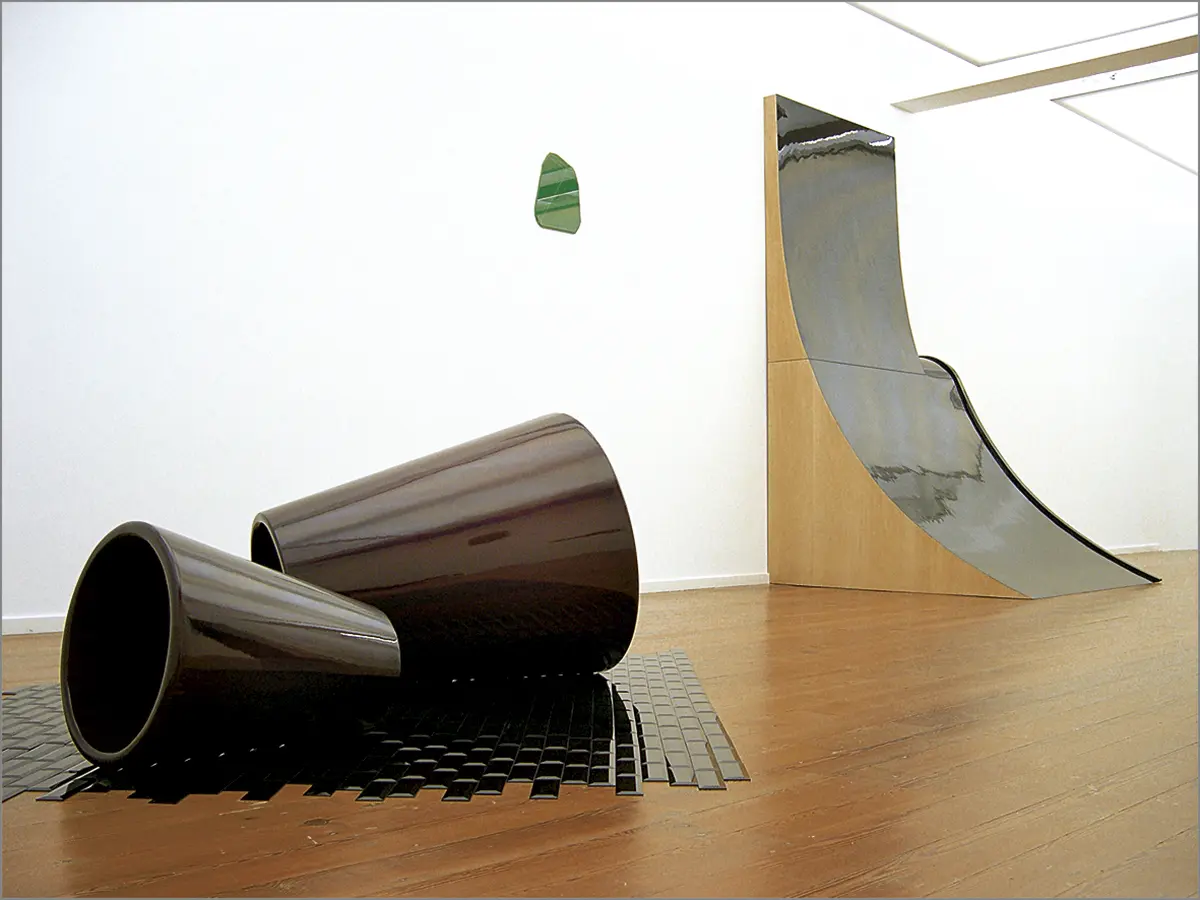
His installation is comprised of fragments and formal interventions at various scales, which always seem to allude to larger systems of signification that are nonetheless impossible to identify. A large skateboarding ramp executed in sumptuous lacquered wood, with a small lateral sub-ramp that could only drive its hypothetical tiny user into the gallery wall, illustrates the artist’s program in terms of its relationship to style: form colonizing the function that generated it. A truncated cone hollowed out and divided in two, rests on reflective black tiles. It cannot contain any substance, for its hollowness voids its use. Paved gardens executed in glass and object paintings with shaped canvas in English green, stamped with pseudo-scientific representations, complete the objectual universe. Two of the corners of the white cube were rounded, and a large window overlooking the street was covered with a reflective film. The rarefied space of aesthetics turns its gaze upon itself, cutting off any external relationship. The interior turned façade. From the street, a window into this utopian interior.
Given the pauperization of the working class and the decadence of the middle class, which exploded Argentina’s sociopolitical situation and drove the country not too long ago to count four or five governments in a single month, Dorr’s profoundly aestheticist gesture should be read as the evasion of a reality that is as melancholic as it is aristocratic. However, the show is also an effective metaphor for Argentinean society and its historical development from the times of the military dictatorship to the present. A country that should have prospered economically instead of sinking into misery, since it possesses one of the world’s richest reservoirs of natural resources per inhabitant, and the Third World’s highest literacy index, resembles closely a set of objects executed in the noblest of materials, installed in extraordinarily complex spatial situations, but devoid of utility or apparent ideological message.
Dorr does not present his work as the socio-historical analysis I am suggesting, nor does he propose his utopia as a model. As the Argentine writer César Aira put it once: "I started understanding something while at the same time, I stopped understanding everything. That is what happens when one finds himself in the presence of a style." It is in such fragmentary understanding, where beauty seduces the historical imperative, that the benefit of the doubt flows until it influences the viewer’s own movements.
NICOLÁS GUAGNINI