The show Homage to Luis Frangella, curated by Elena Oliveras and presented by Centro Cultural Recoleta, is a marvelous, unique opportunity to appreciate the oeuvre of a notable artist and architect who worked mainly out of New York since 1976. It is a welcome reminder that Frangella (Buenos Aires 1944-New York 1990), though almost unknown to the local public, kept alive his ties to colleagues in sporadic visits to Buenos Aires and shared with them his experiences in New York’s East Village next to Mike Bidlo, Jean Michel Basquiat, and David Wojnarowicz.
On this occasion, large-format pieces —up to nine meters— are exhibited, painted using strident colors that coalesce into a passionate, somewhat fierce figurative art; there are also smaller works that reveal a dedicated and delicate draftsman, the antithesis of the furious brushstrokes in his formidable paintings.
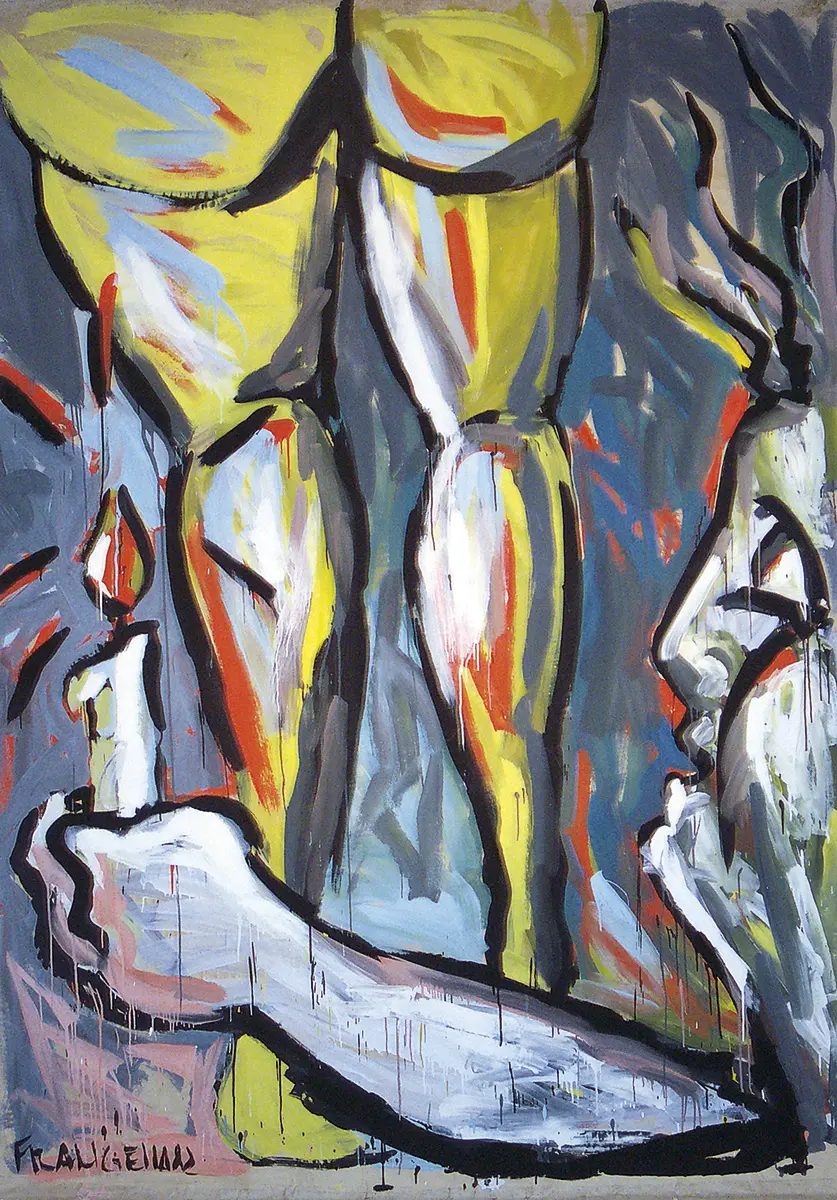
This homage to Frangella is a celebration of painting, the genre to which the artist devoted his best efforts after years of conceptual experiences and explorations. The works exhibited are mostly from the 1980s; they belong to those effervescent movements that brought back painting, in varied supports, into the world of art, with an accelerated production and at a time when the representation of the subject —in fragments or diagrammatic human silhouettes— was once again center stage. This recuperation of painting was characterized by a conciliatory spirit and by the admixture of different artistic styles, especially the trans-avantgarde, and neo-Expressionism. The imposition of these styles meant a return to Painting (with capital “P”) to the craftsmanship and memory of painting. Such a heterogeneous horizon privileged figuration, but abstract art also found its place.
Viewing it after the fact, we could locate Frangella’s paintings —exhibited here— close to neo-Expressionism. The term was coined in 1982 on the occasion of two shows: Zeitgeist in Berlin and Westkunst in Cologne. These shows unveiled a figurative and neo-Expressionistic renovation, highlighting the rebirth of a sensible, allegorical, and gestural kind of painting that could cite history and use humor, be emotional and brutal, harking back to early-twentieth-century German and Austrian expressionism. Precisely that year, 1982, Frangella won a Guggenheim fellowship and took part in Pintura fresca, a Buenos Aires exhibition organized by Rómulo Macció alongside Luis Felipe Noé, Juan Pablo Renzi, and others.
But Frangella’s works are not only representative of that “new spirit of painting” that shook the art world at the waning of ascetic minimalism and the intellectual demands of 1970s conceptualism (in which Frangella participated, collaborating in John Cage’s multi-media works). As Elena Oliveras notes, this return to the pleasure of painting, to a baroque figurativism, and to a mythopoetic kind of art “is complex in Frangella, since they [his paintings] also recover prior explorations by the artist in the field of visual perception.” According to Oliveras, some of Frangella’s works “embody the relativity of ‘point of view.’ When there is no privileged point, the gaze moves constantly in an attempt to solve the uncertainty that governs all registers. In one of his last torsos, frontal representation is abandoned in favor of a destabilizing capture on a tilting plane. This forces viewers to abandon their central position (…). Frangella underscores the absence of a univocal capture (…). The only certain thing is that everything can be (seen and known) and at the same time not be (seen and known).” 1
The iconography of the human figure is protagonistic in Frangella’s painting by way of his fragments, perhaps as a social territory rather than as a sensual mirror, a place to even debate about art, or maybe about those absent bodies.
It is significant that Frangella, while still living in New York in the early 1980s, chose to work with body parts and with anonymous bodies. Those were times when the military dictatorship in Argentina curtailed the movement of people under the State of Siege laws, but they were also times when what had been a secret could no longer be silenced: the dictatorship (1976-1983) had carried out a murderous policy of disappearing people for political reasons. ¿Where are the disappeared? ¿Is that Frangella’s question?
NOTES
1. Elena Oliveras, La metáfora en el arte, Buenos Aires: Editoral Almagesto, 1993, p. 196-197.
VICTORIA VERLICHAK