
In his new solo exhibition at the Whitney Museum of American Art at Altria, Luís Gispert has re-inscribed stylistic elements associated with the urban environment in his reading of the customized car as a post-ghetto-fabulous architectonic object. Combining the unfinished effects of plywood with the decorative surfaces of the oversized silver pendants worn in urban centers around the world, Gispert’s installation references the crossover aesthetic dialogues of contemporary art and urban youth culture.
Proposing the customized “club car” seat as the location of empowerment, Gispert’s throne places the spectator/participant on the thumping end of a giant subwoofer. Each throbbing bass beat is felt on the spectator’s back, mimicking the inside of a car with a booming sound system. The paramount importance of feeling the music —as well as hearing it— is reinforced in this installation, in which sound and the machines that maximize it become cultural signifiers. Across the surface of the grainy plywood, linear graphite drawings recall the forms of cassette players, graphic equalizers, volume knobs, and the plethora of buttons and switches designed to create a total listening experience. The contrast of wood grain with masonite board reinforces the various textural “voices” of the installation, where smooth, flawless surfaces meet grainy planes enlivened by drawings. The boom box, rendered as a modernist object, is reduced to its constituent parts, with geometric forms replacing functional parts. The tension in the installation between the presentation (the silver chains and pendants) and representation (the drawn lines of the boom box) underscores the title word across the top of the entire installation: Dysfunctional. Written in traditional cursive lettering, this giant lexical feature throws the entire installation into deliberation.
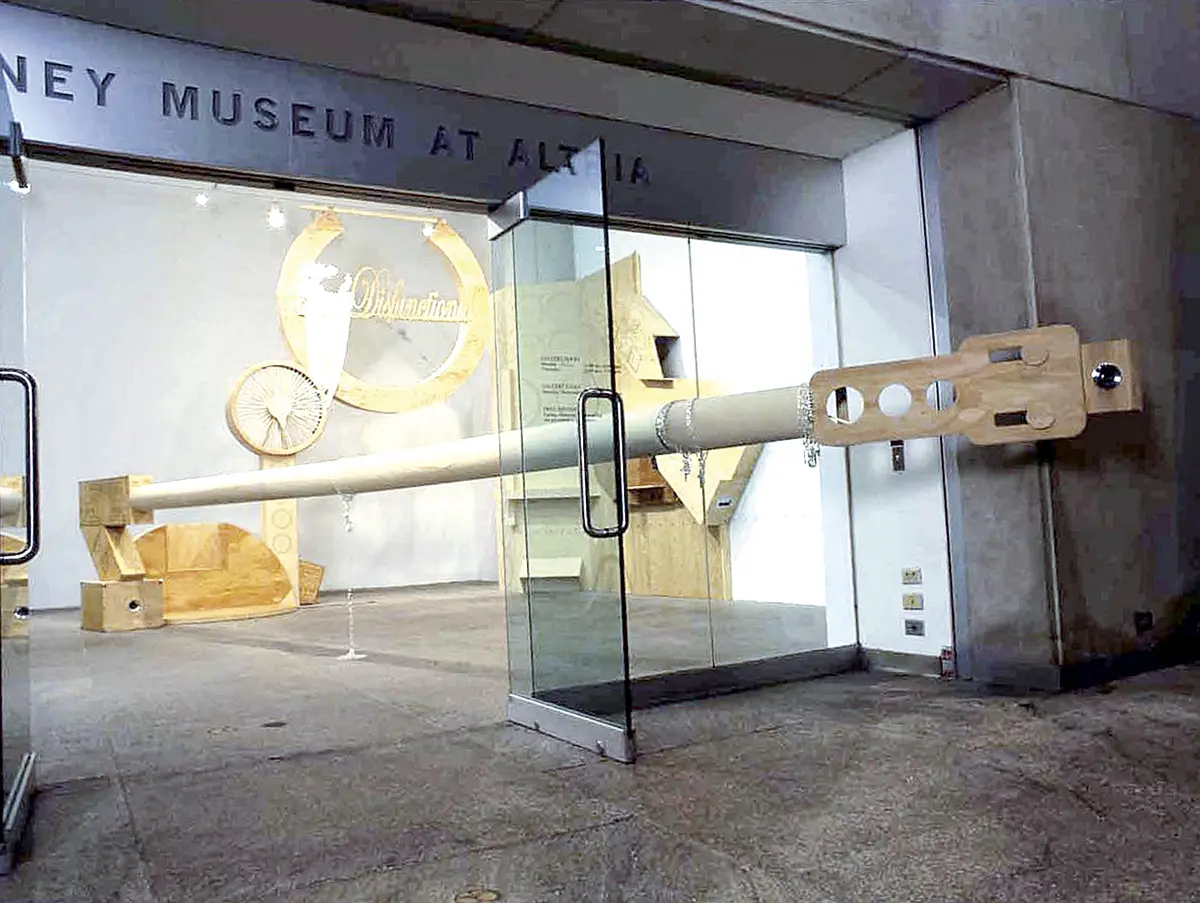
This relationship is addressed in the hectic mix of silver chains and pendants, emblems of contemporary materialism that merge with iconic signs of commerce and nostalgic representations of beloved icons. Treble clefts, capital letters, crosses, a marijuana leaf/Chrysler symbol, the crown of a self-proclaimed graffiti king, the all-powerful dollar sign, a cobra’s poised head, dragons, eagles, the Playboy bunny sporting a ruby eye, and the “Bat Signal” all mark their presence in the profusion of objects. The flagrant, street-style subversion of corporate logos and the reification of iconic symbols mark these pendants as indices of contemporary culture. Each sign, reduced to its most effective parts, is offered for sale to all those seeking immediate gratification in the form of an easily recognized symbol intended to embody the wearer’s personality. The artist proposes these signs not as necessarily sterile images of consumption but as possibilities for aesthetic practice. On the floor beneath the jutting arm of a turntable, a globe pendant “melts” into the floor where silver foil has “dripped” onto its marble surface, revealing the fleeting nature of such objects, despite their prevalence in popular culture. In Gispert’s installation, they trace the form of a jet engine marking the chaos, the turbulence, and the furor with which such objects and their meanings mark contemporary society.
Between two real, but non-functional speakers, a mock turntable divides the space, alluding once again to the non-functional parts of boom boxes sold with excess elements, disproportionately sized for their task. The artist’s wall drawing of an imagined boom box renders it an architectural and cultural monolith. Immortalized in the Spike Lee film, Do the Right Thing, 1989, the size and power of a boom box are directly related to the identity of its owner. The pre-walkman portability of these units marks them as significant cultural objects that re-configured the urban landscape. The adaptation of the graphic equalizer to the boom box, for example, meant that the malleability of music was available to an ever wider population. Gispert’s equalizers, inscribed on the installation’s wooden surface and on the gallery wall, consider the meaning as well as the function of these cultural machines. Between presented objects and invented forms, woofers and drawings, pendants and sounds, Luís Gispert’s installation addresses the layering of influences in contemporary urban culture through a complex matrix of architectural form, the deep bass beats of club music, and the aesthetic possibilities represented by the commodity object.
ROCÍO ARANDA-ALVARADO