
Mario Algaze’s photographs are imbued with a haunting, lyrical quality that causes them to flicker in the mind like candles in the night long after the earth has been enveloped in darkness. The contoured precision of his forms, which usually emerge from late afternoon shadows or luminous early morning haze, lends his everyday subjects a profound, even magical, quality. This suite of works that finds mythic dimensions in late-twentieth-century life emerged in 1999 when the Cuban-born, Miami-based photographer revisited his homeland for the first time in forty years. Mario Algaze: Cuba 1999–2000 profiles his wanderings through Cuban cities including La Habana, Santiago de Cuba, Cienfuegos, Sancti Spiritus, and Matanzas.
Algaze extends the lineage of street photography that winds back to such early photographers as Cartier-Bresson and Edward Weston, whose explorations in turn were expanded by the subsequent generation of photographers that included Manuel Alvarez Bravo. Focusing on ordinary citizens including a pharmacist, market vendor, cleaning woman, schoolgirl, bicyclist, strollers, and old men, Algaze conflates the coincidence of time, space, lighting, and composition, and offers uncanny moments of insight into the nature of existence.
Algaze’s affection for paradox undoubtedly links his works to the magic-realist stories of Gabriel García Márquez, Jorge Luis Borges, and Isabel Allende. Capturing image moments when real people, landscapes, and city buildings whisper of the possibilities of other times and spaces, Algaze infuses his images with mythological metamorphosis. His works describe the physical while hedging the metaphysical, and twine realism and myth, variously whispering of the secret life of inanimate objects and capturing the dream-like visions of an outsider crossing into another world, translating streets and buildings into labyrinths of time and space.
The photo Mercado, for example, taken in Sancti Spiritus, catches a middle-aged man selling beans, squash, and bananas in an open-air market. A boy—probably his son—stands nearby, while a large scale frames the vendor’s upper torso. Caught between the beans, a scale, and De Chirico-esque fruit, the vendor’s plight is linked to the goods he sells. In a magic-realist manner, the inanimate still-life objects are endowed with the uncanny power of granting or stripping away the vendor’s human dignity.
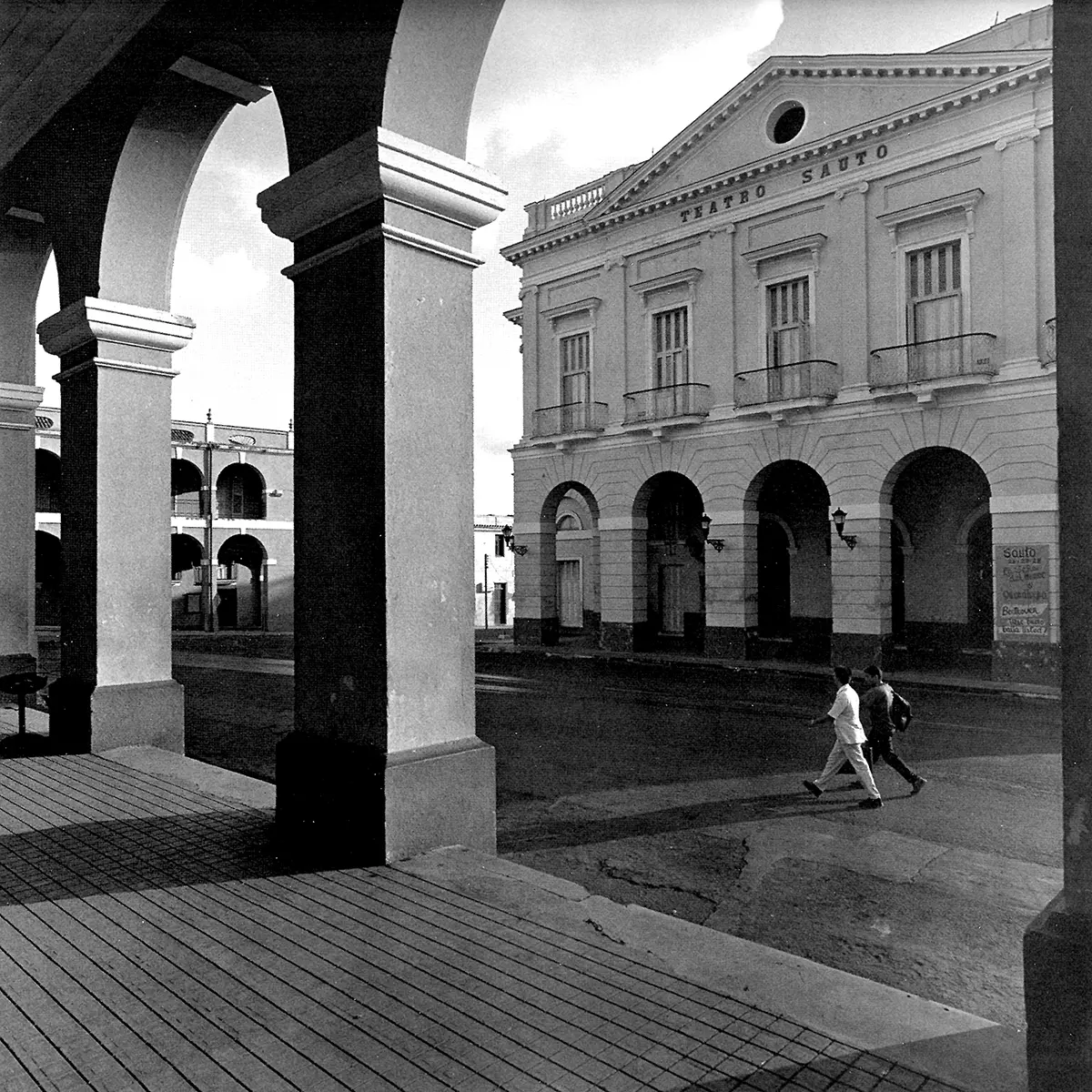
Another photo, Teatro Sauto, taken in the city of Matanzas, sometimes called the “Athens of Cuba,” is a visual narrative that spans time and space depicting a range of concepts from ancient Pythagorean ideals to modern Borgesian labyrinths. Like many of Algaze’s photos, this image playfully juxtaposes the interior structure of the image with the external square format of Hasselblad’s viewfinder. At first glance, the photo appears to present a public square, flattened into a trapezoid by the photo process. But on closer inspection, the illusion dissolves into the realization that the profiled central image space is merely a street boxed in by three interrelated buildings. The allusion to classical idealism is extended further by the ironically backlit façade of the neo-classical theater that gives the image its title. Simultaneously hiding and revealing reality, the neo-classical inflections include a triangular pediment centered by a perfect circle that wryly echoes the square format of the photo image itself. Algaze’s play with space and allusions to space accentuates the irony of classicism’s continuity from the past to the present, whispering of its course from the Greco-Roman worlds through Cuban colonial Neo-classical architecture to the modern world where it subliminally reappears in the photographer’s square formatted images.
COLLETTE CHATTOPADHYAY