An exhibition in an apparently small format, but without the simplistic commercial concept given to that term in recent times. And with an open connotation of the decorative inasmuch as here, Vayda affirms the object in a strong manner; because throughout his career he advanced in the development of his aesthetic premises and located them as they are always in the margin between an architectural project and the concept of sculpture, as I pointed out some years ago, the visual idea of the sculptural model seemed more dominant than a strict conception of the sculptoric. And this dangerous border accompanied him for a long time. But here, that rationalism that sought an order devoid of telluric references already absent, defeated, distanced from all Romantic reminiscence, his visual search canceled or transformed into entertainment without background, the tactile and the sensorial have moved center stage in these explorations of the world, as in the case of Deacon’s Kiekol. Such tribulations that are also openings to new structural fields dictated by what I would call a new situation of sensibility, were illustrated among us by Carlos Rojas, and Carlos Echeverri; autonomous geometries.
But according to the objects presented in this exhibition, Vayda has ended up with a proposition where the visible traces of the process, the notion of a trial run characteristic of that rationalistic logic, have disappeared, and what is presented in this exhibition has the rotundity of that which, personally, is supposed to be a consolidated landmark, after a long search. And this is important because it goes beyond the uncertainty of tentativeness in order of installing itself now in the domain of affirmations, of convictions. Not in a doctrinaire way, but with the inner faith of those who incorporate, amidst the desolation and the historical irrationality we find ourselves once again living through, an object that adds a new notion of beauty to this desolate reality.
And all this without renouncing his aesthetic principles, the ethical objectives proposed and defended for more than two decades. I say this at a time when things “retro” are disguised with the remains of postmodern frivolity in order to cover, under supposedly good taste, their inability to go beyond certain exhausted modern aesthetics or to renovate certain modern traditions that continued to be a premise to follow inasmuch they surpassed cold rationalism and created a poetics: Gabo, Pevsner, Malevich, El Lissitzky, etc.
Vayda reserves for the notion of decoration the same ontological dimension Heidegger gives it in Art and Space, as Vattimo reminds us: “Decorative and circumstantial arts have their essence in the fact that they operate in a dual sense:” this kind of art “attracts the viewer’s attention and, on the other hand, refers the viewer beyond the work itself, to the vaster vital context that accompanies it.” In other words, with due humbleness, it goes beyond the concept of the “work of art” to install itself as that ornamental element added without trauma to an existence that requires renewed references and contents, and whit that humbleness surpasses already in the urban space the academic view of the sculptural work as a monument-fetish in order to try to be that element which, as Mondrian would say, does not impose itself through fallacious arguments, but secretly modifies our life as time passes. “What is lost with this foundation —Vattimo says— and bottom line of the ornament is the heuristic, critical function of the distinction between decoration as adornment and what is proper to the thing itself and the "work.”
Philippe Stark has broken with this view of genres but has done so from the persistence of that which obstinately drags itself from the past: the touch of distinction of the new cosmopolitan elites. And that aesthetic, inasmuch as it is an exclusivist one, closes itself and ends up exhausted, while here the object that has moved beyond the geometric installs itself as that which is light, which is pure form, which is surface and volume as a reference to a gaze already liberated from the “artistic,” from the deformation of the current taste.
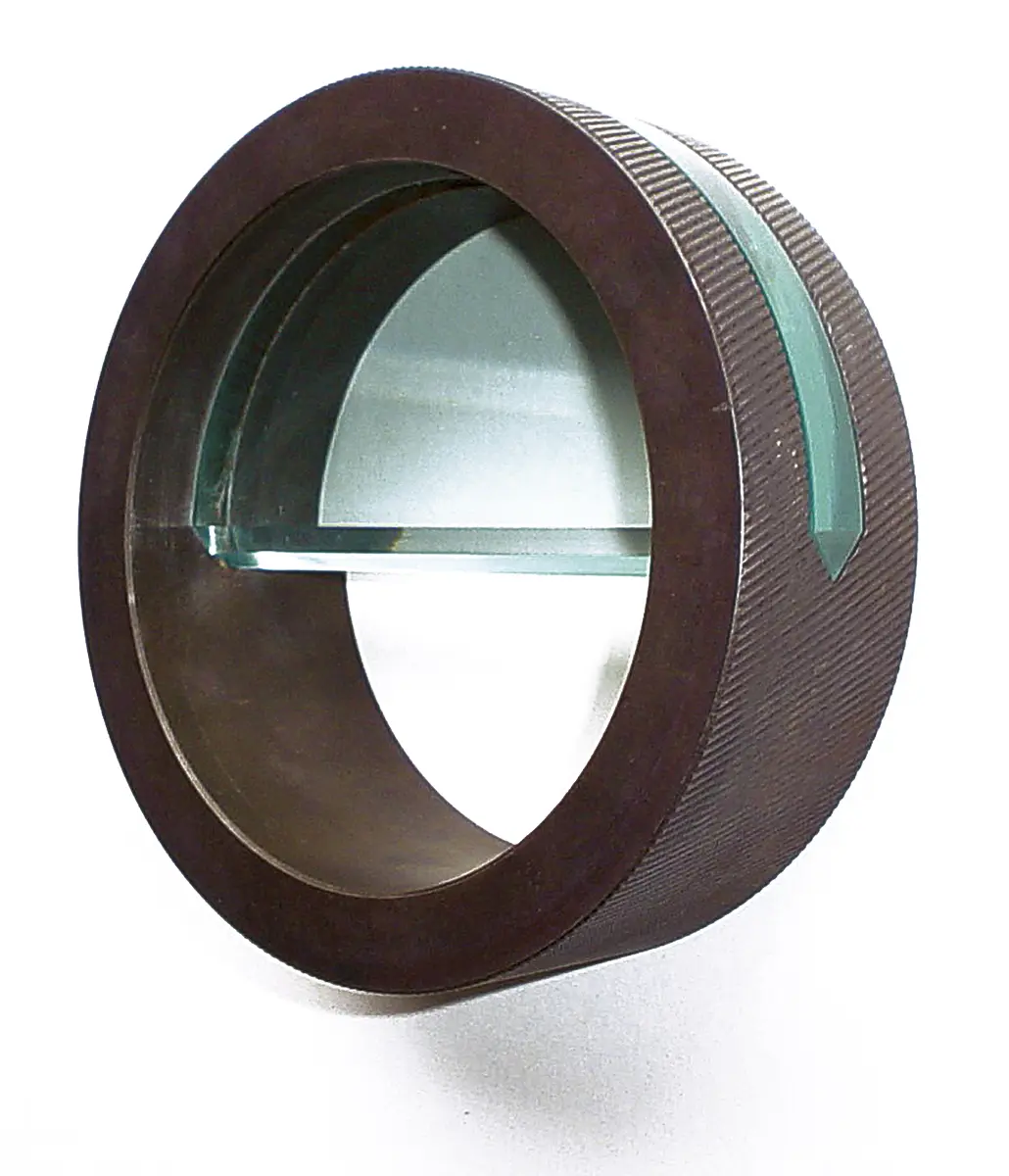
Sovereignty of a different form? Let’s think of what Worringer calls the West's “abstract form,” reason as harmony, as euphony, as beauty idealized to the point of becoming a paradigm and which in fact becomes canonical in the Renaissance, a form that modern rationalism attempts to de-idealize in order to locate it in a tangible, fragile, fungible reality when already its connotations were lost and it was necessary to create new connotation for what is harmonic, what is beautiful.
After each Vayda show, I think it is implicit in his idea that secret proposition around form and around what the affirmation of the object through the reach of a different aesthetic of the beautiful implies in these times of fully neo-liberal economics. And in this process, as he has clearly demonstrated in his urban sculptures, what he has sought to do is not to impose a dogma —a historical error of the old modern rationalism— colonizing the context, making rational what is accidental, mutational, but incorporating into the urban disorder, into the secret flux of natural changes and modifications, the inclusion of an object that is integrated, but through a dramatic contrast. And already in the order of the new everyday life and its characteristic specialization —dead as it is the old house with its connotations of power— these objects highlight splendidly the affirmation of a life where reason and poetry are no longer rhetorical proclamations in occasional manifestos and instead are what they are as expressions of a durable and non-fungible system of objects.
DARÍO RUIZ