
One virtue of contemporary thinking is the fact that it approaches old problems by formulating new questions. With regard to the Luis Caballero Awards exhibitions, I will attempt to skirt the question of what Art is and will focus instead on the relationships it establishes, and I will do this because the subject matter of today’s art is too varied. Artists’ interests in social issues, as Hal Foster has pointed out, have turned the form into something as varied as life itself. However, and in spite of celebrating that openness, from a viewer’s perspective, I would like to highlight the fact that with too many levels of information, one loses interest and, to a degree, faith.
This was evident in the exhibitions that resulted from the third edition of the Luis Caballero Awards. As a whole, they were so thematically complex, and some of them were so uncertain, that the viewer’s perception, one of the most important elements of art, ended up dispersed in a vacuum. It seems to me that we have a right to believe in something while we view an exhibition. If this is asking too much, as viewers we at least have the need to retain one image without having our ideas volatilize.
To quote one example, the artist of one of the exhibitions thought it necessary to bring fireflies into the gallery. In the seasonal cold of Bogotá, these temperate-climate insects did not survive even opening night. The question is: what are some artists thinking? We could bring many thinkers into the fray, but let us just remember Gregory Bateson, who, as a biologist and anthropologist, encouraged almost all disciplines to consider artistic thinking. He defined it as the ability to realize the dance of patterns that connect seemingly disparate universes. Art is for him a kind of hope because it allows us to note the subtlest correspondences between organisms and their habitats. The matter of the fireflies, then, was like losing one’s faith.
Before analyzing the exhibitions in this third edition, we must recall that the Luis Caballero Award was created to promote Colombian artists 35 years of age or older. Through an open call sponsored by the Bogotá District Culture and Tourism Institute, interested artists were asked to present a project, whereupon a selecting jury chose ten entries. In this case, they selected eight out of thirty-five proposals. The local jurors in this phase of the process were Carmen María Jaramillo and Miguel González; the international juror was Gerardo Mosquera. Each one of the selected artists exhibited his or her project for a month at the Santa Fe gallery in Bogotá, at the end of which time a three-juror panel awarded a single prize. On this occasion, the members of the panel were Miguel Ángel Rojas, Carmen María Jaramillo, and Ana María Lozano.
Determined as I am to recover my faith, the Luis Caballero Award still seems to me a salutary event. Despite the level of some of the exhibitions, participating artists made an effort to alter a space that is elliptical and difficult. They also had an opportunity to experiment with and develop their ideas outside the tyranny of the marketplace and of commercial galleries. And more important: in every edition, the public has been able to attend truly memorable exhibitions that would be a pleasure to see again, for example, Víctor Laignelet’s risk-taking installation, a metaphysical reflection on the labyrinths of the brain, which won the prize in the event’s first edition. And Luis Roldán’s more than thirty-meter-long canvas, winner of the second edition, whose presence in the exhibition space was almost as challenging as the Colombian landscape itself.
It is also fair to recall some of the exhibitions seen in previous editions that, although denied the award, were able to materialize important ideas with fluidity. The list is diverse. We could mention Rodrigo Facundo’s enchanting vision-sharpening devices, used to invoke collective memory. Or Álvaro Barrios’s exhibition of a coal-and-fire marble podium, a whole kitsch ceremony in memory of his friends who died of AIDS. Rony Vayda built a metal ring whose curvature adapted to the walls like one of the rings of Saturn. María Teresa Hincapié allowed a dog to walk at random through an entirely white space, while one of her neighbors sang in an unexpected and affectionate intervention. We also saw gardens appear slowly, as light transformed the sheets of sensitized photographic paper that Jorge Ortiz used to cover the gallery’s walls and floors. José Alejandro Restrepo’s reflections on the destruction and adoration of images, and Beltrán Obregón’s paintings that widened of our visual sensitivity were also important. The same goes for the relationship between ritual and violence explored by Clemencia Echeverri, and Wilson Díaz’s rumors and hidden narratives —a different way of telling the official story.
In this third edition, if we consider art as a way of establishing relationships between worlds, we must start with the two most acute shows: María Elvira Escallón’s Nuevas Floras (New Floras), this year’s winner, and Jaime Ávila’s Diez metros cúbicos (Ten Cubic Meters). Despite being very different exhibitions, both explored the way in which culture marks landscape, in Jaime Ávila’s case, the city; in María Elvira Escallón’s case, a forest in Bogotá’s savanna.
We should remember that nineteenth-century geographers were the first to define landscape as the relationship between culture and space. Beginning in 1990, Paul Claval brought this concept to the center of cultural geography studies once again. For contemporary geographers, the analysis of a particular landscape is a tool in the observation of techniques and sciences, as well as of religious, social, and political manifestations. These two shows benefited from that concept, even if they did not make it explicit, because “landscape” is a highly efficient plastic tool. In the first place it allows us to choose a space and to frame it, and in the second it allows the conceptual relationships between things to become tangible, which, in these cases were the contradictions of an imposed and segregationist social system.
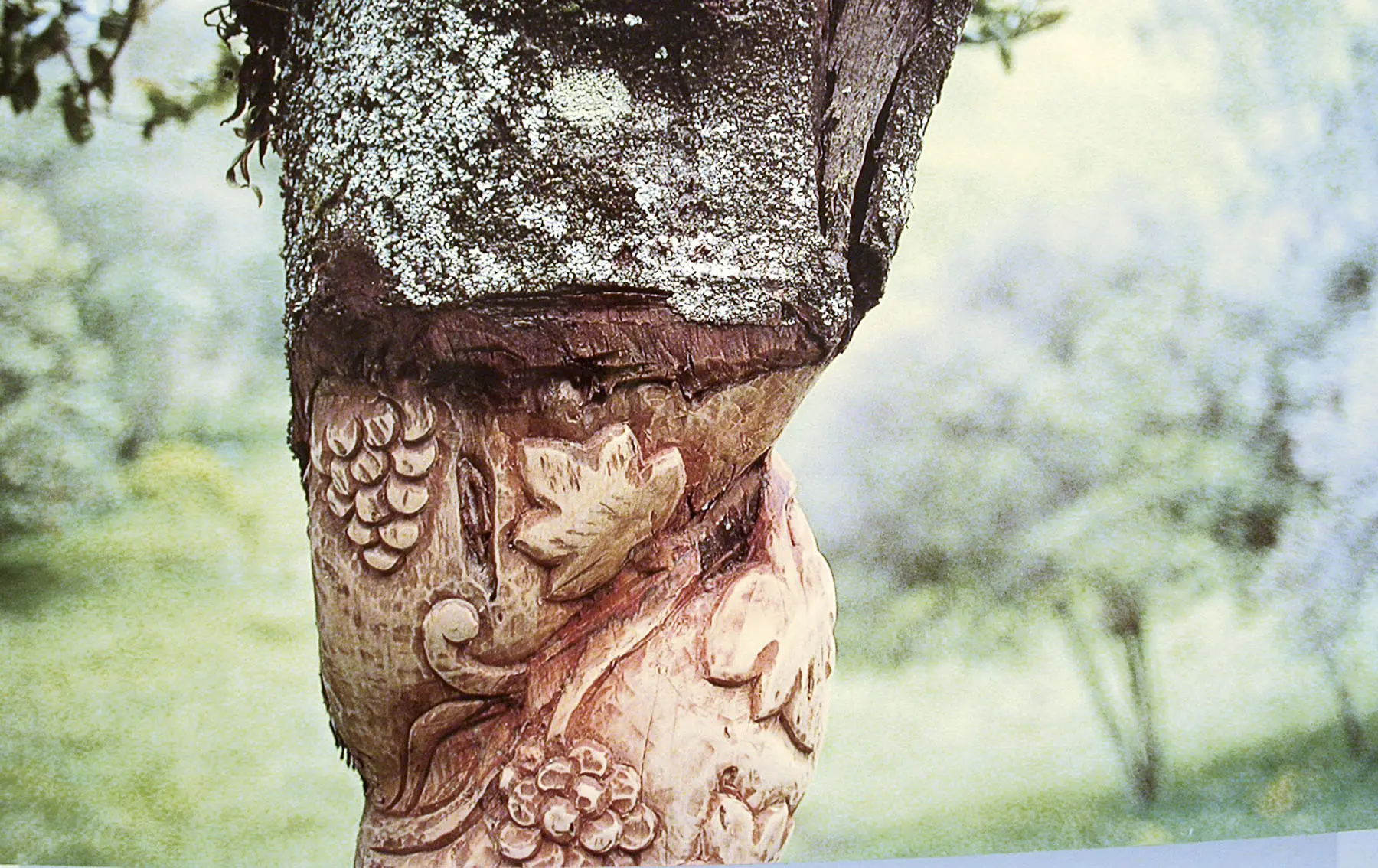
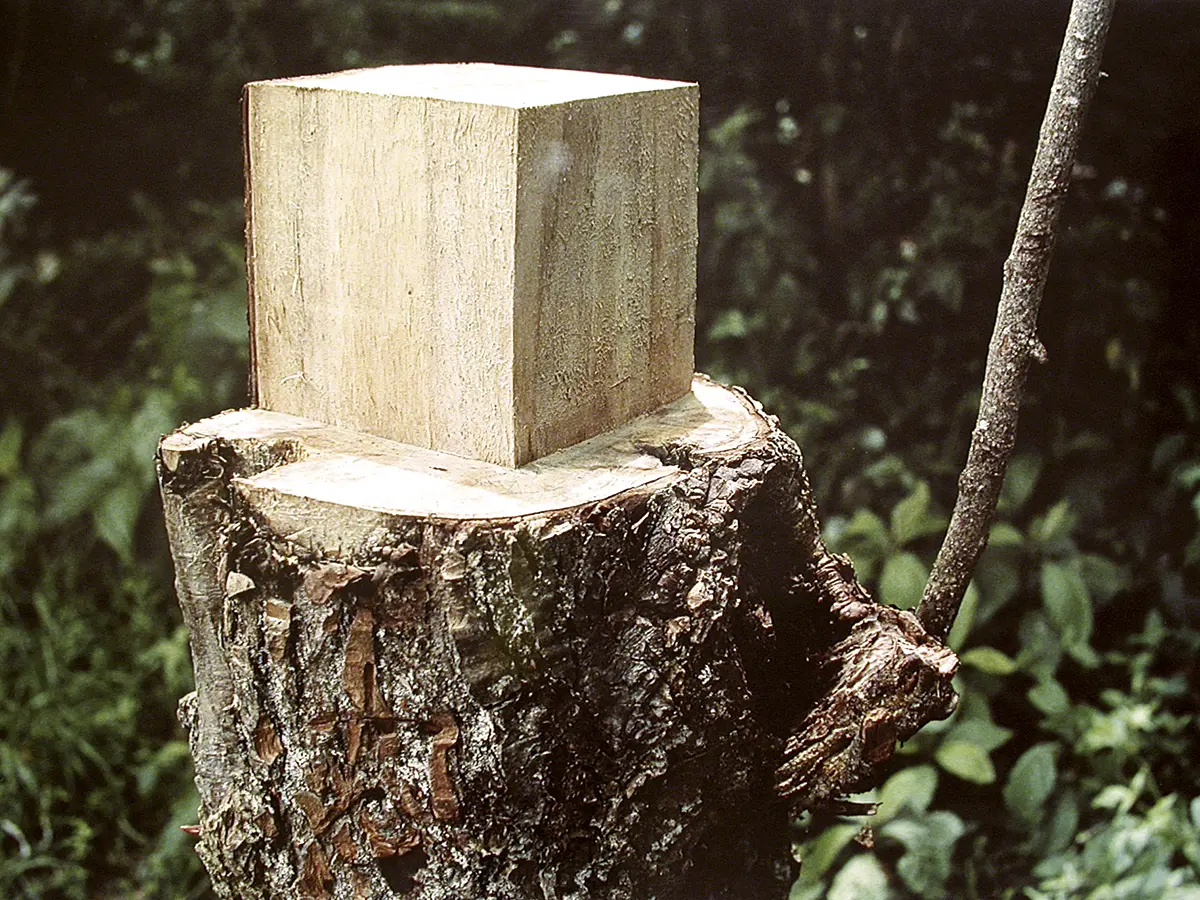
Nuevas Floras comprised large-format photographs of a native forest in Sopó, a municipality near Bogotá. These forests are framed by myrtles, prickly pears, and encenillo trees that have been carved with signs. Since they are rather slim trees, the weight of an imposed cultural mandate was clearly felt. Thus, the trunk of one myrtle was a column covered with colonial decorations; some of its branches became the legs of chairs in the “French classical” style imposed by “good taste,” or had been trimmed into a perfect cube. Today, these trees have blossomed again, because Nature transcends such a rigid trimming. What is important in this proposal is the fact that it creates strong images that the viewer was able to retain, and which trigger all kinds of associations about history and about persisting cultural impositions.
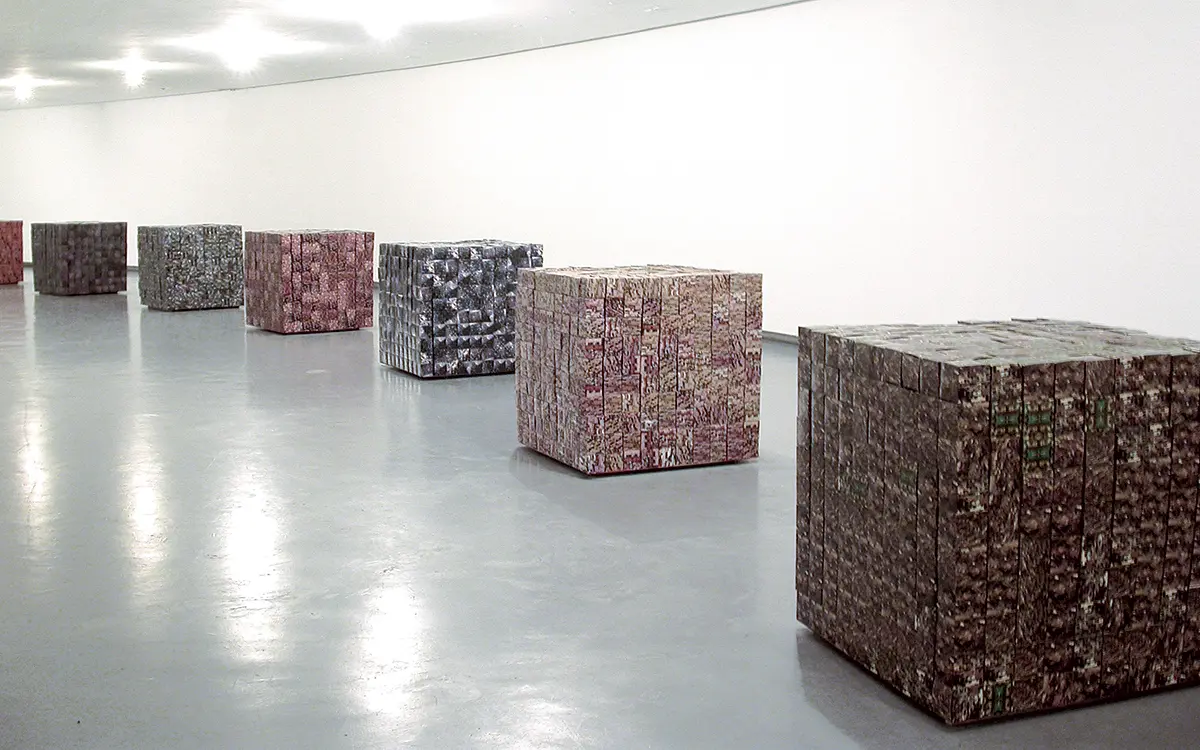
In regard to the artistic map, Jaime Ávila focused on the congested Latin American city, which the viewer could see from both inside and outside: from outside, through photographs of neglected neighborhoods whose texture reflects the superposition of materials and values. With the photographs, he built 10 x 10 cm cubes that could be piled up, like those marginal areas, of interest to nobody. In this exhibition, Diez metros cúbicos (Ten Cubic meters), the artist created ten larger cubes —each 1 m square— with the small ones. Since exhibiting is also a way of establishing relationships, these cubes, seen under a grayish light caused an impression of abandonment. The society also creates a menacing urban landscape that is kept in the shadows, and the exhibition framed it well.
Jaime Ávila doesn’t limit himself to showing the city from the outside, in the way of bad contemporary ethnography. On the contrary, he develops an interest in the imagination of its inhabitants and shares it. A number of years ago his work began to incorporate adolescents, whom he termed “radioactive,” from Ciudad Bolívar. On this occasion, we saw pictures of these “throwaways” presented as monumental urban survivors. They set themselves on a stage in order to exist. The artist understands that a neatly contemplative attitude is not enough, and through precise narratives drives the viewer to think of Latin America as a Fourth World.
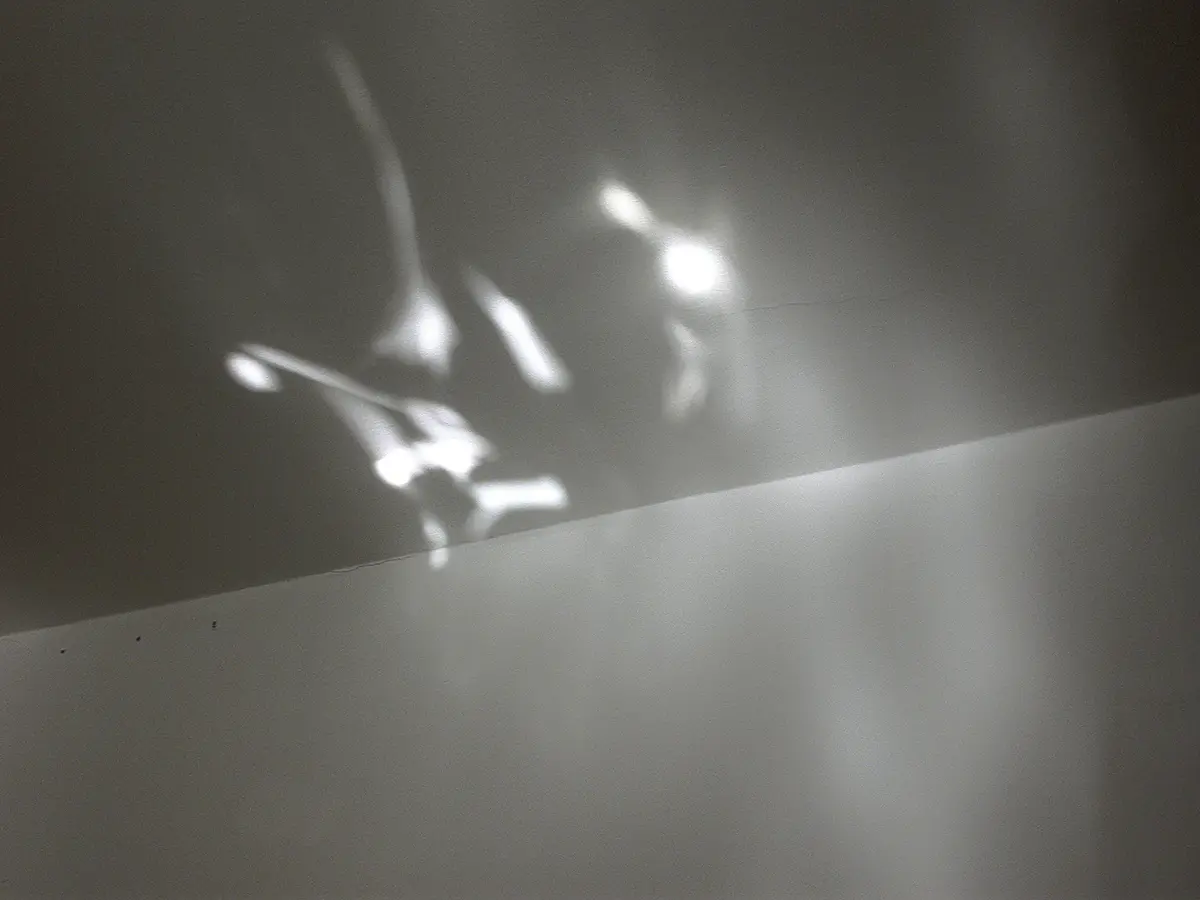
This methodology of the landscape, I maintain, is key, and contrary to other shows that were based on ideas that the artist attempted to make concrete in the gallery, but which resulted in a mere addition of objects and images to the space. That was the case with Todo lo que parece ser (Everything that Seems to Be), by Ana Patricia Palacios. It had the additional problem of posing a closed question that had only one answer: are the twins identical? Yes. Why not ask about the difference? In science programs on television nowadays we are shown faces in close-up in order to show how an almost imperceptible emotion makes a difference in human faces that appear identical. In Carlos Uribe’s Murmullos (Whispers), something similar occurs. Displacing a landscape is not the same as framing it; in such a way, Medellín communities are subjected to violence. Amidst the city’s welcoming climate with its fireflies, what are most important dies. We must again invoke Bateson: What pattern connects the crab with the lobster and the orchid with the narcissus, and the four of them with me? And me with you? And the six of us with the amoeba in one direction, and with a schizophrenic in the other? The landscape is not a matter of things but of imperceptible relationships. The conclusion to be drawn from these three versions is that space continues to be an implacable judge, and if ideas are not concretized beforehand, any intervention in space will be rather weak.
Danilo Dueñas’s exhibition had all the elements this intelligent artist has always used. He imagines his art “outside” of conventional idealizing categories. Local, then was an installation linked to the specific gallery site. A space in the center of the gallery held, among other things, models built by first-year architecture students that represented paradigmatic buildings: cathedrals by Borromini, for instance. In this space as well as in university classrooms these architectural “exercises” produce amazement. They are beautiful. The remaining space was the gallery, undecorated, with its dirt, its half-painted walls, and its crumbling beams. I felt that such nothingness, such deterioration, was all there was to it, and that was, it seemed to me, too open a position. I need art to believe in something before I can, in turn, believe in art.
There are three more exhibitions I need to review. Víctor Robledo’s Naturally comprised photographs of what has been called “the remainders.” Moss, cobwebs, and fallen leaves accumulated on the floor. A self-referential exhibition, correct and pretty. But I would like to focus, before we end, on the other two, which although they did not possess the solidity of Jaime Ávila’s piece, or María Elvira Escallón’s, they dealt with highly interesting issues, which one hopes will be further developed in the future. We must indeed read Georges Bataille and Paul Virilio with the same enthusiasm as these two exhibitions. I’m referring to Elías Heim’s and Juan Fernando Herrán’s.
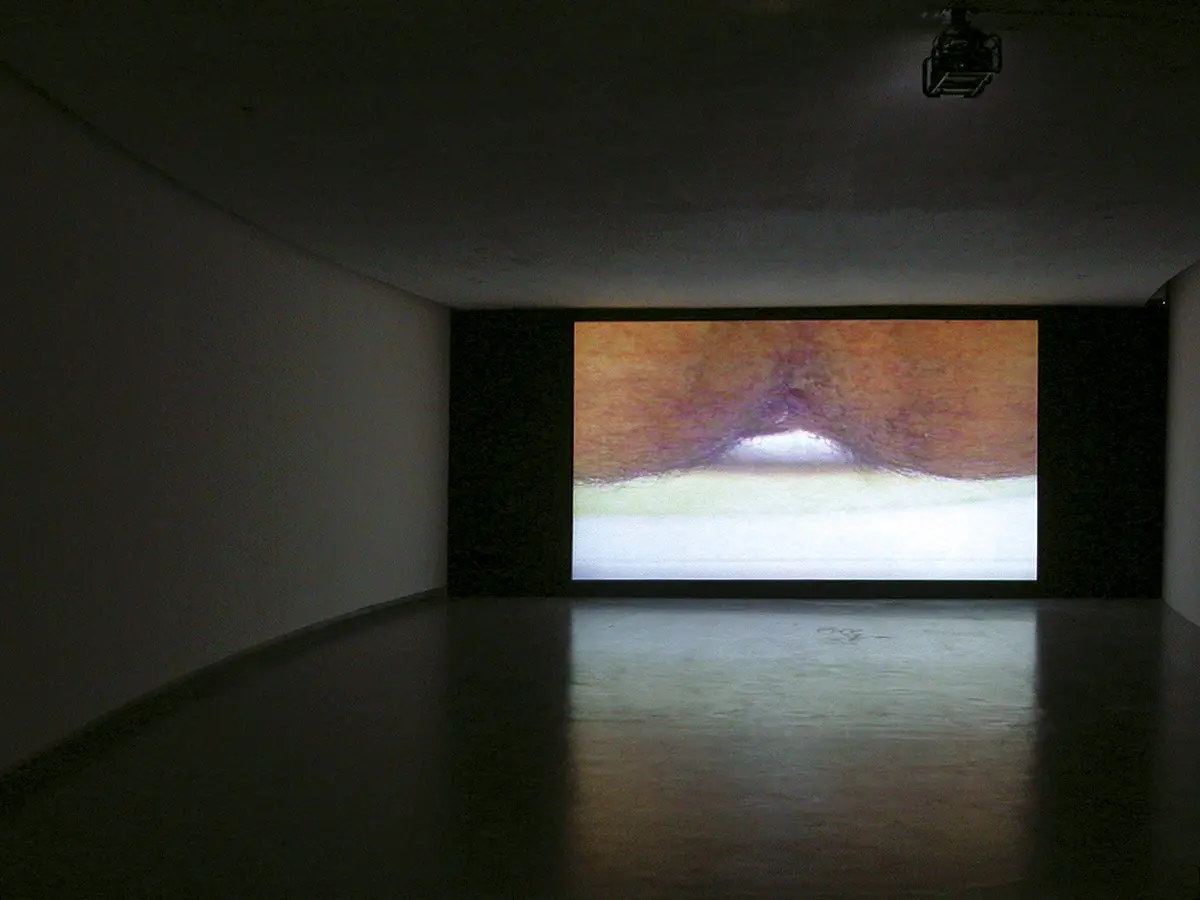
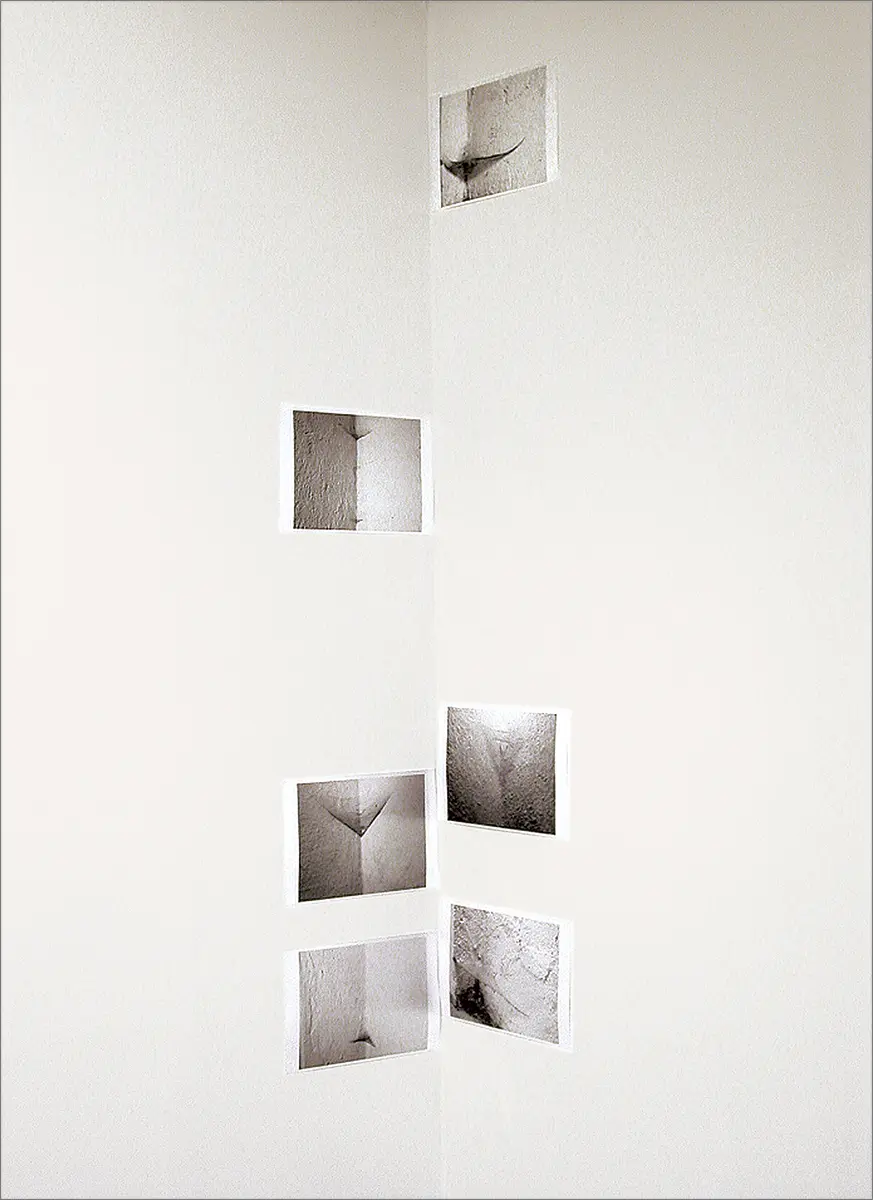
Elías Heim’s La proeza del Avaro (The Brave Action of the Avaricious) was the image of an anus, expelling and retaining, with great pleasure, its excrement. It was an anus that turns into a mouth if it decides not to accept the culture’s moral imperatives. In the catalog, Elías Heim gave some guidelines for understanding his objectives, and I believe the most pertinent is his quotation of Rosalind Krauss. In her Theory of Displacements, she points out that Bataille combines the mouth and anus in order to reorient the structure of the human body from a limited structure to a more open one because the organs are slaves to the power of a cultural system. Another series of connections could be read, for instance, with retention as a symptom, or with the canard of avariciousness in reference to the Jewish people. But in my view that image of an anus/mouth was a prompt to read Bataille, which is necessary since we tend to think that subversion and violence are equivalent to images in the mass media. On the contrary, it is art that has the power to find such correspondences. Perhaps Bataille’s erotic revolution is more subversive than others since it questioned the same nineteenth-century morality and propriety that is still current in Colombia.
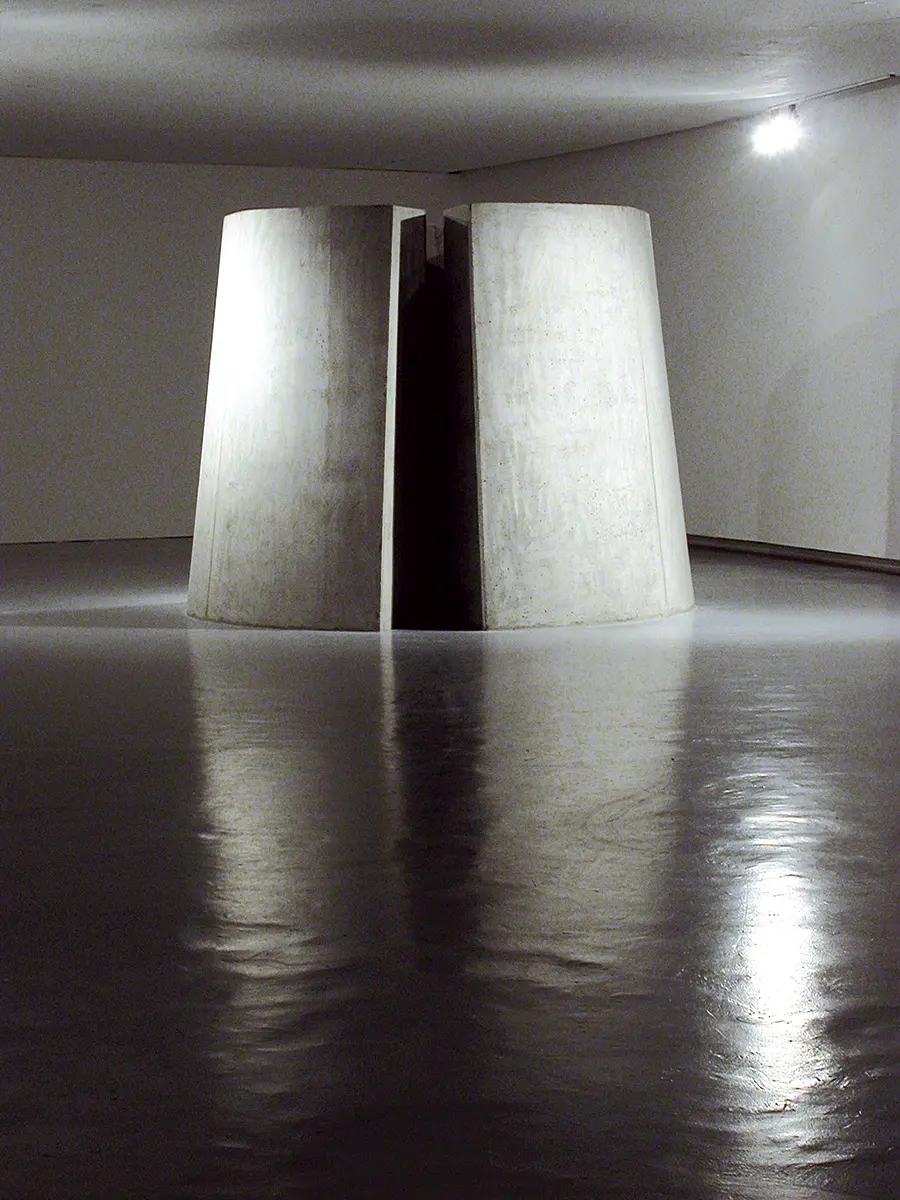
Juan Fernando Herrán’s Emplazamientos (Placements), worked on military buildings, army barracks, and bases that appear, menacingly, on the landscape. The most interesting aspect of the exhibition was its theme, which is very pertinent, and the course of his thinking about it, as reflected in the catalog. Photographs, texts from Paul Virilio’s Bunker Archaeology, old maps, sketches, and drawings showed how the sculpture was born of these sinister architectures. I enjoyed the paths followed by Juan Fernando Herrán’s thoughts that opened worlds with which I was not familiar. Because of this, I missed them on the gallery walls. The show comprised two cement sculptures inspired by an architecture of power, but, which in truth, were harmless. Does a question lurk inside this project: sculpture with a form that says it all? Or complex sociological narrative? Time will tell. For the time being, I missed his maps of wind and rivers, where narrative and image are interwoven organically.
NOTE
1. James Clifford, Itinerarios Transculturales. (Barcelona: Gedisa, 1999).
BIBLIOGRAPHY
Gregory Bateson, Espíritu y naturaleza. (Buenos Aires: Amorrortu, 1997).
NATALIA GUTIÉRREZ
Professor at the Universidad Nacional, Colombia.