
The Real Royal Trip, a touring exhibition curated by Harald Szeemann, was recently on view at P.S.1 and is continuing on to the Museo Patio Herreriano in Valladolid, Spain. The show features the work of twenty artists and one artist collective from Spain and Latin America held together by a questionable premise: Columbus’s fourth voyage to the Americas (1502-1504). Inaugurated five hundred years later on October 12, Columbus Day, the exhibition celebrates the “transcultural exchange” that resulted from the navigator’s journeys. This dialogue is presented somewhat unevenly, however, for only three of the artists in the show are from Latin America: Tania Bruguera, Priscilla Monge, and Ernesto Neto. Rather, what this exhibition in essence champions is the underappreciated but vibrant contemporary art scene in Spain. The Real Royal Trip and its accompanying catalog are sponsored by the Spanish Ministry of Foreign Affairs, regional Spanish governments, and Spanish businesses, and thirteen of the artists have never before shown their work in the United States. Why then would the exhibition need to be framed around the controversial figure of Columbus, whose legacy caused the suffering and death of millions of indigenous people and who, until the end of his life, failed to realize that what he had reached was not Asia, but rather a continent unknown to the rest of the world? And why focus on his fourth voyage, in particular, except to commemorate another quincentennial that celebrates Spain? Unsurprisingly, the works of art for the most part do not cohere in the service of the show’s puzzling theme, nor do they participate in a profound dialogue with each other. On their own, however, many of them do stand out for their conceptual and formal qualities.
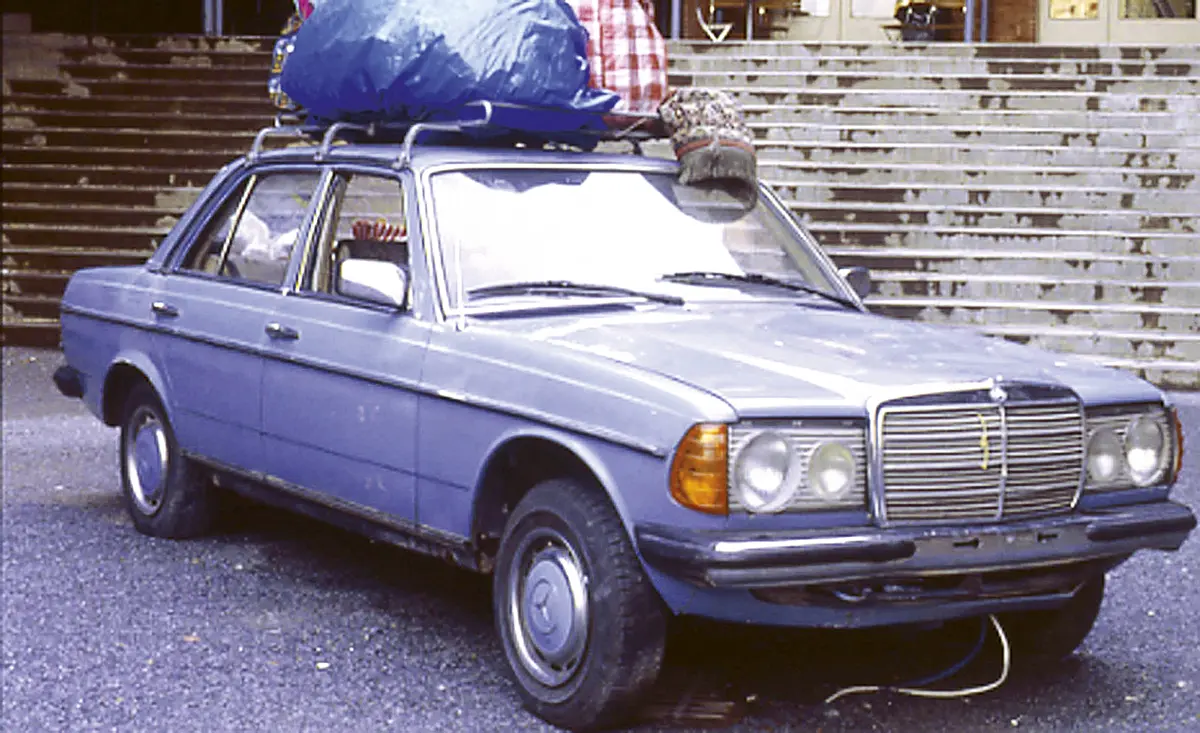
Pilar Albarracín’s The Trip: Habibi greeted the visitor in P.S.1’s courtyard. This memorable piece consists of a beat-up blue Mercedes laden with colorful suitcases intended to evoke the travels of North African immigrants across Europe. Spectators were invited to climb in the car, which would begin to vibrate wildly, simulating a bumpy journey through time and space. The artist also presented video art. In Singing Prohibited, a flamenco singer’s cries grow increasingly louder and out of control. Another video features a belly dancer whose waist is encircled with chains, locks, and coins. In these and other works, Albarracín, a native of Andalusia, challenges stereotypes dealing with gender and identity.
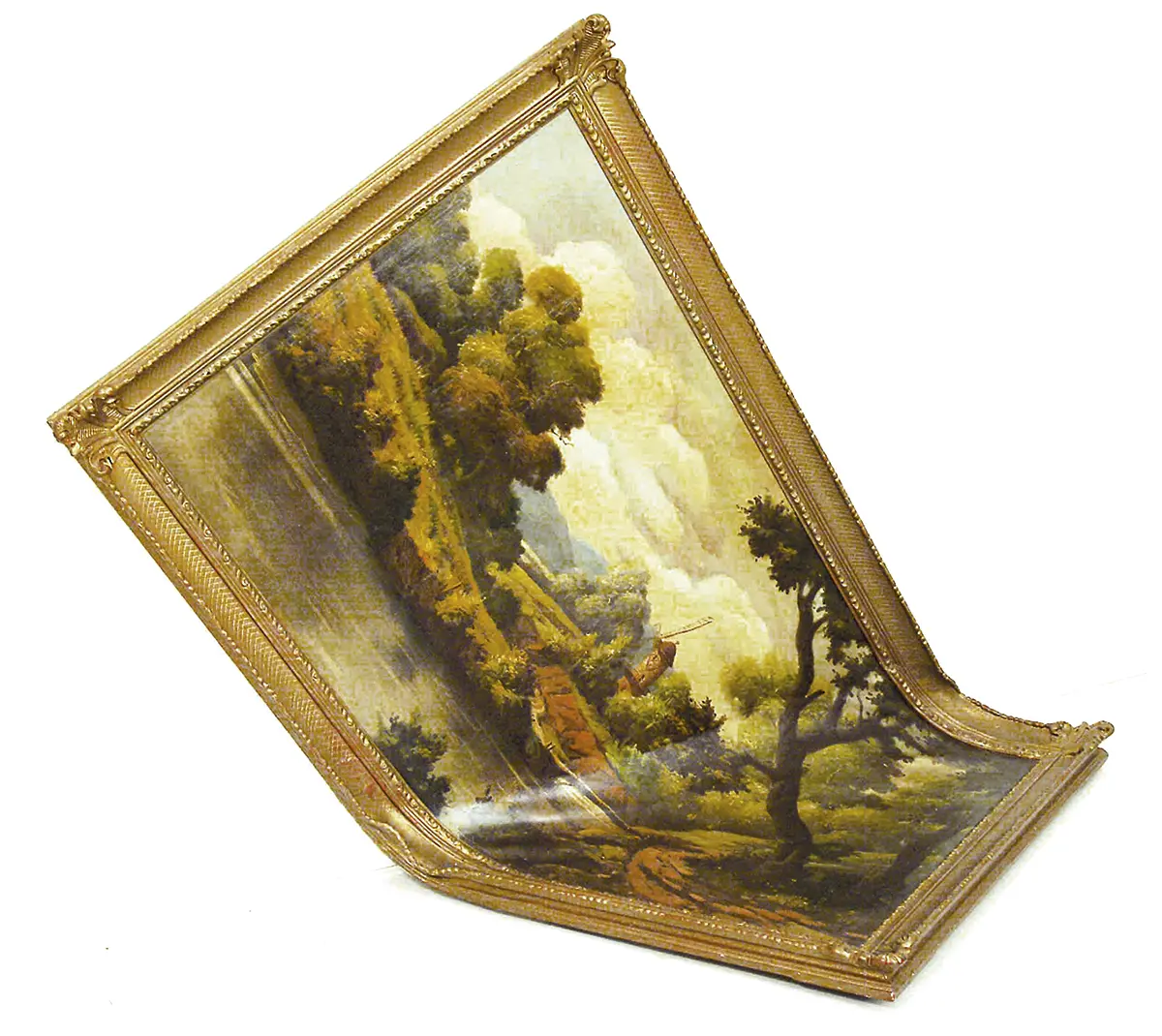
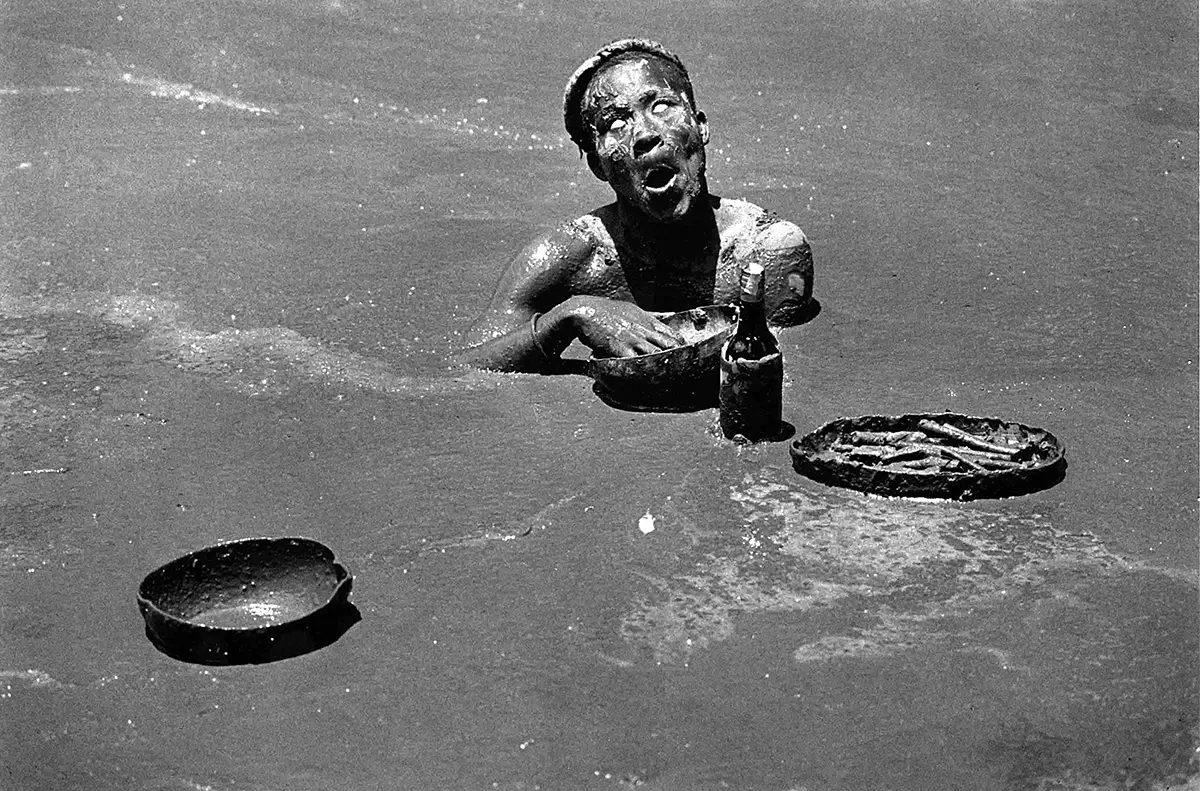
The black and white photographs of Cristina García Rodero also evoke stereotypes about exoticism and national identity. She presents powerful works from two series dealing with religious fervor, Hidden Spain and Rituals in Haiti, which were juxtaposed in the show’s installation. Seen on their own, the Haiti images appear as voyeuristic forays into enigmatic voodoo traditions. In one, a man covered in mud is shown in the process of decapitating a goat, while in others, people participate in communal trances. These images gain another dimension when seen in conjunction with the Spain series. Here, García Rodero captures religious processions and other aspects of the Catholic faith that recall medieval piety. Together, the two series demonstrate the mysteries of faith and cut through the dividing line between the self and the other.
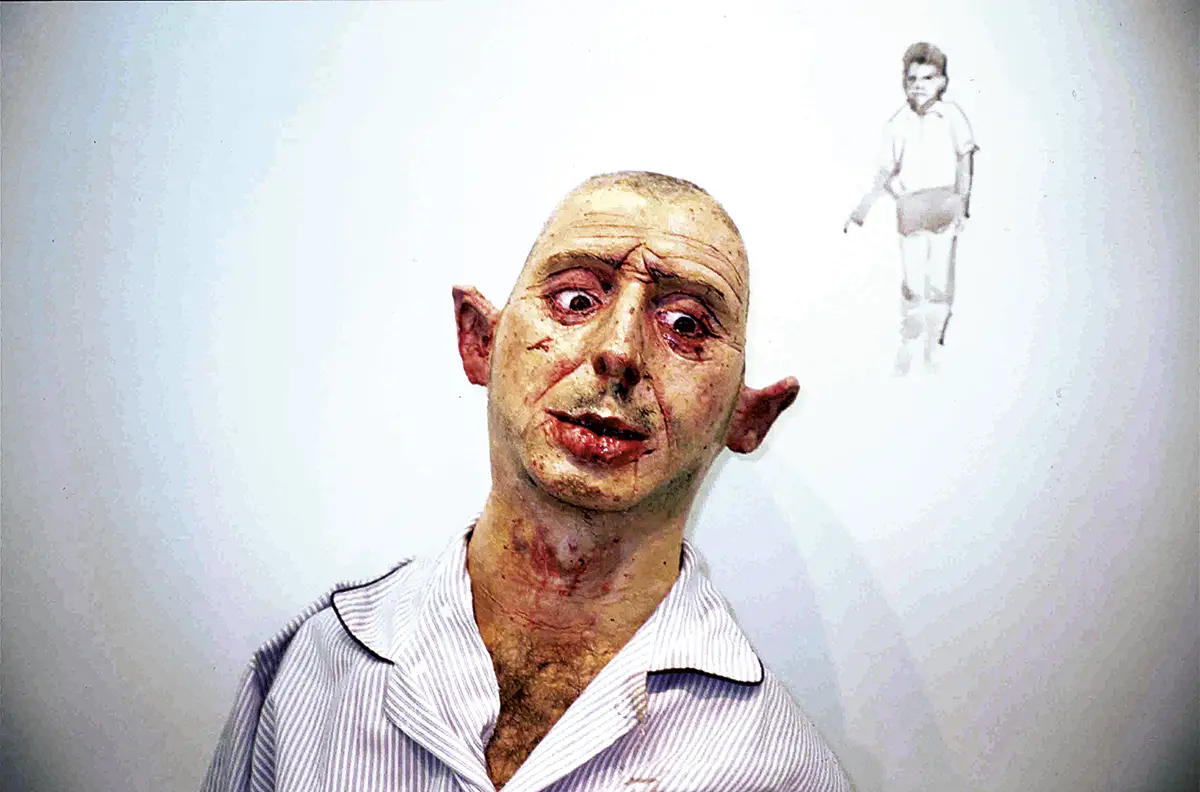
Works by Carmela García and Enrique Marty explore themes of alienation. García presents large-scale photographs mainly from her Ophelia series. These images, based on a character from Shakespeare’s Hamlet, depict a lone woman posed against a lake. In one, the subject sits on a rock in the middle of the water, staring off into the distance with no possibility of escape. In another particularly haunting image, the woman is completely submerged in the lake and stares up at the spectator. The ripples of the water across her face and body have a flattening effect which gives the image an other-worldly quality and recalls the brushstroke of Impressionism. The lyrical beauty of García’s images gives way to harshness in the work of Marty. His site-specific watercolors on the walls of the museum’s cafeteria depicted lone, at times freakish figures. Marty’s most memorable contribution to the exhibition was the sculpture The Madman, installed in the museum’s boiler room. In this dark, industrial space, the visitor would confront the lifelike image of a crouching man, with overgrown toenails, deformed ears and feet, and mouth splattered with blood. The shocking experience exposed the voyeurism inherent in spectatorship.
The work of Nestor Torrens and Ana Laura Alaez exploited voyeurism and its connection to sexuality. Torrens presented his Seductions videos in two separate rooms. One was furnished to appear as an upper-class space, with a chaise longue, plasma television, and stacks of books. On the screen, the video is edited so that a newscaster repeats the same phrase and motion, blinking her eyes over and over again. The repetition of sounds and images creates an orgasmic effect out of a seemingly mundane news program. In the second room, decorated with two cheap sofas of flowers and plaid and other tasteless furnishings, four televisions are set up which alternate between showing CNN and pornography. In these humorous works, Torrens reveals the undercurrent of seduction inherent in mass media. Alaez uses her own body to work through issues of sexuality and gender in the series Shiva. Here, she poses nude atop a circular mirror surrounded with large-scale lipsticks, phallic in form. Together, the lipsticks and mirror could be interpreted as a surrogate for the artist’s palette. This is supported by the way in which Alaez herself exerts autonomy over the image. She stares at a hand mirror, which she reflects towards the viewer, and in so doing, recalls Velázquez’s Rokeby Venus, a nude who looks at herself in a mirror but does not allow the spectator access to her reflection. In her role as an artist and subject, Alaez inverts traditional gender roles.
Mateo Maté also uses himself as a subject in his installation Disoriented. This work consists of a room with a mattress in the shape of North America and a projection of a video on the wall in which the artist in miniature travels through a landscape of rumpled sheets. It is somewhat reminiscent of the scene in Pedro Almodóvar’s film Talk to Her, in which a miniature man wanders through the body of a woman also as if through a landscape. Maté’s piece incites the viewer to meditate on travel in terms of an inner journey, rather than a physical dislocation.
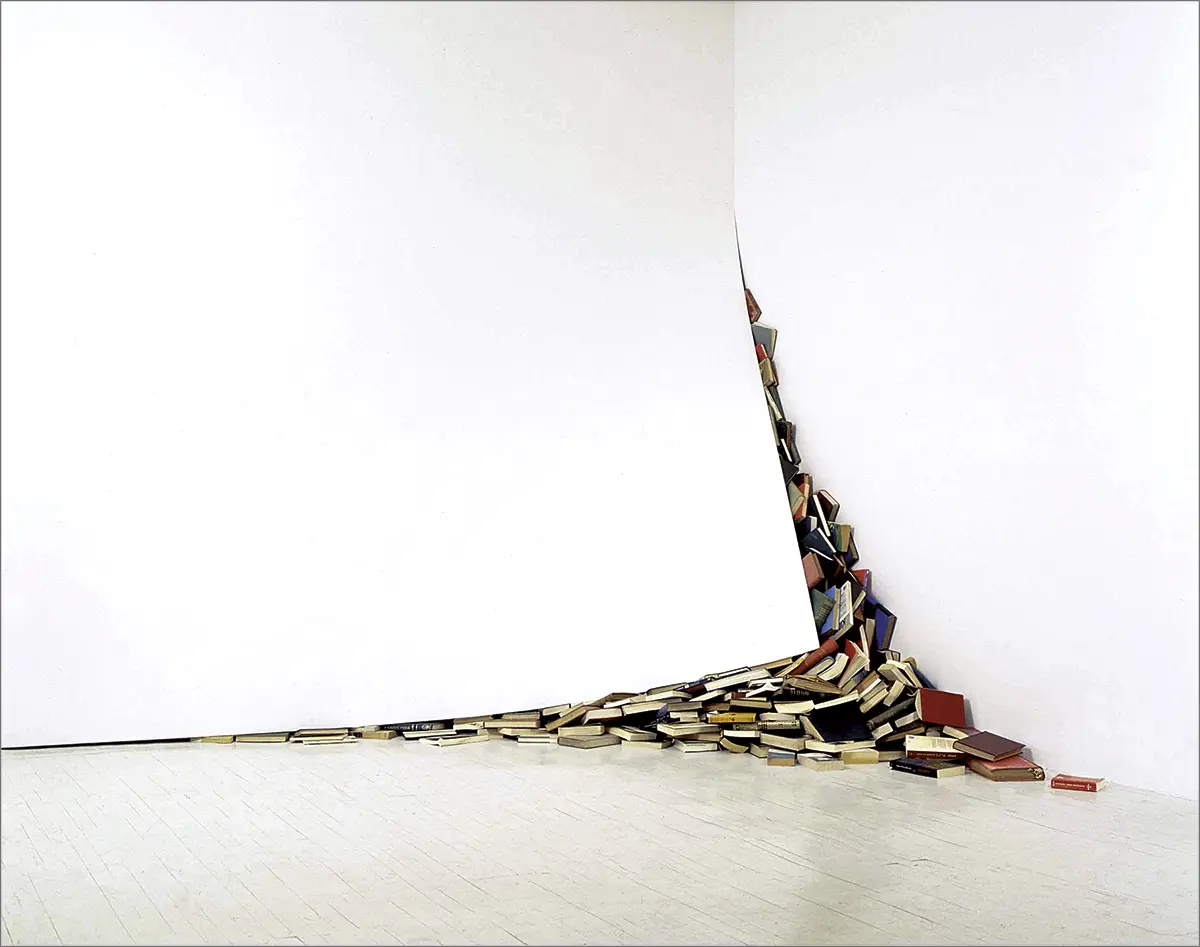
The work of Alicia Martin evokes mental journeys through other means. In the video Polyglots, books fly through the labyrinthine spaces of the museum, signaling the limitations of exhibitive frameworks as a means to transmit knowledge or to communicate history. Similarly, Contemporaries is an installation in which a pile of books literally breaks through the museum’s walls. Apart from its impressive physical presence, the work, in its juxtaposition of the clean white planes with worn books, makes a memorable visual impact.
Among the most conceptual work in the exhibition were the contributions of Antoni Abad and the artist collective El Perro, comprised of Ramón Mateos, Iván López, and Pablo España. Abad created a virtual project consisting of a fly that was disseminated both physically and virtually throughout New York City. The online project, Z, may be viewed at www.zexe.net, where the virtual parasite is available for download. Furthermore, P.S.1 distributed postcards with stickers of the fly, which visitors stuck throughout the museum. El Perro in collaboration with PSJM and Aitor Méndez presented the humorous installation Critical Situation, a futuristic employment office for artists which promised temporary work upon the completion of a questionnaire with such questions as “Have you ever found pleasure in taunting animals?” and “True or False: Sometimes I can’t sleep due to a headache.” With its modernist design and sardonic questionnaire, Critical Situation mocked the goal-oriented and career-driven nature of contemporary society. The installation also called attention to the plight of emerging artists as they struggle to support themselves while attempting to make it in the international art arena.
Santiago Sierra, a native of Madrid who lives and works in Mexico City, exposed social divisions and inequities in his black-and-white images documenting empty labor. He presented a selection of works in which he paid poor and marginalized people to do such things as wash the floors, have a line tattooed on their backs, dyes their hair blond, and remove and reinstall a bathroom sink. These disturbing images, executed in Europe and Latin America, underscore the plight of the needy, who, as Sierra demonstrates, will do anything for money.
Tania Bruguera presented one of the most powerful and overtly political works in the exhibition, the sound installation Autobiography. To experience it, the spectators were forced to walk through a long white hall divided by curtains. As they approached the end, the sounds of slogans from the Cuban Revolution grew increasingly louder. These had a disorienting effect, as cries and also whispers bombarded the spectator from all sides. The effects were at once hypnotic and disturbing. Fernando Sánchez Castillo also contributed political works, including Shining Path, a site-specific installation of eight bronze dogs hung around the museum’s courtyard as a reminder of the Peruvian terrorist group’s action of hanging dead dogs from lampposts.
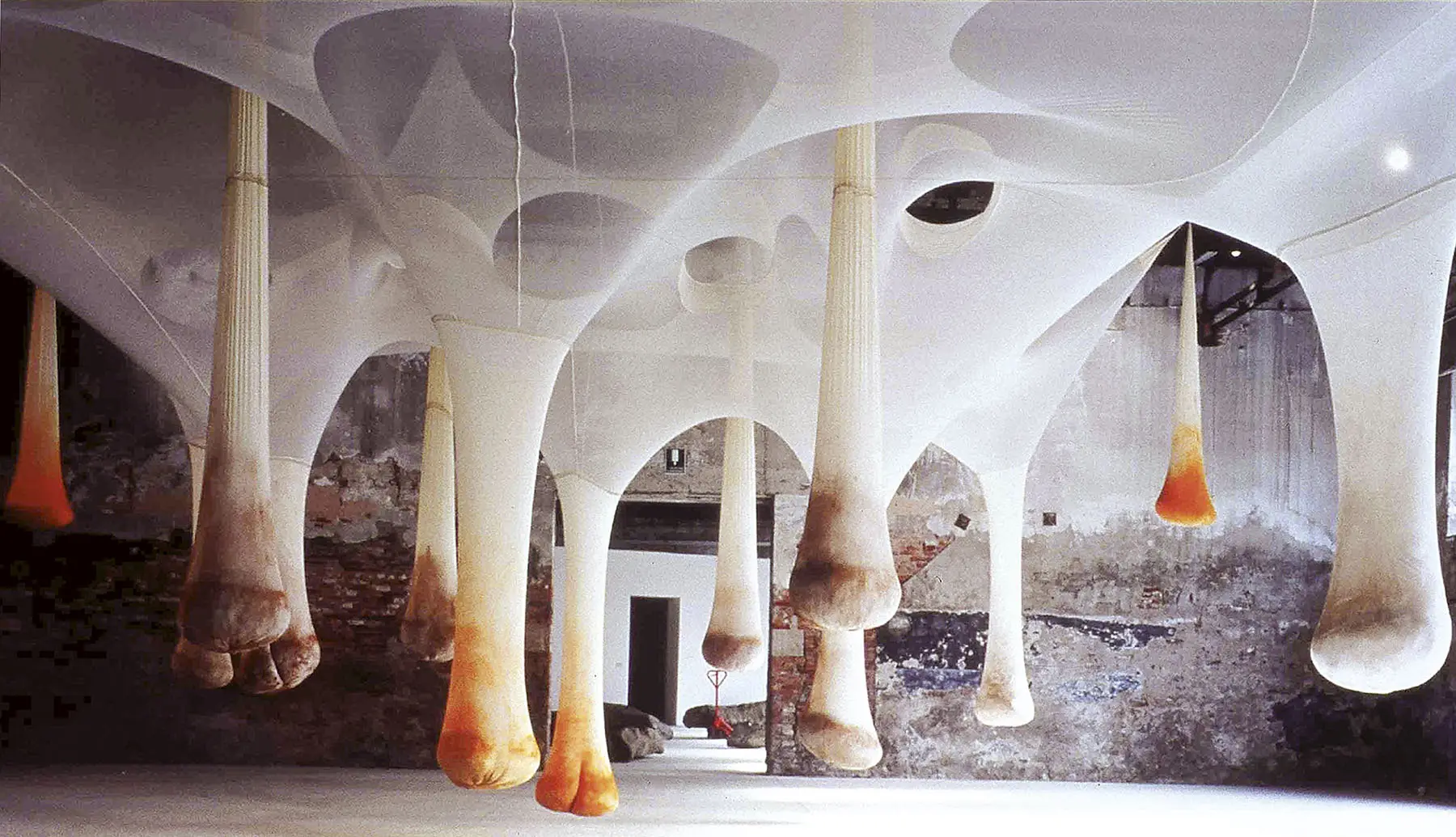
Finally, Ernesto Neto’s site-specific installation, … In the meanwhile, the baby is coming, I’m living, deserves mention. Hanging from the ceiling, the massive polymorphic sculpture resembling a pregnant belly inspired awe and reflection. Though on the surface it had little in common with the rest of the works in the exhibition, it served as an apt metaphor for the process of artistic creation itself.
TATIANA FLORES