The paintings that Ricardo Maffei shows to the public every once in a while immediately immerse us in a silent world, a world that forces us into a contemplative state.
Entirely unconcerned with the aesthetic postures that have emerged in the field of visual arts over the last twenty-five years, this Chilean artist, born in Santiago in 1953, has devoted himself to seeing, with infinite patience, the world that surrounds us and which we are absorbed. Maffei is a realist painter who works with realities he himself generates, undoubtedly, an uncommon choice these days. He has always been attracted by a mode of expression in which one reality generates another that is no less concrete: the reality of painting. The artist does not have a ready explanation for this tendency. It is simply a fact. “I was fascinated by realism from a young age, above all by some seventeenth-century Dutch painters, particularly Vermeer."1 Until his first trip to Europe, Maffei had to acquaint himself with Vermeer through reproductions, because there are no works by the Dutch master in Chile, nor had any exhibitions that included Vermeer been in the country.
Maffei’s vocation manifested itself early. In many of our conversations, Maffei recalled a painting class he took with Mario Toral at the Instituto Cultural de Providencia, when he was barely twelve. He was the sole minor among a group of older women who followed the direction of the prestigious teacher.
Ricardo Maffei began exhibiting his work more than twenty-five years ago in student shows. His technical mastery, however, was not acquired in academia. His university education at the Universidad de Chile’s Fine Arts department lasted one semester in 1974—a semester Maffei failed. The military regime at the time had a strong presence in the university, particularly in the humanities. Fine Arts schools did not escape the dictatorship’s repressive policies. The doors of academia were closed to Maffei under the pretext of his supposed lack of talent. The artist was not involved in political activities, but we need to remember that Van Gogh was disqualified from the Antwerp Academy for the same reason.
What could this young man do when, despite that failure, he insisted on becoming an artist? Fortunately, he could count on the support of his father. Ricardo is the sixth brother in a family of seven, children of Eugenio Maffei and María Luisa Reyes. A renowned architect and builder, the artist’s father sought his friend Miguel Venegas Cifuentes, an artist and architect whose drawing and painting workshop had a small group of students. Years before Venegas had taught Claudio Bravo. The young Maffei Reyes was accepted in a group that included, among others, Andrés Baldwin, Gustavo Ross, and Christian Abelli. He was to follow Venegas’s strict course for two years and it was during those long weekly sessions in front of a model that Maffei found the roots of his current work. Charcoal, pencil, and oil were the technical media he learned to use during that period. Today, most of his work is in pastels, a self-taught technique, but he has never left oil painting completely behind.
A specific memory that marked him deeply also emerges. In 1975 in one of its cultural magazines, Santiago’s daily El Mercurio published a then-recent work by Claudio Bravo, who had already achieved international recognition. El traje naranja —a motorcycle suit complete with helmet and gloves in homage to the absent athlete Antonio Cores— fascinated the young Maffei. Could realism refer to everyday current events? Could one be freed from painting models, religious, or historical themes, or landscapes as seen through academic eyes? We can assume that the reproduction of Bravo’s piece was not the best quality, but it was enough to fire up an artistic consciousness still in its formative period. To his admiration for the Dutch masters, Maffei now added an undifferentiated appreciation for his compatriot, Bravo.
Around the same time, the artist’s father made a trip to Europe. Pressed by his son, Eugenio Maffei contacted Claudio Bravo, who was living in Morocco, and visited him in his home/workshop in Tangier. Again his father’s support proved important for Ricardo Maffei. Eugenio helped convince Bravo to return to Chile, at least for a while, and the renowned artist settled in a house that belonged to the Matta Echaurren family, in the Zapallar sea resort area. Bravo kept his distance from a city that was suffering from cultural asphyxiation, but still sought out his old teacher and came to work with Miguel Venegas Cifuentes’s students for two weeks. That is how Ricardo Maffei came to meet Claudio Bravo.
Bravo returned to Tangier and, in 1978, Maffei traveled to Spain with Andrés Baldwin, and the two settled in Madrid. Maffei’s stay would last for ten years, with some interruptions. The young Chileans assiduously visited the collections at the Prado. As new artists, foreign and poor, they lived in difficult conditions but had the good fortune that the realist (or hyperrealist) school dominated in Spain at the time; in two or three months, Enrique Gómez Acebo’s Egam Gallery began selling their works.
Once he was in Spain, an opportunity for Maffei to visit Bravo in his Moroccan workshop developed. After a year of patient, insistent phone calls, the older artist accepted Maffei for a month as a visiting artist, fulfilling one of his fundamental aspirations. Maffei was accompanied by Gerardo Pita, from Spain; in Bravo’s workshop, located next to a Muslim cemetery, they went through rigorous eight-or nine-hour daily work sessions. Maffei’s stay with Bravo lasted for two and a half months, enough time to develop the friendship that continues to this day. After that initial visit, Maffei returned several times to work at the workshop.
After returning to Madrid, one of his older brothers invited Maffei to go visit another brother, who was living in Bali. Following this adventure, which lasted several months, the artist returned to Chile where he remained for two years. The country was still undergoing political and economic troubles. Maffei then met the man who would end up being his father-in-law, the father of artist Paula Lynch. He was an antique seller and offered Maffei a space to work. But after a while, the artist decided to go back to Spain. He lived for some months in El Escorial, a colony of Chilean and Argentinean exiles. He later moved to Marbella, a cosmopolitan city on the Mediterranean coast. His work faltered: Maffei devoted his time to making a series of portraits that he discounted as “light.” After three years, he decided to go back to Madrid. Over a period of several months, he prepared a one-person show that was finally presented at Egam in 1987. The following year he returned to Chile and settled in Santiago. His formative period had come to an end.
In 1991 Maffei presented his first one-person exhibition at Santiago’s Época Gallery. Cecilia McKay wrote the text for the catalog. In its very title, Del realismo melancólico y solitario de Ricardo Maffei (On Ricardo Maffei’s Melancholy and Lonely Realism) McKay points out the artist’s peculiar gesture. Maffei also participated in some group shows in Santiago.2 In his first solo presentation he exhibited oils made in 1988 and 1989, pastels from the same period, and two pencil drawings dated 1984: two desolate landscapes depicting Chile’s rough mountainous region. But the most constant theme of these large-format works (up to 1.50 x 110 m) is the female nude: standing, sitting on a chair putting up her hair, looking out a window, and leaning on an antique bed. Although immersed in specific environments, these nudes are lonely, and discretely occupy their assigned space.
We could even describe them as monochromatic. The young model’s nude body lights up the piece with its rose-hued ochre. All other elements are limited to coordinate the indicated chromatics. A wall or the white bed sheets in the background highlight the flesh, which is compact, terse, and perfect to the point of unreality. The artist’s idealization of his model brings to mind the neo-classicists.
For the still life theme, Maffei creates his own models: a supporting plane, table, or cloth, and a few bodies that trap light and define color. They might be pumpkins, pencils, a peeled orange, ceramic utensils, kilim rugs, glass jars, small plants in their pots, or freshly baked bread to go with a steaming cup of coffee. The small objects observe an extremely precise syntax to achieve an expression that seems casual, despite being the product of crafty artifice.
If we realize that the artistic scene in those years was dominated by the gestural abstraction of artists like Gracia Barros or Balmes of the Signo group, or by extreme leftist performances like those of Lotti Rosenfeld, Maffei’s position appears even more isolated. In fact, his name seldom appears in Santiago’s modest criticism of the years immediately preceding the return to democracy. It was as if painting in the realist manner was nearly outside the pale. There was Claudio Bravo, and Muñoz Vera was beginning to gain notice, but both of them worked abroad and they didn’t confront the city’s critics or the public. A culturally isolated country like Pinochet’s Chile becomes, by necessity, reductionist, not in the positive sense of the word, implying purification and the distillation of essences, but in the sense of impoverishment and limitation. That claustrophobic environment was what Ricardo Maffei faced as he began his career. With admirable tenacity and against all odds Maffei held on to his options as a realist painter.
With the same honesty, he resisted the thrust of new pictorial trends brought on by the artists of the 1980s: the new expressionist figurativism. At that time in Chile, artists like Samy Benmayor, Omar Gatica, Matías Pinto D’Aguiar, or Carlos Maturana (Bororo) illustrated the vital impulse of Germany’s New Savages or the neo-figurative of the Italian artists promoted by the critic Omar Calabrese.
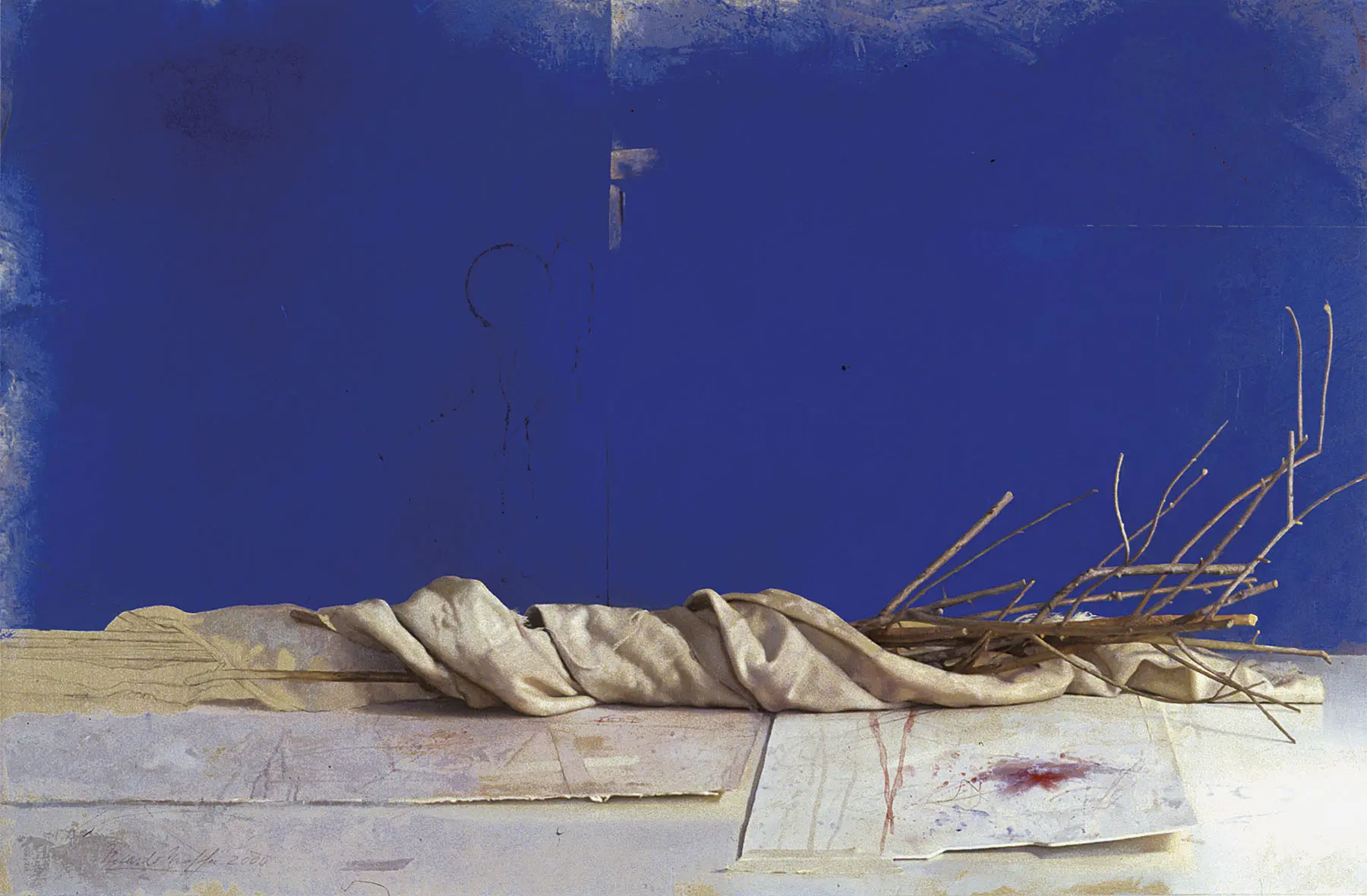
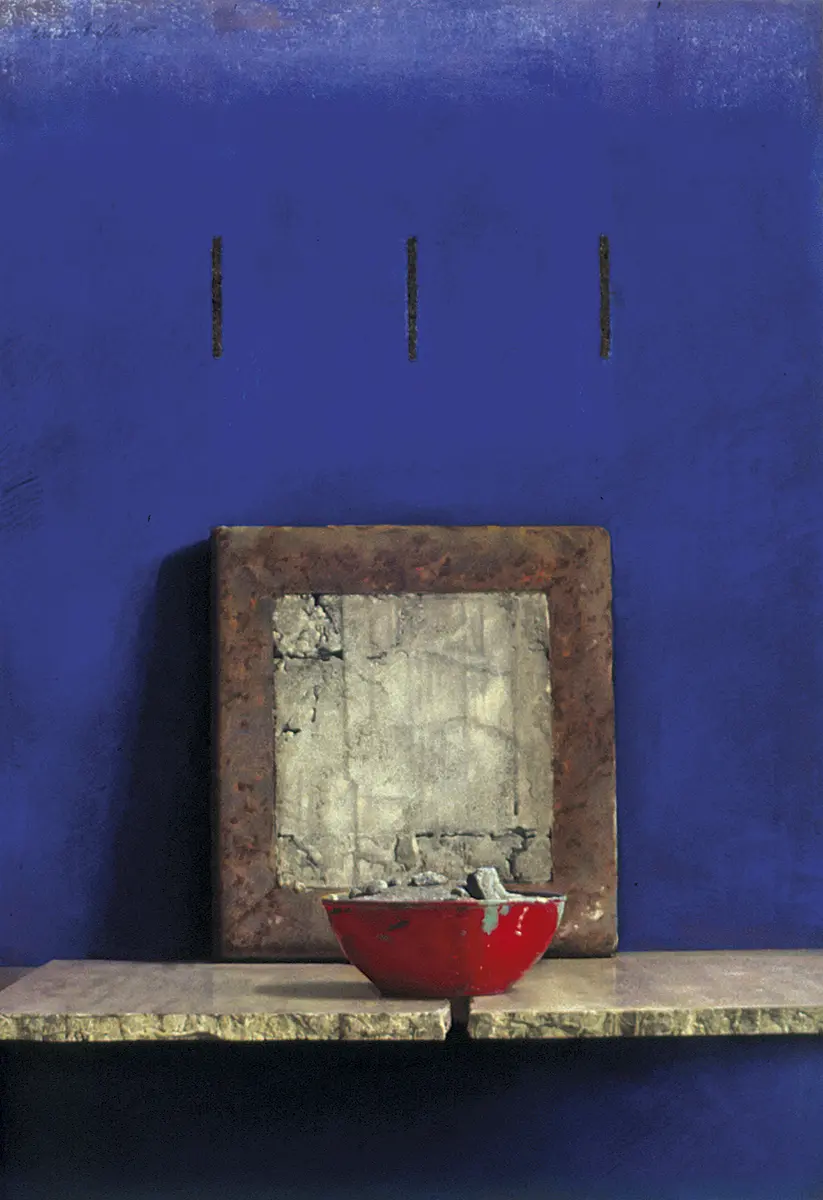
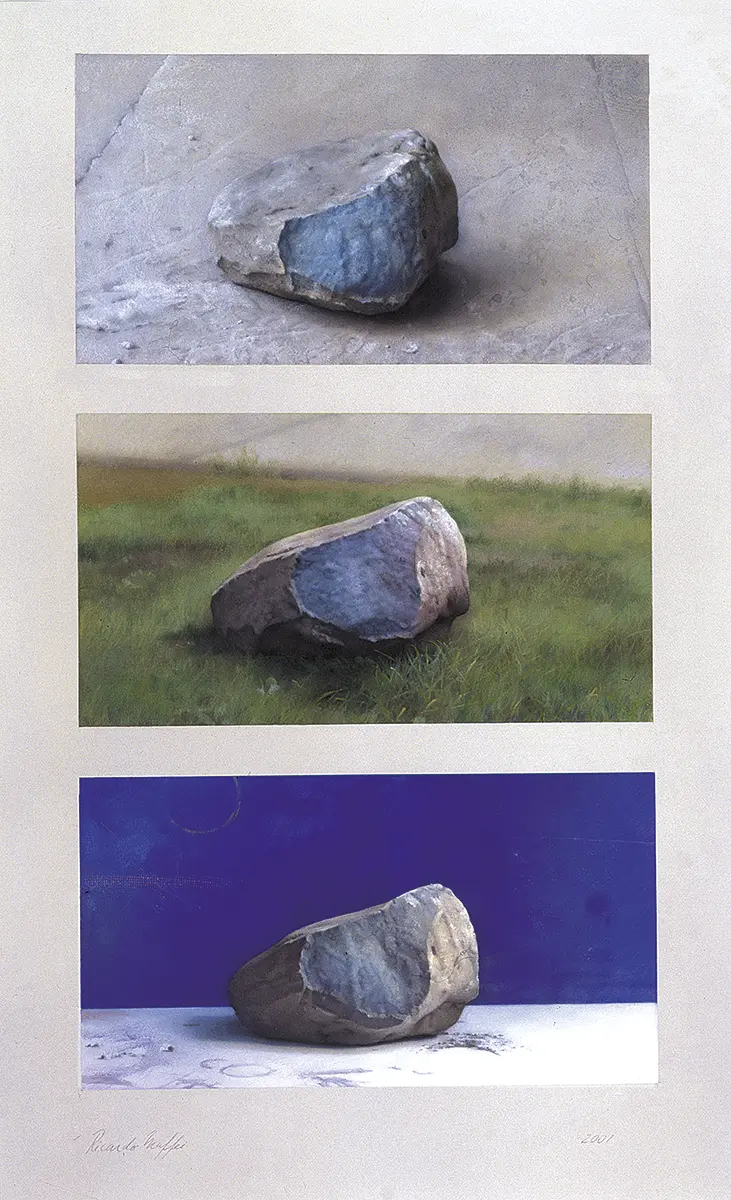
Maffei had a new one-person exhibition in 1996, at Tomás Andreu’s gallery.3 Between solo shows, Maffei took part in several group exhibitions, both within Chile as well as abroad.4 He also distanced his work from that of Claudio Bravo. Like Bravo, Maffei paints real objects, but he seeks to de-contextualize them. The groups he sets up for his models and which he then paints are impossible, in reality. Bravo does not break with reality in this way. He certainly tweaks it, especially in terms of lighting, but his workshop scenes, his still lives, and his canvases are absolutely feasible. Maffei invents his own semantics. The stone on a folded piece of fabric, the small branches bundled up in cloth, the plants growing in their pots as they wait to be transplanted, the pigments haphazardly strewn about on a piece of wood or cardboard —all of these combine into a metaphoric language that does not exist outside the world of art. Some works are even mounted on a rigid surface that served as support for their execution. Although Maffei is a realist painter his motifs and themes are not.
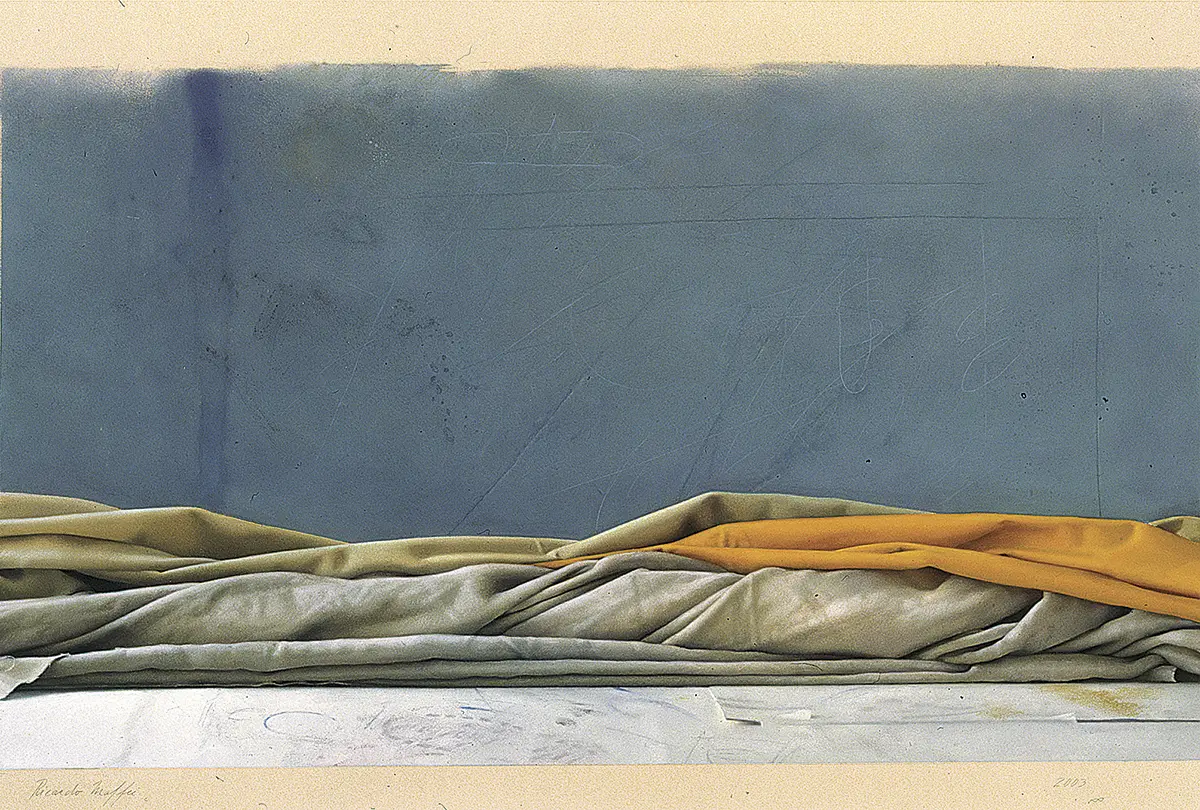
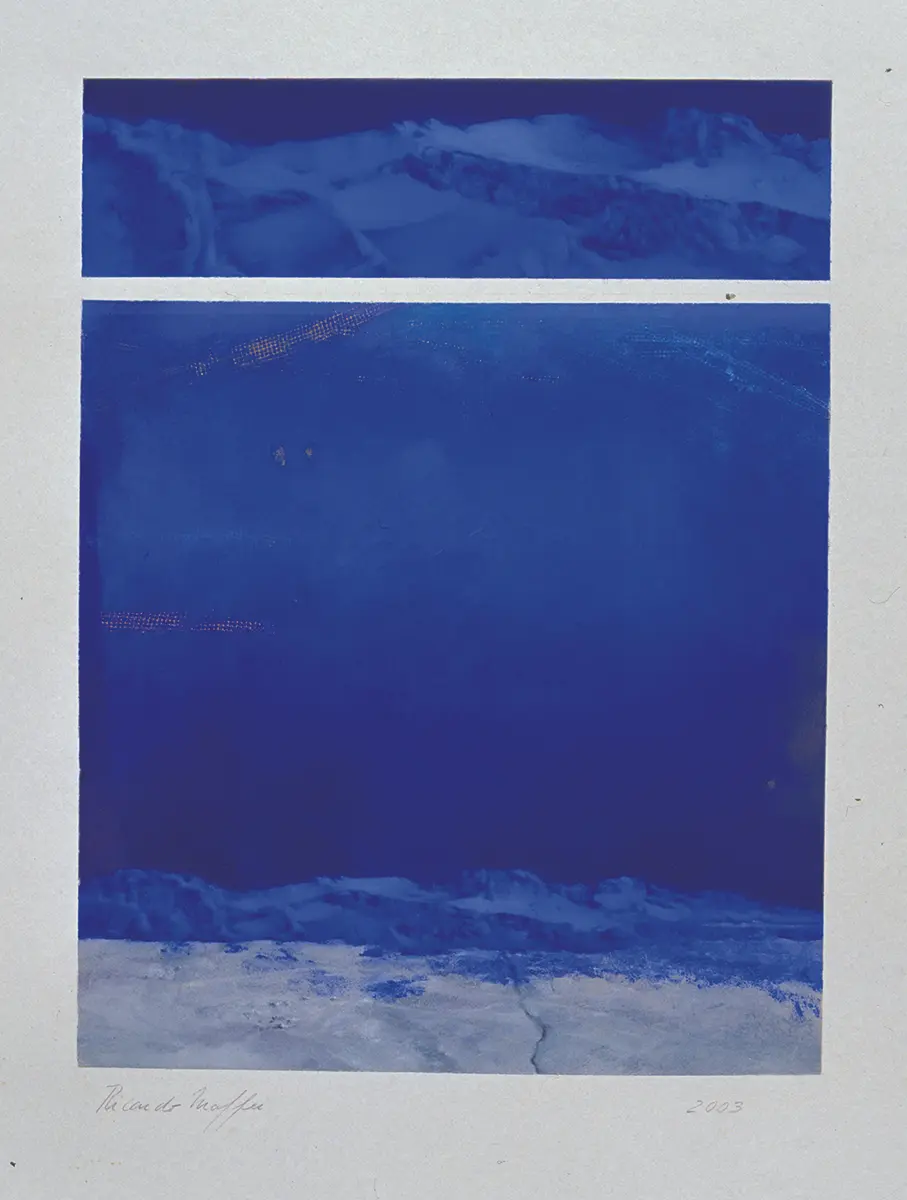
Until this period Maffei had used color parsimoniously, but it was clearly emphasized in the 1996 show: particularly the color blue —an absolutely pictorial, that is, the non-realistic shade of blue. Nature offers us very few blues of such intensity: pure cobalt blue, pure indigo like that of the minuscule flowers of the zinnia, used in supporting planes, in flat or broken backgrounds, suggesting textiles or papers that show their folds. These blues take over large surfaces on the pictorial plane. Maffei includes notes of an intense red in discreet allusions to informalist painting. The tension between the supposedly realistic motif and the chromatics becomes extreme.
In his text for the exhibition catalog, Félix Lazo underscores the subtlety of the trick the artist plays “… from his station, with an impeccable, anachronistic, and infinitely seductive historical technique."5 The objects, the bodies conjured by this painting become more real than reality itself.
Maffei’s pastel works have traveled to several significant international exhibitions, such as Art Miami, Arco, and the Latin American painting shows organized by San Salvador’s Galería Espacio. Ana María Stagno promoted Maffei’s work to Marlborough Gallery in New York City, from her gallery, which was Marlborough’s Santiago affiliate. Ricardo Maffei’s work has been shown there in 1997, 2000, and 2002.
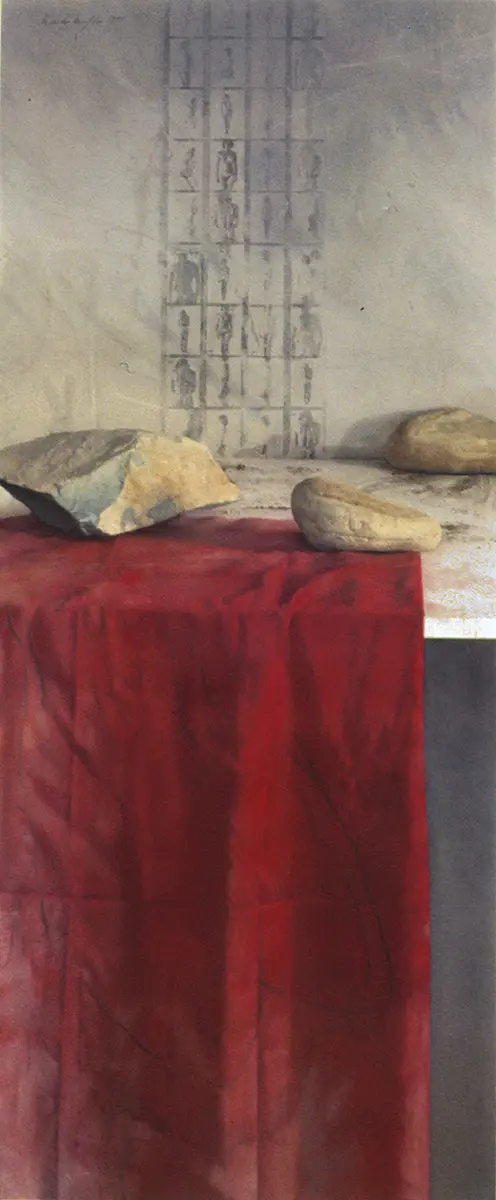
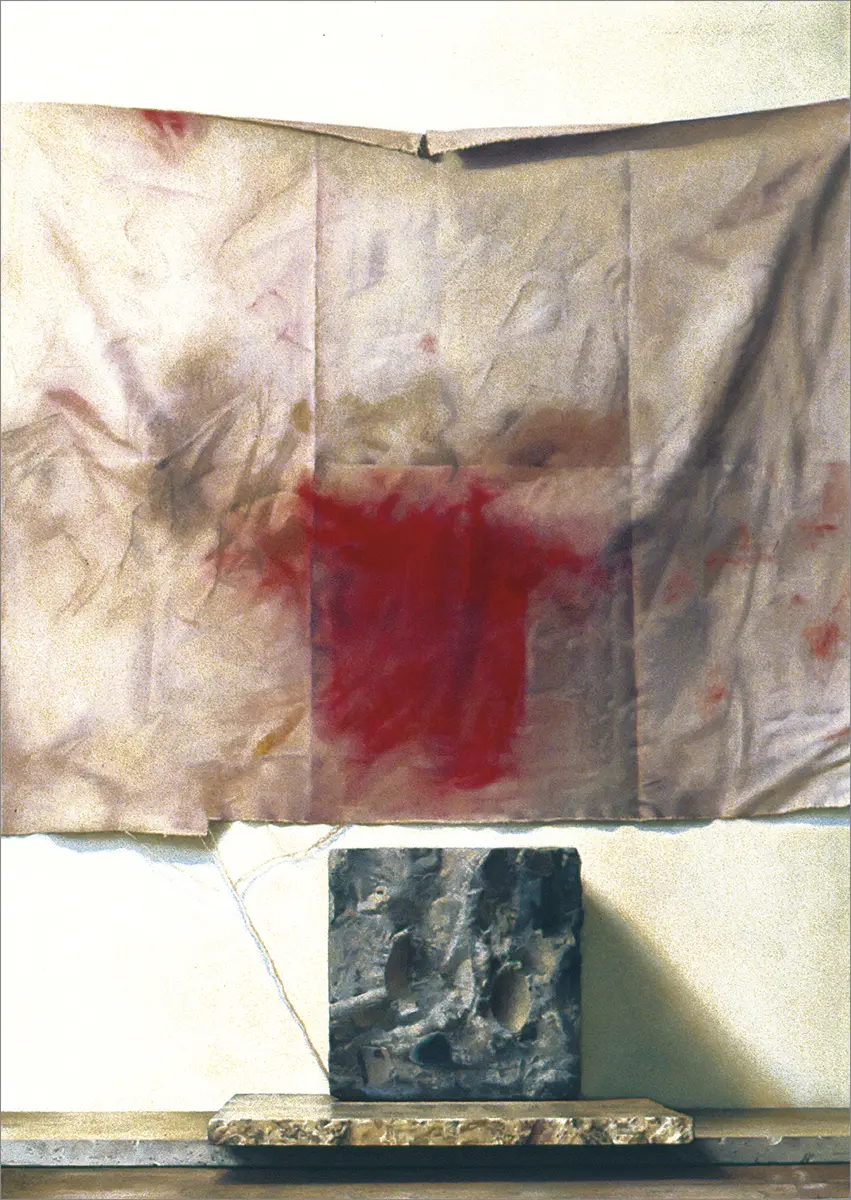
In mid-1998, Maffei presented another solo exhibition at AMS Marlborough in Santiago.6 More than his technique or his themes, the novelty here was the structure of the compositions, to give accounts of real elements. In his catalog text, Edward Sullivan points out the tension generated between weight and mass —a broken marble plaque, a stone, or an old brick— and the fragile, fleeting appearance of the fragments of nature, of textiles, or of paper that confront them. The interplay of light and shadow is more pronounced than in previous works. It enriches and complements the colors, without lessening their central role.
Shadows are an integral part of each composition and they allow those strange still lives, set up as theater stages, to breathe. The theatrical nature of Maffei’s work cannot be denied. His still lives are artifice, conceptualized in terms of a precise, confined space that is usually close to the viewer. Painted objects are clearly detached from their real environment and appropriated as protagonists of the piece. They are the actors in this atemporal theater. We could almost speak of a “realist abstraction.” The diagonal gaze, which is generally the perspective of still life, is softened. Viewers do not look from a distance; instead, they adjust their focus.
In his most recent exhibitions, the artist remains faithful to himself.7 He continues to explore the indefinable territory we call reality: that which is visible to the eye, that which is outside us and which we see only partially, that which we have already created mentally, that which can be recorded by a photographic camera. What Maffei’s realism questions is, precisely, reality itself.
How many realities are there? How many can we apprehend with our senses? How many are preconceived intellectual schemata?
Throughout its long history, realist painting —from the murals of Pompeii and Herculaneum (they themselves no doubt derived from lost Greek sources) to the photorealism that emerged in the 1970s— has been the consummate trickster among modes of expression, painting passing for reality. Maffei is a realist, but before that, he is a painter —one who has chosen to wear the realist costume.
NOTES
1. Ricardo Maffei, interview with the author, Santiago, March 2003.
2. Among them: Galería del Campus Oriente, Universidad Católica de Chile, 1977; Instituto Cultural de Providencia, Santiago, 1979; Galería Arte Actual, Santiago, 1982; Galería Praxis, Santiago, 1988; and Museo de Bellas Artes, Santiago, 1990.
3. For more than ten years Tomás Andreu’s galleries have been among the most active and significant in Santiago de Chile. In them, we have seen the work of the newest artists as well as emblematic figures of Chilean art such as Matta, or Lily Garafulic. Today, Andreu’s new space, Galería Animal, is the foremost advocate of avant-garde work.
4. It is also important to mention Art Miami 91; Galería Heller, Madrid; Galería Época, Santiago, 1992; El espíritu del realismo contemporáneo, Galería El Museo, Bogotá and Cali, 1994.
5. Félix Lazo, Introduction to the exhibition catalogue, Ricardo Maffei, (Santiago: Galería Tomás Andreu, May 1966).
6. At AMS Marlborough.
7. Text by María Elvira Iriarte for the catalog of the Marlborough Gallery exhibition in New York.
MARÍA ELVIRA IRIARTE
Ph.D. in Art History and MFA. She teaches art history at the School of Fine Arts, Finis Terrae University, Santiago de Chile.