
The claim by the London-based Mexican curator Pablo Léon de la Barra that this work would “destroy the stereotypes of Latin America (whatever that is) and Latin American art” is mostly a straw dog set afire for drama. The Latin art and ideas in existence for years prior to this exhibition are very much aligned with most of what is offered here as the antidote: art that is performative and participatory, conceptually vague but self-conscious and politically committed in its anti-capital and pro-communal, anti-exclusionary impulses.
What seems significant here is not the raillery against other art they feel is too nice, but their attempt to configure the next step, after the utopic claims of “art” and the unactualized pluralities of postmodernism and falsified equalities of globalism are realized.
This generation born in the 1970s directly faces the harsh realities of being rendered powerless by both neo-global conditions and their individual peripheral position. But they refuse to abandon their memberships in the many societies of which they are a part: traditional yet members of the new exotic third-worldness, avant-garde but raised within mass and media cultures, youthful good-time culture with an accumulated social conscience, modernist but concerned with the local survival of individuals rather than universal remedies, a privileged class that is often financially limited.
They address the most important issues in contemporary art: its relevance as social production and its relation to social change in terms of present socio-political realities that are both overpowering and underpowering. In many ways, their answers are a return to tradition, a rear-guard action in their call for an emphasis on strengthening relationships between individuals and for localized and unregulated bottom-up rather than top-down solutions, of which their art is a part. The personal and social embeddedness is often the nexus for the solutions and projects by these several dozen artists. (315)
Over half of the participants self-identified as Latin-based organizations, projects, or cooperatives that do not fit the profile of past artistic collectives dedicated to the pursuit of art. Rather they are friendships and shifting alliances (“mutant” seems to be the current favored concept of choice), born of common concerns for social and political progress, often with no home base (nomadic) and no real power base while consciously deploying strategies that recognize their powerlessness, and have no set program aside from social politics often related to change. They function as facilitators, producers, and social condensers (to use the old Bolshevik concept) and often create their own worlds through publications, temporary and collaborative productions, social interventions, music, information and discussions, parties, CDs, videos, films, and websites. The same characteristics fit the other “individual” artists.
B-Lo (Beatriz López), born in Bogotá and a co-director of the London based 24/7 Projects with de la Barra and Sebastián Ramírez is a perfect example. She claims no real talent is needed to make art —which confirms the layman’s secret feelings about the bogus quality of “modern” art— and there to be no difference between the life she lives and her practice of “art.” Like the older and preceding avant-garde, her Spontaneous Manifesto questions the relation between art and life but her terms are different. For her, much of the past avant-garde had remained aloof from their life relations. Her life, or in this specific case, her non-life is art. The British government became an unwitting collaborator by denying her a travel visa during a period of Tony Blair-based British coalition suspicion of the foreign. She was represented by a video apologizing for her absence.
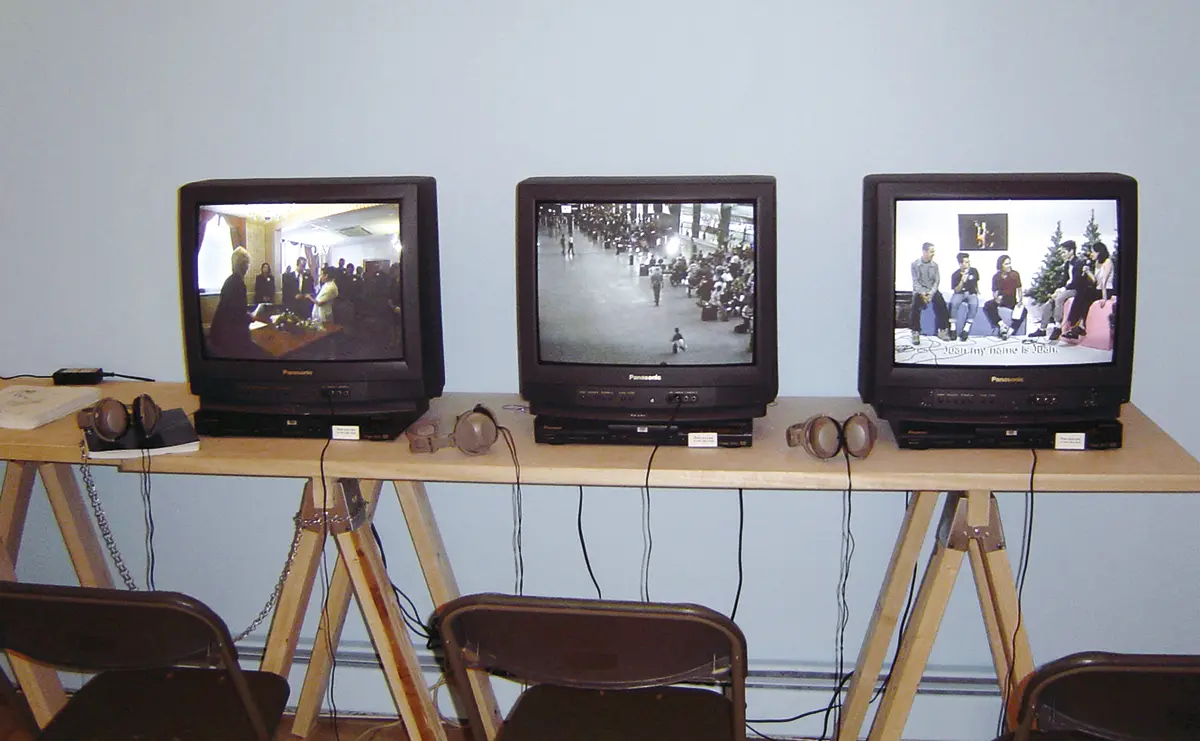
The denial of a travel visa to B-Lo dramatized the contrast to Carolina Caycedo’s project, who by accident of her birth in London of Columbian parents, was privileged with both national and transnational status via the legitimate “rights” of British citizenship, which she then temporarily "bestowed" on another through an arranged marriage. The project and more were recorded on her DVD How to Get a British Passport (with a book of documents). If the empires of rights and privileges migrate along such tenuous threads, what then of our understanding of borders, citizenships, and laws: what of inside and outside positions? Caycedo’s ongoing project, known as Day to Day, is a continuing series of street barters and exchanges for survival, again throwing into relief our daily processes, not as conceptual street performance art but as elements of daily living and survival.
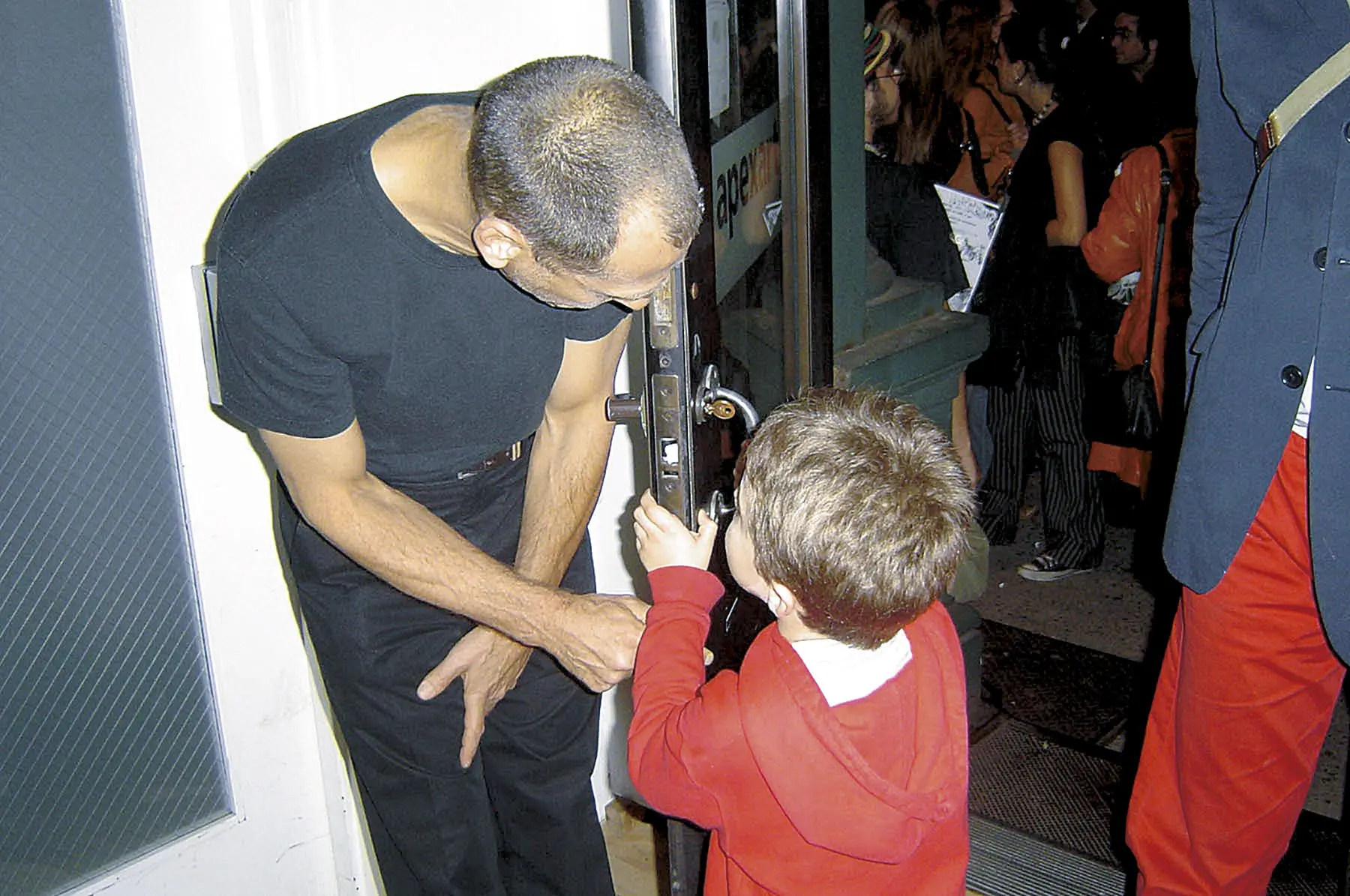
A conceptual but wonderfully pedestrian way to examine the borders of such relations came in Mauricio Guillén’s project, Mi Casa es Tu Casa. Born in Mexico City, he exchanged the keylock between his house in London and the door to Apexart and hung the key on the wall so people could let themselves into the space rather than asking the gallery (institution) to let them in. There is no better demonstration of his central concern to reorganize the relationships between dominant ideologies and institutions and reverse the inclusion and exclusion prescribed by the power of commonly accepted social order.
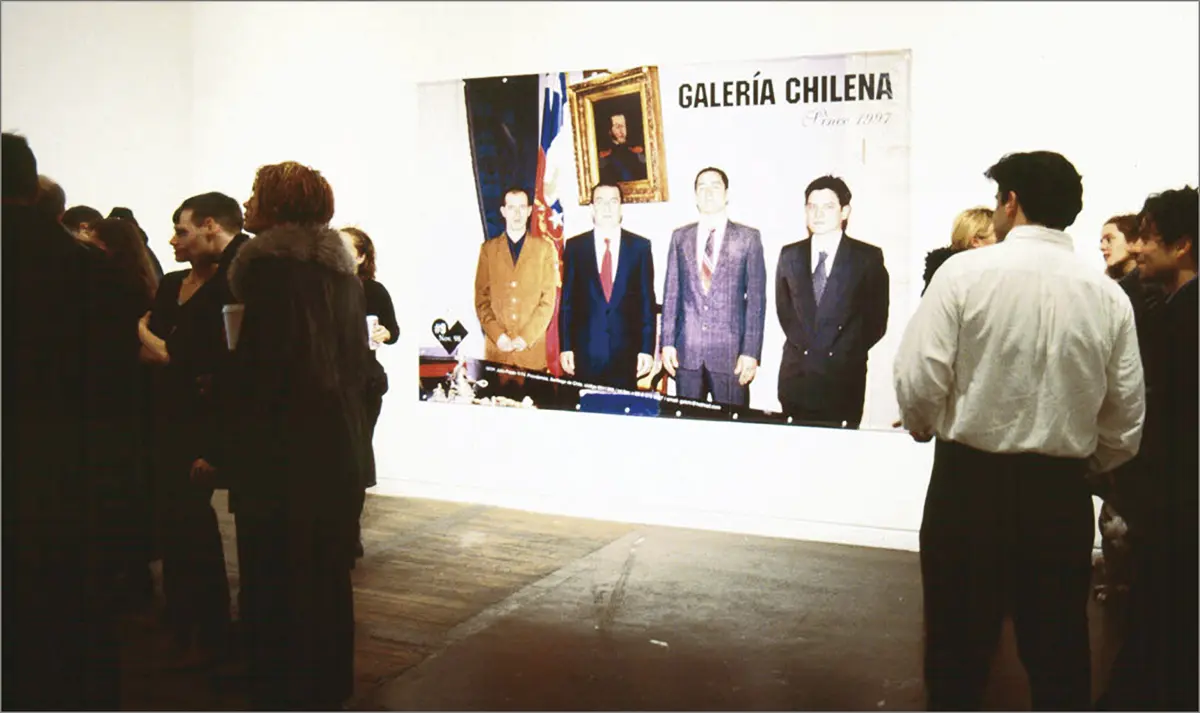
Among the groups, Galería Chilena (GCH) can stand as an example for the dozen. It is a mobile and mutant artist-run space working between Santiago de Chile and New York. Founded by Joe Villablanc, Felipe Mujica, and Diego Fernández in 1997, this is their first activity in New York and outside Chile even though two of the three now live in the area. They are perhaps best known for their ability to convince the president of Chile to pose for a photograph with them (in suits of course!) and to become a collaborator to their efforts in raising support and consciousness. By their own admission, they were “quite a social circus in Santiago” and proclaimed as “the paladins of self-management” by the late 1990s, drawing impressive crowds. For this exhibit, aside from exhibiting a version of that photo and an Exquisite Corpse drawing, they produced a book filled (mostly) with their letters (in Spanish) exchanged during their July and August brainstorming for the Apexart exhibition, their attempts to obtain funding for flights, and a photo history of their exhibition projects beginning in 1997. They sold their histories outside the studio space on the streets, like pirated DVDs set out on a piece of cloth, ready to roll and run. Typical of all the presenters, GCH points out that if there is no fixed space then your gallery remains not an institution but the cultural space you inhabit and create through a series of social negotiations. This remains perhaps the most radical message and major difference from the past avant-garde. Art is a negotiation that creates rather than is victimized by history.
Apexart deserves a word for those unfamiliar with it. Despite the newly exotic relationship between art institutions and the global, Apexart has for ten years been one of the only venues that consistently provides a place for global art and ideas to speak. It is an institution in the best sense: one that provides support for others to be heard.
RICHARD LESLIE