“The horrors of war and the way in which they become normality are unthinkable for us. We can’t understand them, we can’t imagine them.” Susan Sontag
A few days after visiting Beatriz González’s show titled Verónica, I read Susan Sontag’s book Regarding the pain of others. Immediately I started finding correspondences between the American critic’s writing and the Colombian painter’s work, since both of them reflect, from their different perspectives, upon the same issues: war, death, and the photographic image. They both deal with photography and how our society approaches “the pain of others.”
“The well-known and celebrated image of agony in the rubble is an inescapable attribute of our camera-mediated knowledge of war. We know war through the camera” (Susan Sontag.) But while Sontag warns of the course of these photographs in a world already saturated with images, Beatriz González, knowing herself close to that pain, inasmuch as a war is raging in her own country, presents in her work a way of seeing that rips through any banal act.
“Since the invention of the camera, photography has accompanied death. Since the image produced with a camera is, literally, the trace of something that presents itself before the lens, photographs were superior to all painting as far as evoking the dearly departed and the disappeared past” (Susan Sontag.) The interest in death, painting, and photography has appeared in the work of Beatriz González since Los suicidas del Sisga (1965). This early painting, which has become an icon of Colombian art, takes as its reference a newspaper photograph showing two young, smiling lovers who pose for the camera holding hands minutes before dying by their own hand. Curiously, in this case, it is a painting that immortalizes a photograph of two anonymous suicidal lovers.
Since the 1980s Beatriz González has been solely devoted to Colombian reality. Perhaps this is a reason why death is a recurring theme alternating with images of Colombia’s presidents, where with irony and sharpness González points out the contradictions of a country that slides into war. But it is since the 1990s that her interest has focused exclusively on the issue of death, and she employs as a reference photographic records taken from newspapers. During these years she has presented a series of shows such as El color de la muerte, Las Delicias, Dolores, Papel de colgadura, and now Verónica, all of which are composed of pictorial images that in different ways congeal and preserve the painful gestures of those who have suffered by death.
“The image has been abused as the medium through which suffering is seen at a distance, as though there was a different way of seeing. But seeing up close —without the mediation of an image—is just seeing at any rate (…) There’s nothing wrong with taking a step back and reflecting.” (Susan Sontag) And, stepping back and reflecting on the words that define Beatriz González’s position regarding the death around us. As the artist once said: “News photographs are an instrument. When I choose one of those photos it is because in it I identify values, elements that already exist inside me… and I find them in the expressions, in the pose (..) I have always clipped news photographs, and I have said many times that news photographs are my inspiration, my model, and this happens because in them I find my world.” Later she adds that what she wants to paint is not the photograph itself, but “the sensation the photograph provokes."1
González’s reflections about death reached her through images and materialize in her painting. First, through her selection of imagery from the newspaper, which she clips and saves. When the time comes to paint she selects some elements from that image and distributes the figures and objects in the two-dimensional space to give the image a certain dramatic quality. Above all, it is her use of color, which is so characteristic of her work that becomes an entryway into each of her paintings.
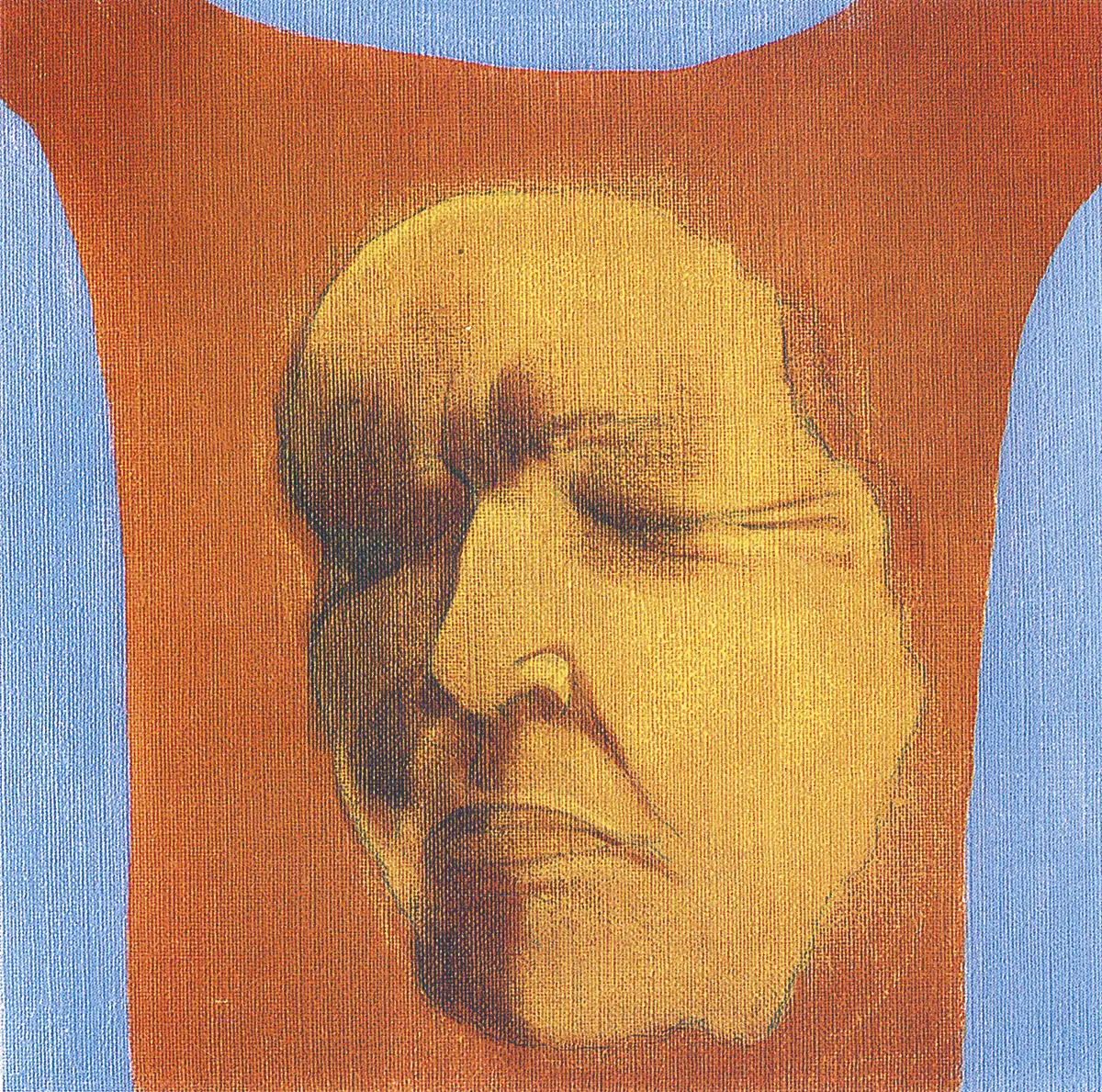
In her most recent show, as always, González deploys the strength of vibrant color that surprises, holds, and poetically introduces the viewer into a set of truly moving images comprising seven series: Lápidas, Identificación, Autorretrato con mascarilla, Paisaje, Verónica, Dibujos and Autorretratos a partir de mascarilla natural. Walking through the gallery we perceive that the same color with which she used to play in a whimsical vein, with a sense of good and bad taste, has now acquired painful, cutting undertones, which, as Carmen María Jaramillo points out, tends to purify and sacralize those deaths.
“(…) there are many uses for the innumerable opportunities modern life affords to see —at a distance— the pain of others. Photographs of an atrocity can produce opposite reactions. A call for peace. A scream of vengeance. Or, simply, a befuddled awareness, without pause in the photographic information, that terrible things happen.” (Susan Sontag).
Most of the images in this exhibition come from newspapers, some depict an American Indian rights activist cruelly murdered by the FARC and some respond to a new process in González’s art. Carmen María Jaramillo says that these recent works “have as their model a mask that reproduces the artist’s face, developed after having turned the portraits of American activists into mortuary masks; thus, while approaching the death of others, she started projecting her own. Projection and identification, as modes of recognition in the other, appear now as strategies and interlock on the idea of making her own face objective. Portrait and self-portrait come together in Verónica’s small icons, inasmuch as she works on her own image, her pain, and her death, as well as on others. This series shows with great clarity the way in which the boundaries between self and others break down when the issue is approached with a compassionate gaze."2
Beatriz González knows that for many years terrible things have happened day by day, hour by hour in our country. Those daily deaths that enter into her world through war photography shake her conscience, touch her, and evoke the effects of her own death, in the sense in which “we are all Freddy,” as González puts it in the title of one of the most moving drawings in this show, where with a broken, tenuous line barely touching the paper, she reminds us that we all are potential victims in this absurd war. Her images tell us that “the pain of others” is also hers. Because of this, we find in González’s work an ample iconography where color evokes pain and where it is made evident that death is the communicating thread running through Colombia’s convulsed history.
NOTES
1. Beatriz González una década 1980-1990, Museo de Arte Universidad Nacional: Bogotá, October 18, 1990.
2. Carmen María Jaramillo, Beatriz González: Verónica, Alonso Garcés Gallery: Bogotá, 2003.
MARTA RODRÍGUEZ