César Menéndez paints disquieting images in intense colors and complex figurations, a phantasmagoric world of tenebrous characters and surrealist environments that surprise and intrigue the viewer. Menéndez’s style has evolved over 30 years, in a career that began in the late 1970s as part of a remarkable generation of Central American artists born in the mid-twentieth century. Although Menéndez initially explored abstraction, which still underlies most of his compositions, his art has become known as part of Latin America’s figurative tradition linked to his Salvadoran predecessors Julia Díaz and Benjamín Cañas, as well as to other Central American artists such as Nicaragua’s Armando Morales.
Despite the incorporation of many influences in the process of his development, Menéndez’s style is readily identifiable for its handling of volumes, its use of color, and the powerful personal iconography that enrich the artist’s canvases with sensual male and female figures, fantastic animals, locomotives, boats and piers over suspicious waters. A look at the development of his work reveals certain realities within his illusionism that allow us to decipher the elements of his visual code. For example, in the large landscape titled Memorias para un instante de eternidad, included in his most recent exhibition at Galería Imagen in Panama, there are two horses, a muscular woman dressed only in tights and, in the background forming the line of the horizon, a train that cuts across the canvas leaving behind a vanishing trail of steam. Color, more subtle here than in other works in the exhibition, serves to create a landscape that suggests naturalness but does not actually reproduce nature. In the foreground, the woman stands with her back towards the viewer, holding the reins of an enormous, fiery-eyed horse, next to which we see, in contrasting peacefulness, a colt with gray wings. As in many of Menéndez’s works, what we have before us is a dream-like scene of erotic insinuations —some more explicit than others—that evoke nostalgic feelings for remote times and places.
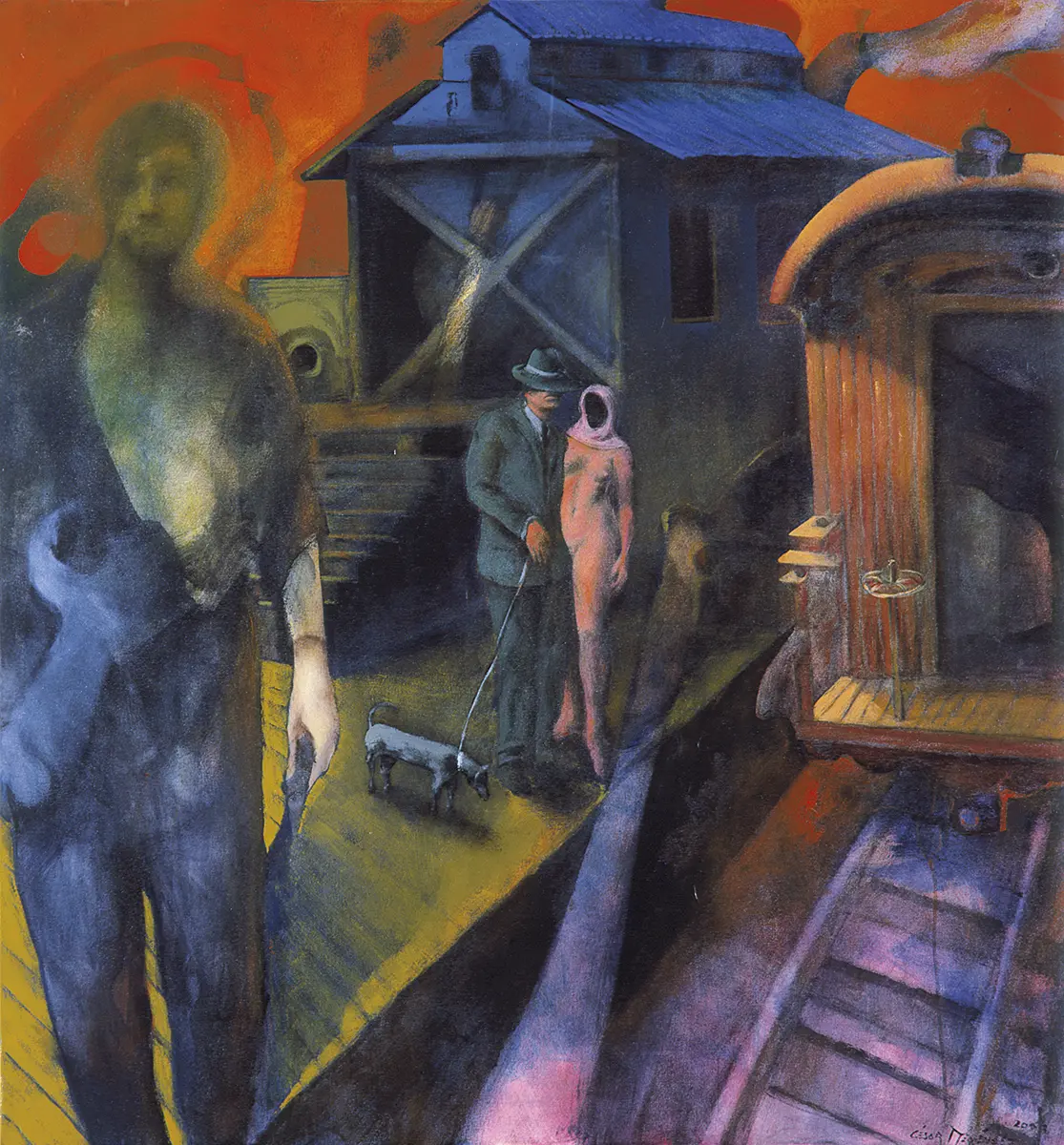
Menéndez’s vocabulary is comprised of a series of visual and narrative elements among which the female figure is predominant, but which also include angels and other winged creatures, circus characters, centaurs, trains, ships, and ports. It is tempting to make a Freudian interpretation of these figures, objects, and symbols that in some cases are well known, almost universal, but in the case of this artist emerge from his personal experiences. Trains, for instance, have played a major role in Menéndez’s life: both his grandfathers worked for the railroad, and it is there that he places the origins of his family history. Journeys, farewells, and absences all relate to this mode of transportation in the childhood memories of this artist who was brought up in the countryside. Among the canvases in this show, the topic comes up repeatedly, for example in El viaje del Dr. Díaz, which depicts a couple on a platform in front of an intensely blue wooden stationhouse and next to a train’s last coach, with an open door that leads to a dark interior. The couple is unusual: the man wears a jacket and a hat and holds a gray dog on a leash and the woman is naked and ghostly, with a black hole in lieu of a face under the shawl that covers her head. Dark, deep circles are a recurrent motif in Menéndez: they appear as the ends of tubes, as the mouths of fish, or as undecipherable vacuums. Black holes are an interesting element for the associations they bear, in the science of symbology, with female organs and with the “entryway” to the subconscious.
Menéndez’s world includes many animals, with a noticeable preference for the horse, a figure that alludes to strength, power, and virility, which the artist uses as a symbol of masculinity and of himself. Sometimes it appears in the guise of a centaur, an equine body with a human torso and head, associated in mythology with brute strength and sexual drive. Several horses of dynamic forms and passionate eyes appear in this exhibition, among them one painted with a wind-up toy’s crank in its abdomen. In another painting, De caballeros y caballos, the animal is mounted by an angel, and in Amazona it is mounted by a woman, in an allusion to the role of the horse in the history of art.
Menéndez’s compositions emerge from the subconscious, which relates them to the work of artists he admires. For example, from early on in his career Menéndez painted painful-looking bodies that echoed those of Francis Bacon. Also present in Menéndez’s art is the legacy of Benjamín Cañas, in works such as El día que me quieras, where the figure of an animal with a man’s face accosts a woman inside a distorted interior space. On the other hand, Menéndez’s constant references to death and his shawl-covered figures on boats —like the one in Marina, exhibited here— bring to mind late-nineteenth-century symbolist painting. We perceive in his work an air of despair and anguish that relates to the Romantic movement and to artists like Arnold Böcklin. In this context, Adonde van a morir is an exceptional piece in the exhibition, due to its limited palette and its nocturnal, mysterious atmosphere, as well as its central figures. In a large, circular space similar to a Roman amphitheater, the artist has painted a pedestal that supports a nude figure with dramatic spread-out wings, carrying a corpse. Beneath this figure, a woman and another nude angel contemplate what seems to be a dead animal, or a fleshy heart, with an arrow through it. The woman’s shadow has the shape of a horse, and in the background, we see an archway and distant towers. As in a historical nightmare, the piece makes references to death, sacrifice, women, and angels, in a narrative we can’t understand but which is nevertheless fascinating, perhaps precisely due to its incomprehensibility.
Menéndez’s recent works are all distinguished by their dream-like atmosphere. The artist has left behind all content related to Salvadorean reality that characterized his impressive paintings of the 1980s, which reflected the country’s tragic political situation. He no longer paints human massacres, helicopters, or wars, but rather hallucinated or mythological situations that do not represent facts but ideas and sensations. Disturbing darkness has been replaced by strong contrasts of saturated colors in almost acid shades of green and red, blue and orange. In some cases, the colors are so intense that they compete with the dream-like qualities of the composition, invading the subtlety that characterizes Menéndez’s best work. Other recent works display a surprising lightness, as in Tu pecho es algo así como una taza de café, which combines passion and irony, two constants in the artist’s oeuvre. As always, Menéndez’s paintings represent rarefied scenes charged with a disturbing atmospheric sensation, with characters that emerge from dark backgrounds achieved through the dramatic handling of light and color, in works where chiaroscuro —both erotic and poetic— continues to be the mark of the artist’s identity.
MÓNICA E. KUPFER