The Dominican Republic has important cultural networks, especially in the field of the visual arts: Museo de Arte Moderno, Museo Bellapart, the arts complex at Altos de Chavón, numerous galleries, and multiuse private centers. Three major competitions are held bi-annually, and there is an abundance of exhibitions, both group and individual. Four generations of artists are currently at work.
Nevertheless, until last year there was no nationwide structure, be it public or private, able to do promotion, research, and education in the humanities and the arts. There wasn’t a single institution, outfitted with the latest technology, capable of placing those tools in the service of knowledge of the past and of the present, with the integration of the country into the Caribbean region as a natural and necessary goal. Neither was there a strict, well-funded, and well-managed organization that combined altruism, respect, and high standards.
Centro León, inaugurated after four years of planning and preparation on October 3, 2003, in the city of Santiago de los Caballeros represents those plural values, and everything guarantees success for a community-oriented service unit where aesthetics, entertainment, and documentation come together harmoniously. This high-level experiment is a first in the Dominican Republic, and it will undoubtedly constitute an example and a lasting model for those to follow. The surprising number of visitors, for a country where people do not visit museums, and the earliest activities held at the Centro are already very good signs.
A History of the Centro
The story begins in 1964, with the First E. León Jimenes Art Competition, which captured the nation’s artistic enthusiasm from its earliest edition. The competition reached its 28th edition in 2003. The awarded works, reflecting four decades in the evolution of Dominican visual arts, crammed the offices of the sponsoring financial group. The creation of a museum was necessary in order to give them the proper space and conservation and to present the public with a collection that had been put together methodically and was truly exceptional in our country. The Eduardo León Jimenes Foundation, the result of a growing cultural philanthropy, was then formed by the financial conglomerate to attend with greater exclusivity to cultural matters and to the fate of so many works of art.
It was in 1998 when José León, head of both the financial group and the Foundation, announced: “The Museum will be based in Santiago. We want it to have all the characteristics of a modern museum. The inauguration is slated for 2003, corresponding to the 100th anniversary of E. León Jimenes’s birth.” In fact, E. León Jimenes Foundation is the history of a family that began its contribution to the country’s economy at the dawn of the last century and has not stopped seeing it grow.
The news was received enthusiastically by the Jimenes family and by collectors, who made important donations to the Foundation in the form of archaeological, ethnological, and documentary pieces. But the situation had become more complex! The art museum was no longer sufficient, and a number of experts —consultants and professional advisors— were contacted: How to bring together archaeology, anthropology, and the visual arts? How to include in a single institution a distant past and active modernity?
Thus emerged the proposal for an interdisciplinary institution dedicated to protecting, researching, educating, and promoting art. According to established philosophy and traditions, the fundamental goal was to revolve around the themes of expression and identity. From the city of Santiago de los Caballeros, a city with solid traditions in culture and education, the objectives were to extend to the country as a whole, and even to the Caribbean region, and to crisscross with ancestral ties. The Eduardo León Jimenes Foundation approved the plan. The Centro León, under its current form and concept, was about to be born.
Rafael Emilio Yunen, the Centro’s general director, put it this way: “In truth, we can say that the four-and-a-half-year period prior to the inauguration was devoted not only to the physical construction of our site, but also to the creation of a complete cultural institution, with well-defined personnel, programs, and projects geared towards a culture of respect for the works and for their creators, based on methods of cataloging, conservation, and prevention.”
In other words, we can say that this is the Dominican Republic’s great pilot project in cultural administration and promotion, in agreement with the most advanced norms and oriented towards permanent service to the community.
Centro León was built on Santiago’s east side. Its design and construction were assigned to Borrell and Associates, the firm headed by Pedro Borrell. The building is of great quality. Borrell defines the architectural complex as “pavilions in very simple geometric shapes” where curved lines, straight lines, and angles alternate rhythmically and are always concerned with the human scale. From the entrance and its glass porch, an open and wide space welcomes the visitor. Preceding the building’s main body we find a vestibule and reception area, information module, store, cafeteria, education unit, and a multifunction hall, all of them greatly welcoming.
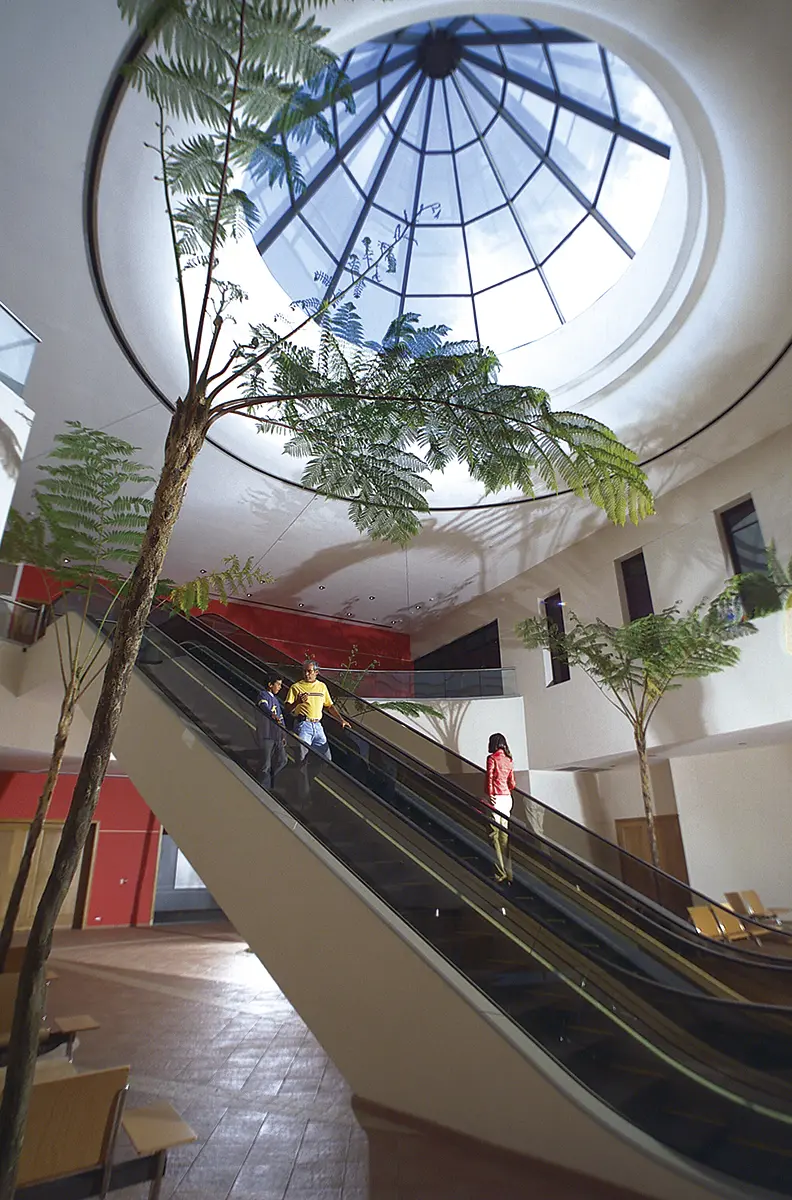
We arrive then at the most spectacular part of the architecture, the interior patio, an area for the circulation of visitors and for access to the different departments. With floors in double height, radiating sun design, and a transparent central cupola giving out a zenith of real/symbolic light, the atrium is aesthetically impressive. Even the dual escalator that carries us to the second-floor moves beyond the merely utilitarian and presents a kind of sculptural elegance.
The hall distribution has been conceived so that visitors feel entirely free. They can be interested in the Media Center, with its advanced technology and its vast information; they can attend an activity in the Auditorium; or they can enjoy grand exhibitions. The latter are presented in three halls— two on the first floor, and two on the second floor —conceived, planned, and executed with extreme attention to materials and spaces, lighting, and gallery design. We must emphasize as well the interior architecture of the Visual Arts Hall, which hosts part of the collection, mostly comprising the award winners from the National Competition and was begun in 1964, and which was also the initial drive behind the whole project.
The quality of the interior is reflected in the tropical garden surrounding the building, carefully designed with native plants identified, where a vast aviary, populated with species endemic to the Dominican Republic, invites us for a stroll.
Three Exhibitions
Centro León has three exhibition spaces, two of them permanent, and the third one temporary. Its world-class technical installations were commissioned, after a bidding process, to a Spanish consortium, Espai Visual. The viewer, whose dynamic intervention is always sought, feels free to create his or her own path, although a basic circuit exists, as well as two very well-prepared guides who can orient the public and explain things.
Expectations were high for the temporary exhibit Huella y memoria. Un Siglo en el Camino Nacional, tells the story, through testimonial objects and documents, of the evolution of the León family and their one-hundred-year history of entrepreneurship. What could have been a personal and provincial saga became instead a projection of a country’s and a people’s history. National memory comes back to life spontaneously; each Dominican refers to what he or she sees to his own family, and the foreign visitor learns about Dominican history. It is a temporary exhibit —it’ll be open for six months— but there is a consensus to make it permanent (in a different place since the Centro needs this room for international shows and for its biennial competition.)
Beautiful examples of furniture and objects, photographs, and archival documents invite contemplation and reading. These testimonials alternate with architectural models, reproductions of a tobacco ranch, or a beer production line, thus avoiding a reiterative presentation and diversifying the range of perceptions through aromas, sounds, and movement. We see glass displays turning around, mechanisms activating, and our sense of touch and a third dimension become part of the viewer/participant’s experience.
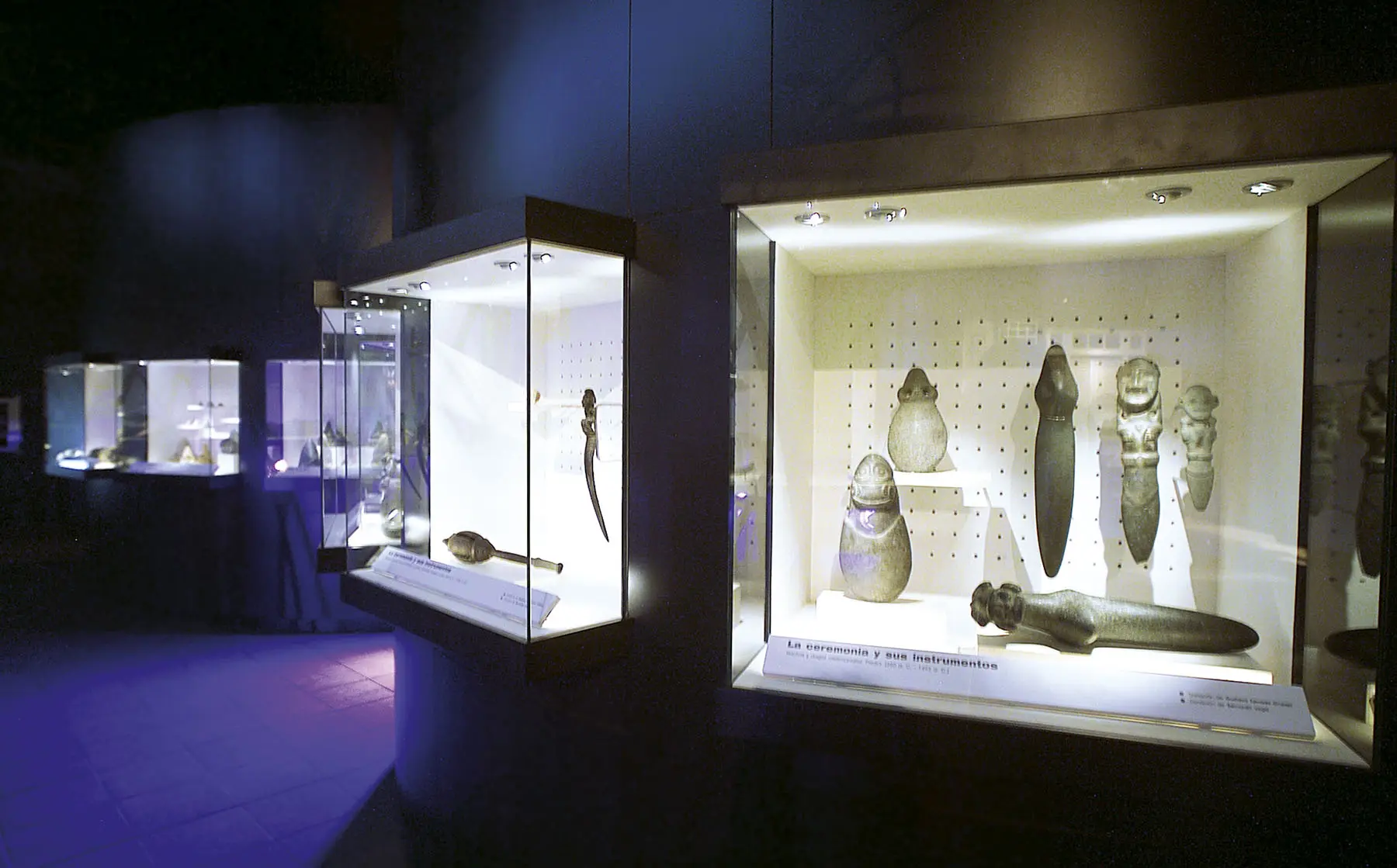
Throughout the Antilles, and perhaps throughout the world, there is nothing comparable, in terms of cultural spaces, to the Signos de Identidad (Signs of Identity) hall; not a comparable space, that is, that exalts Caribbean reality in its idiosyncratic whole, its anthropological, ethnic, and cultural profusion. All Caribbeans are proud of their history and geography, but due to a lack of resources, and especially the lack of a concrete wall, no institution had up to now taken on the challenge of producing a summary at once dense and clear, defining the Caribbean in its multiple components and its universal openness. Marco Veloz Maggiolo, researcher and principal curator, as well as a brilliant intellectual active in several fields, describes this museographic vision as “a visual, digital, and sound Caribbean that moves, turns, shines, and integrates us to the refulgent life of a plural and unitary space.”
From the entrance, projections on two curved walls introduce us to the mixing of peoples and to nature with photographs of popular types, habitats, and landscapes. The journey commences, and the region’s biodiversity finds its metaphors in displays —comprising 125 species— between branches of a steel wetland that symbolizes the nutrient life force, under a cloudy and vibrant sky to a floor evoking wet sand. Later, the areas of prehistory, ethnography, and everyday life are illustrated by archaeological pieces, multiple testimonies of African and European heritages, rural markets, and dwelling environments, as well as a sector devoted to Santiago and to the Dominican Republic as a part of the Caribbean.
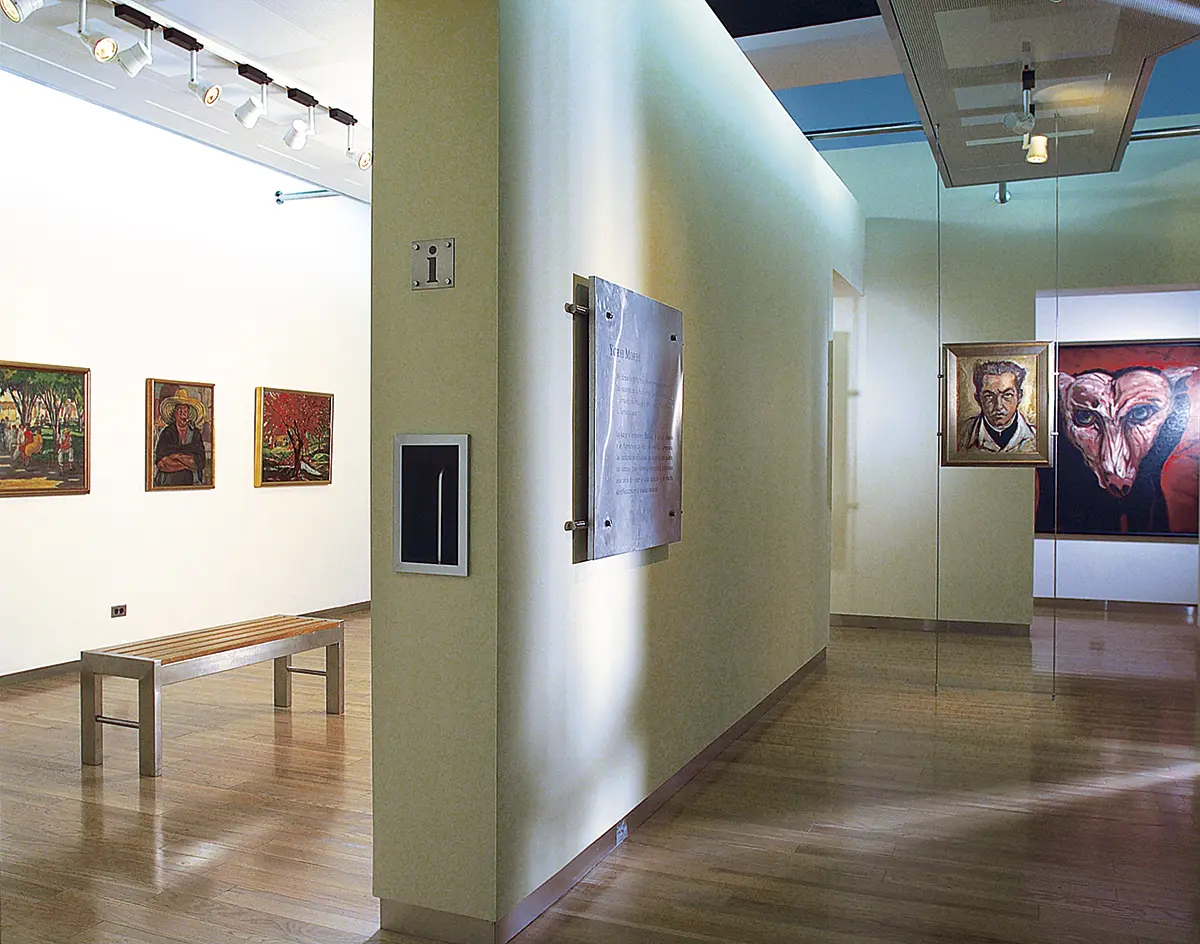
The Visual Arts Hall, under the direction of art historian Myrna Guerrero, is on the second floor, with its exhibit Génesis y Trayectoria: La Colección E. León Jimenes. Arte Dominicano de los siglos XX y XXI. An ambitious title? No, a reality that gathers 100 years of Dominican art, between award-winners from the National Competition and complementary acquisitions, including anthology photographs and paintings from the Santiago school, identified for its costumbrismo up to the moment of contemporary ruptures.
The space’s gallery design and organization, of the highest material and conceptual quality, distributes 150 two-and three-dimensional works, capable of being exchanged periodically in order to present the complete collection over time. Three designs based on a museographic script were elaborated, culminating in a consensual solution among the Centro’s specialists. The viewer advances through seven visual-reading nuclei, from the early twentieth century to the 2002 E. León Jimenes competition. The excellent lighting is regulated according to the works on exhibit, and the spatial program follows, at the level of architecture —curves, angles, volumes— the evolution of the nation’s art, its periods, its ruptures, and considers the changes undergone by the competition itself, formerly conservative, today bolder even than the official Biennial. In this room, we watch, we enjoy, we learn: local visitors can become proud of their artistic heritage.
Services and Programming
If the halls devoted to exhibitions are exemplary, the same criteria of excellence are found in the Media Center, which, besides a well-stocked and well-selected library, offers visitors one of the most sophisticated digital information systems. It invites research in any of the human sciences, cultural goods, in the visual arts, on the basis of a system of classification and cataloging that is consistent with the most stringent international norms. It is an interactive information technology offered in a welcoming environment, at the service of researchers.
The Centro’s conservation and restoration services follow the same pattern of sobriety and optimal resources. In the warehousing area for the collections and works of art, environmental conditions, and controls are excellent, which has allowed Centro León to receive loans from large museums and international organizations.
Now, beyond exceptional events, the program of smaller shows, educational workshops, conferences, and concerts in the auditorium is a daily attraction.
To say that a bright future awaits Centro León is to say that, at last, the Dominican Republic has institutional means akin to those of the most developed countries in the hemisphere in terms of facilities and programs in the realms of art and culture.
MARIANNE DE TOLENTINO
Art critic and member of AICA.