
A picture may be worth a thousand words, but if it needs that many to make its point something’s amiss. This is the case with “identikits,” Elia Alba’s show of photography, video, and performance-based objects. Rather than manifesting a singular vision, Alba’s artistic project is lost in a panoply of theoretical musings and didactic gallery texts.
This over-determined exhibition proposes to “ask fundamental questions about race, gender, ethnicity and how these are constructed in contemporary society.” The exhibition brochure states that the New York-born, Dominican artist “is interested in exploring how the face becomes a sign for the person and how people’s perception of a face influences how a body is perceived, interpreted, and treated both publicly and privately.” There is also some discussion of the face in relation to the history of masks, as well as the role of onnagata—or female impersonator—in traditional kabuki theater.
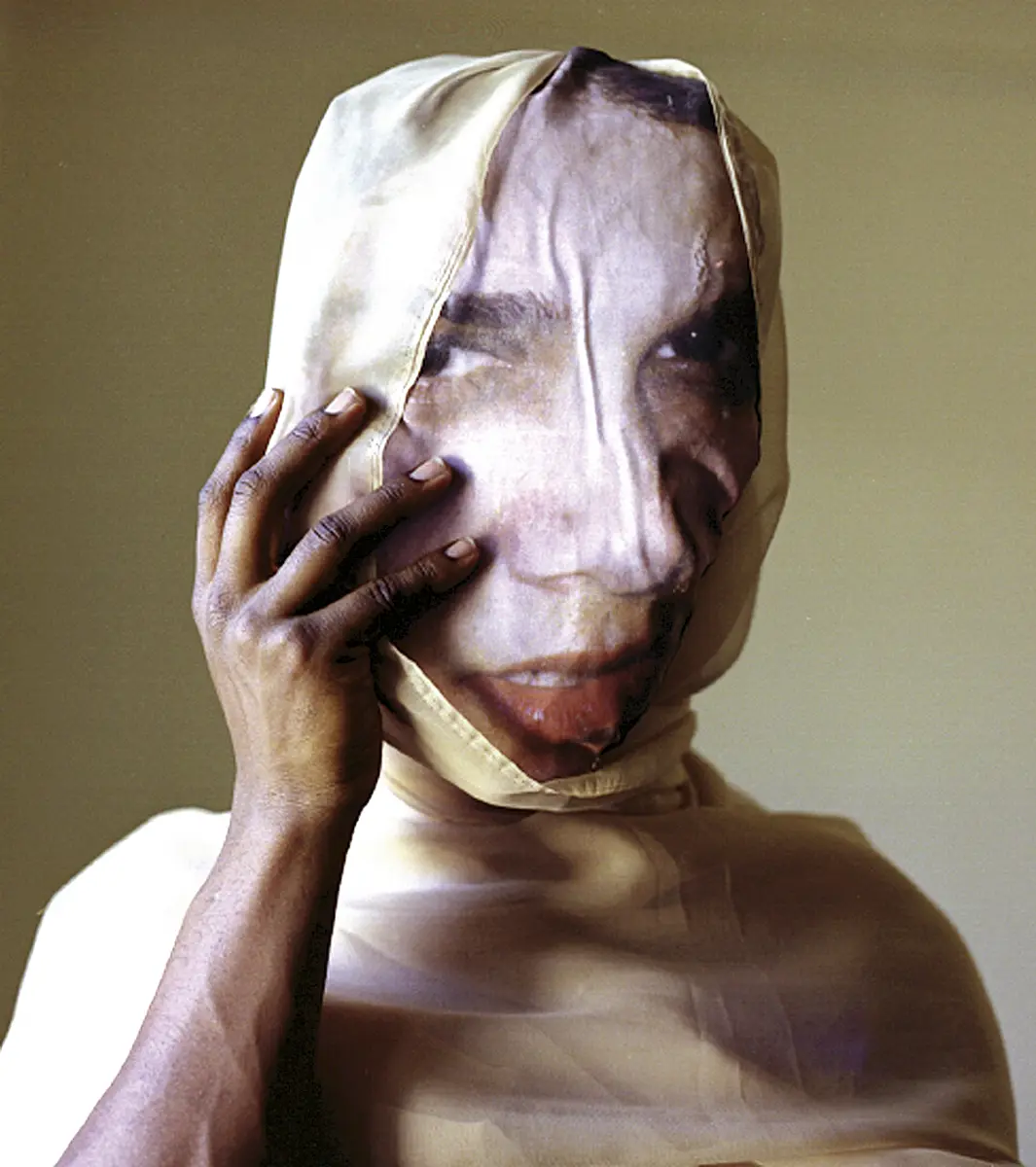
That’s a lot of work for a face! In the end, Alba’s primary strategy is to cover up faces and bodies. In a series of portrait photographs, for example, the subjects’ faces are completely obscured by phototransfer images of faces, enlarged to be slightly out of proportion with the subjects’ bodies. These bodies are veiled in gauzy cloth and posed in nondescript, shadowy settings.
Other identifying qualities like gender and age are also effectively erased by the masks and tightly wrapped veils, leaving the viewer even less to respond to. Because the figures are so thoroughly covered, it isn’t known whether the mask-face is that of the subject or someone else, except in several instances where an exposed hand held up to the mask clearly indicates a racial mismatch.
The connection of hand to mask, however, generates the most interesting dynamic in the series. It suggests the figure’s corporeal ownership of the face, which the viewer naturally projects onto the mask. Interestingly, one is also tempted to project life, sight, and consciousness into the mask’s face—all of which does exist, in fact, but in some unknown, photographic “elsewhere.”
This sensation of a photographer gazing at the viewer from within another photograph is the most compelling element in Alba’s work. It is a double illusion twice removed, which is an entertaining conundrum to foist onto what is potentially the most accurate means of technical representation—photography.
Alba’s gamey manipulations of photo representation and their implications about consciousness are artful and more compelling than the race/gender/ethnicity issues discussed in the exhibition materials. For the most part, there is an oddly conservative restraint to the photographs and videos that fail to engage the dynamic tensions inherent in these cultural topics. One would expect art about repressed, misrepresented, or stolen identities to be more visually engaging.
For instance, in the 1920s Hannah Höch inserted faces and masks into startling photomontage abstractions of Europe’s modernizing, polyglot culture. Today, the Brooklyn-based collaborators Aziz + Cucher defile the integrity of the face by digitally erasing eyes, noses, and mouths, forcing an aggressive confrontation with current modes of representation. Likewise, Tony Oursler’s video installations of disembodied faces both shock and delight the senses, while depicting extreme caricatures of social interaction.
Alba’s exploration of identity issues is most effective when she hews to the extreme, such as in three, wall-mounted body suits included in the exhibition. These “skins”—used in the artist’s photography and video work—are muslin covered with photo transfers of the artist’s body. Fragmented like patchwork, the digitally altered images depict enlarged genitals and dramatically varied skin tones.
These suits possess a wild, physical energy and have a totem presence that nullifies everything around them. Their singular power is clearly born of an intellectual, even spiritual, reckoning with prevailing attitudes about race, gender, and ethnicity. As the most visually arresting work in the show, Alba’s body suits transform difficult ideas into compelling art.
JOHN EWING