Fernando de Szyszlo, the Peruvian master abstractionist, has been written about often, and sometimes quite well. He has been lauded by figures whose literary magnitude matches his own stellar rank in the art world, like compatriot Mario Vargas Llosa. In accordance with his nearly legendary status, de Szyszlo makes grandly sized acrylic paintings of monumental somberness and mystery, murky depths that might be the vast, night-darkened expanse of a strange land or claustrophobic antechambers, such as those that occur in dreams. Whatever the dimensions of his disarranged spaces, there often glow about their centers a fierce but eerily cool and circumscribed light.
A painter and sculptor who does what he does insistently and well, de Szyszlo is something of an anachronism in the burbling conceptual stew of twenty-first-century art, a musty classic. But there is satisfaction in looking upon such splendid, reflective dedication, and as the decades come and go, the work’s sincerity echoes from time to time with something beyond its own accomplishment.
De Szyszlo trained briefly to be an architect, and the paintings and prints in the survey of recent work at Miami’s Durban Segnini Gallery, Elogio de la sombra, convey a sense of containment, or containment’s unsettling converse: the overwhelming extent of the cosmos, its unimaginable age, its fearsome events. Befitting this high drama, the spaces are often theatrically framed, with the action coming from stage left or right, or descending from above. When there are characters in de Szyszlo’s redolent milieu, they are domineering and as steely as the bronzes that accompany the exhibition’s canvas and paper works: creaturelike monoliths, toothed stones, and decorated cadavers just cooling from their death throes.
In terms of light and color, de Szyszlo comes across as a minimalist, doing much with little, although to say “minimal” about any aspect of such overwrought work is absurd. Nonetheless, the hour for both interiors and landscapes seems to be deepening twilight, or the first pinkish hints of a frightful dawn. Browns, grays, and an astonishing panoply of blacks predominate, with ray-like flourishes of violet, blue, green, and red. Even in the bruised and crimson-soaked confines of the painting Cuarto en Auvers, 2002, all bloody walls and an impassive obsidian monument creature with a powder blue-lipped vagina dentata, the light is dusky and mournful.
But the provisional nature of these works, more than their magical radiance, is their sine qua non. There may be stairs, but they lead blindly to a wall. Windows exist not for the view; they are almost always oblique to us, admitting the light of an uncertain sun whose position in the heavens changes from one part of the room to the other.
The paintings’ narrative scraps are also quick to dissolve into an alarming mumble of pure abstraction. Blink at the above-mentioned Cuarto en Auvers, and a bulwark of ceiling and walls crumbles. There, in its place, our slab-goddess-maneater stands amid a pitched battle of reds and fuchsias.
De Szyszlo the modernist artist, in other words, may trump Szyszlo the seeker, who dabbles in a distinctly unstable late-twentieth-century netherworld, if it is hoodoo he means to explore.
Whatever their ideological or spiritual purpose, the paintings and prints work best when their machinery is least exposed, like a good horror movie. Dos: camino a Mendieta, 1999 is the stroke of midnight among the other works’ darkening hours, a tone poem of blacks and browns cohering around a vaulting juggernaut of dense shadow that rises amidst the smears of crashing waves into an infinite shroud of night or death. This jutting, tarry slab seems a living thing, a force; its blackness is lined in a scarlet so fine and brilliant that it sears the dark like furnace fire, with a wan glow near the monolith’s upper part where pinpricks of light have broken out.
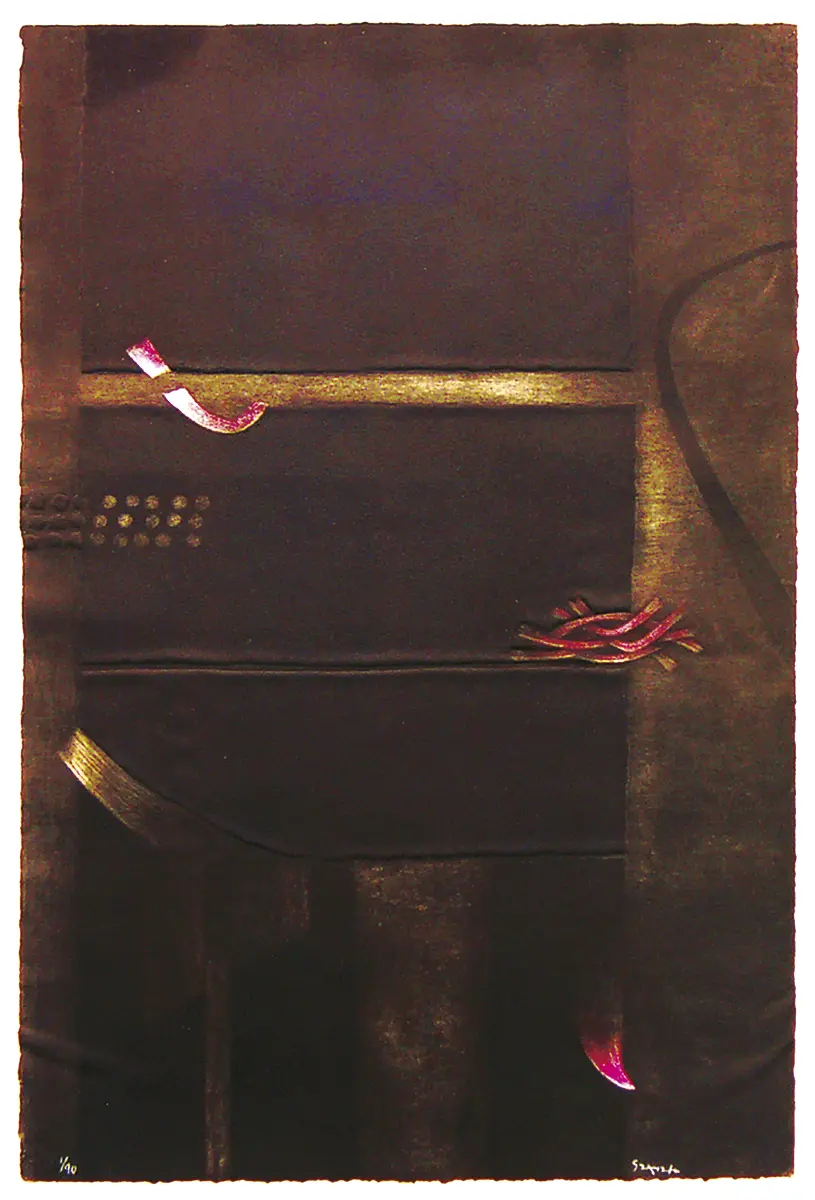
As evocative as de Szyszlo’s paintings are, the two prints in the show, produced by etching and aquatint at Bogotá’s renowned Taller Arte Dos Gráfico under the direction of Luis Ángel Parra and María Eugenia Niño, achieve a majesty of touch and intention. Velvety of surface and organic where the paintings seem laborious, if lovingly, made, the prints are equally imposing: the black, upright Ceremonia Uno, 2003 and the red Camino a Mendieta, 2003, horizontal as a tomb. All the familiar motifs are there. In Ceremonia Uno, behind a stack of rectangular forms that might be coffins or reliquaries or, in their unremitting, worrisome blackness, instruments of torture, the darkness gives way to a faint illumination. What is surprising about this is not the presence of light itself —which, like the force of knowledge, invades everything de Szyszlo does— but the way it’s revealed. Here and there are customary slashes of pink, yellow, and red, but the work’s primary glow has been achieved by leaving the paper nearly untouched; an unusual turn, indeed, in the labor-intensive de Szyszlo method.
Among the many notable things about the red print —conceivably a story of a deceased or sleeping sovereign and its hovering dreamlife or spirit— are the bumps and indentations so smooth they seem to have grown there. More remarkably, the veins and comet tails of color that crisscross the composition are made of the fine lines that only lithography allows. It is as if de Szyszlo’s concentrated efforts have scraped aside the skin of the artwork’s fibrous fruit or revealed its network of speeding, molten energies.
That so much dynamism suffuses works that are essentially about profound stillnesses —sleeping, age-old ritual, and death— deepens their mystery. This is why what the artist does is called a practice; why seeing a master’s work, no matter how often, is as much our reward as making it is his.
JOEL WEINSTEIN