
Chilean-born artist Francisca Sutil paints abstract canvases filled with bold vertical lines that echo over the surface in rich and dramatic hues. This exhibition titled Transmutations explores thematically the cycles of life symbolized through bands of color, such as red for life, yellow for transcendence, and blue for death.
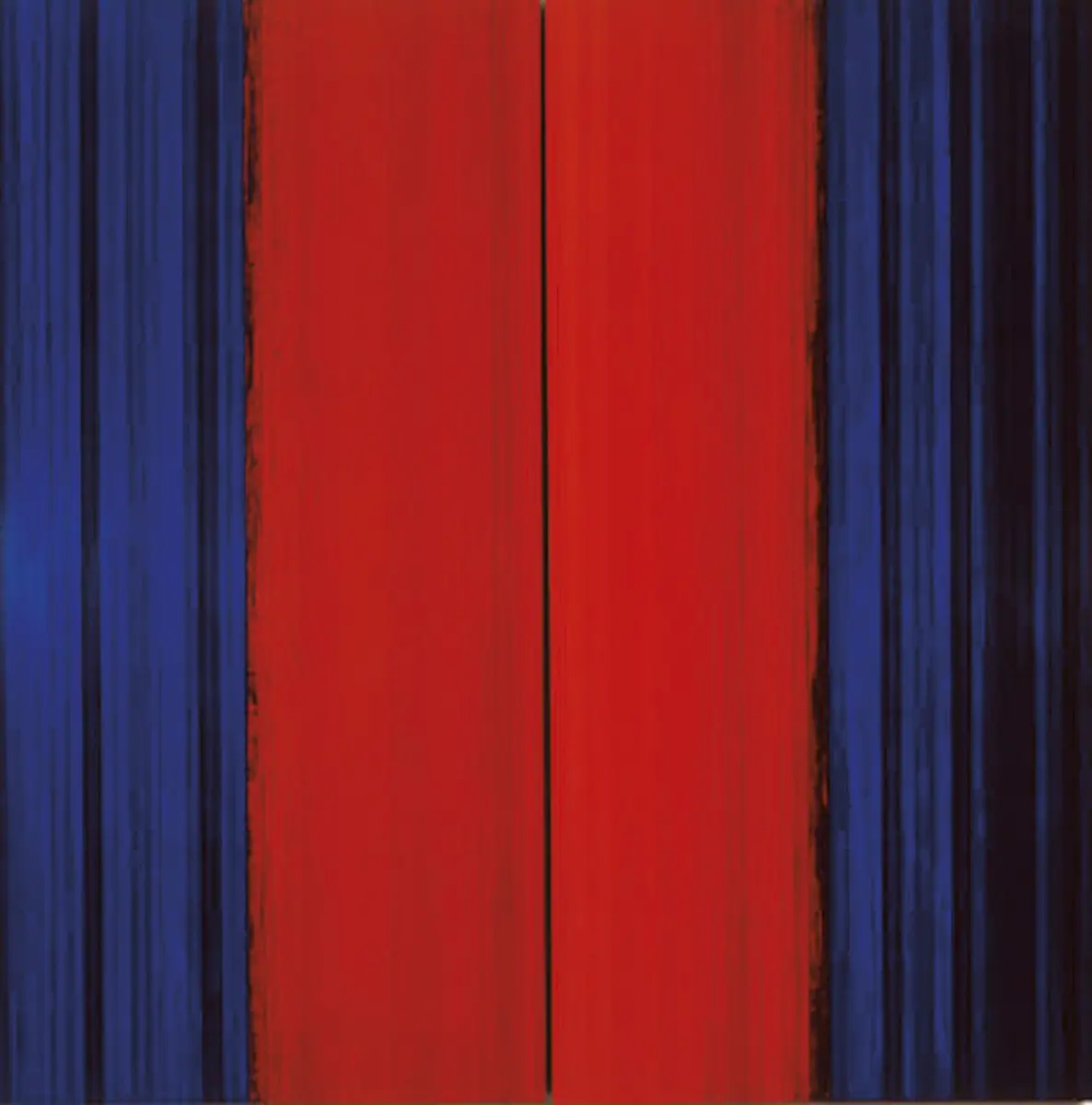
In the diptych Homage, 2002, radiant red pigment appears to bleed and pulsate in a broad vertical swath that defines the center of the painting. Even lines that vary from light to dark blue fill the spaces to the right and left of the scarlet center. Visual energy, similar to the work of the Venezuelan kineticists, Soto and Cruz-Diez, is created by the chromatic variations and pattern of repeated, parallel verticals. Unlike the Venezuelan artists, Sutil deliberately infuses her tactile work —oil on pigmented gesso on linen on wood — with an expressiveness born of evocatively applied and smeared pigment. Her lines appear at once regularly repeated in form but varied so that, for example, the left and right edges of the painting’s red center ebb and flow spilling over onto the cobalt verticals beside it. The artist touch figures significantly in the visual statement. This is not a seamless, mechanistically precise picture. It conveys warmth and depth equated with the themes of life and death the artist explores.
On a more intimate scale, Transmutation I, 2001 leads one from a life beginning, at left in shadowed reds, to its maturation in radiant scarlet, to its abrupt end in deep navy to black that fills the right half of the canvas. Vertical lines of pigmented gesso mark the tonal changes on palpable, one-inch-wide lines. The effect is dramatic. Tension builds as the red hues change from antiqued to bright tones then sink into inky darkness, from life’s onset to its conclusion.
In Passage, 2002 Sutil describes life’s cycle with her characteristic pattern of adjacent verticals, but does so in rich and varied pigments. This enormous watercolor on paper is 43 inches high and stretches more than 36 feet long, curving around two corners of the gallery. Beginning at the left, brilliant yellow and orange pigments saturate the paper in vertical paths, recreating the sensual effects of Morris Louis’s veil paintings from the 1960s. Unlike Louis’s paintings, Sutil’s colors flow downward and are carefully contained within her classic, vertical strokes, beginning and ending in a clean line. The tones build from lemon yellow to pale and dark oranges, to turquoises, greens, and robin’s-egg blue at the painting’s center. The remaining bands of color begin with blinding yellow, then abruptly change to cobalt blues, then to charcoal, and finally to black. Beneath the spectrum of hues filling this extended horizontal picture, Sutil penciled (in Spanish) the life stages these colors depict: birth, growth, and love are reflected in radiant yellows to oranges; the weakening of the body and the loneliness of old age in blue-greens; the time of remembrance in brilliant yellows; and death and its finality in midnight blue to black. Examined stage by stage, the watercolor absorbs the viewer’s eye and ignites the mind.
Although Sutil’s abstract works might be deemed predictable, defined as they are by repeated, vertical lines of color, instead they envelop and enervate us. The constancy of her vertical bands and the dramatic rise and fall of pigment tones within a textured ground, draw the eye into a complex, ever-changing interplay of lines and colors. An abstract language is often difficult to express convincingly and Sutil manages to articulate both an original and enduring statement.
MARY SCHNEIDER ENRÍQUEZ