
The Zulia Museum of Contemporary Art is one of the largest cultural centers in Western Venezuela. Located in Maracaibo, the capital of the state of Zulia, an active city full of contrast, it celebrated its fifth anniversary in October 2003. Five years have been dedicated to supporting the work of Zulian artists and consolidating an institutional profile increasingly open to the present. And to commemorate the occasion, the Museum’s Sala 5 presented Nostalgia de lo real, an exhibition of works by Francisco Bellorín comprising 42 recent pieces created by the artist during his last stay in Paris (1999-2002).
José Francisco Bellorín (Caripito, Monagas State, Venezuela, 1941) is considered one of the most important Zulian artists, although he was born in Eastern Venezuela. His ties to Zulia began in the 1960s when he settled in Maracaibo after completing his studies in Caracas and Europe. Today he is acknowledged not only as a painter but also as a teacher, graphic artist, and mentor to generations of artists. His work has remained cohesive throughout a 30-year career in which the study of the history of art, a formal interest lined to the avant-garde, and the appropriation of everyday elements have combined to produce a discourse that is as stable as it is ever-shifting.
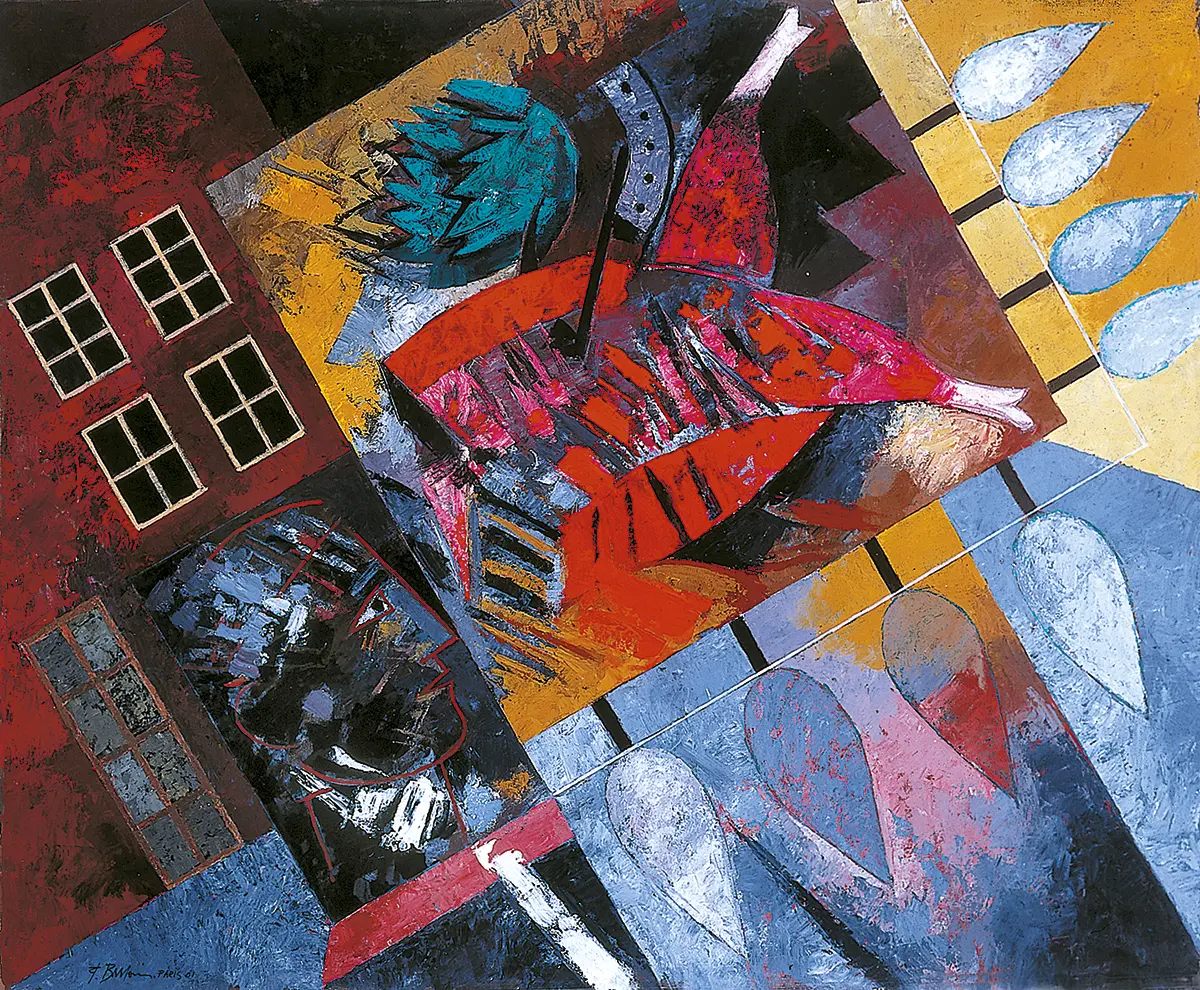
Nostalgia de lo real marks a transit. It is thematic since it shows us the reality of nature and artífice; the world of landscapes, of vegetal exuberance, of dawn lights and birds, presented next to human constructions, the space of cages, tables ready for the feast, dance steps, bridled horses, and wounded birds. The nostalgia of the real oscillates here between these two worlds in order to build themes that are simple and readily identifiable, creating a communicating bridge distant from any conceptualist intention, but profoundly symbolic. The artist feeds on remembrances and lived experiences to present images displaying an exquisite technique and a fascination for the accidental, whose vital force is immediately perceivable. We find, thus, birds that speak to us of freedom and death, architectural spaces that reflect urban violence, and colorful still lives that celebrate life.
Besides the thematic force, we find in the exhibition’s 42 paintings, there is the mastery of drawing and color that we have come to expect from the artist. Drawing and color are used to solve the pictorial space through fragmentation, delimiting planes with contour lines that are clearly defined, and using small blotches in various tones that work as backgrounds on which the figures, generally painted in flat colors, are differentiated. Bellorín rejoices in the revision and superposition of pictorial styles that are the legacy of the avant-garde, provoking a stylistic transit between abstraction and figuration, and producing a body of work rich in historical references but undoubtedly original. A body of work in which the artist displays the features that have distinguished him throughout his career: an interest in Cubism, Surrealism, geometric abstraction, and African arts, in what amounts to a sum of styles filtered through his personal interpretation.
Finally, Nostalgia de lo real is a transit of the artist through his own oeuvre. Bellorín recapitulates in this exhibition a formal, thematic, and expressive synthesis of his own history as a painter, approaching his work through the creation of new works, in a profoundly reflexive artistic exercise.
SUSANA QUINTERO