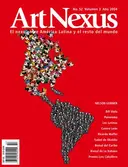
In her most recent show, (her second in France,1 but the first one in Paris), Graciela Sacco presented two interventions in different spaces —the building’s interior and exterior— and two different times. This fortuitous metaphor of oppositions would seem to be perfectly apt for the artist if we take into account that her work is built around that axis of reflection. Indeed, it is precisely the capture of such a dual notion of time and place, materialized in a constant real or virtual movement, that lies at the heart of the profound coherence of Sacco’s work.
Sacco came to Paris for this occasion inscribed in a wider event: the city’s Foreign Cultural Centers and Institutes Week. Her intervention was part, particularly, of Paris’ second nuit blanche (sleepless night,) for which the organizer convoked foreign artists (among them James Turrell, Yann Kersalé, Ange Leccia, and choreographer William Forsythe) to “illuminate” with ingenuity and imagination the French capital’s architectural patrimony. Thanks to them, as night enveloped streets and squares and attempted to drown the city in anonymity, Paris found itself inhabited from outside, awakened by images that took over its churches and bridges, as well as its theatrical, political, and administrative institutions.
As soon as one enters a public space, escaping from other people’s gazes becomes impossible. It also happens that one is permanently and against one’s wishes subjected to moving images —since screens are found in train stations, cafés, department stores, and every other place of transit and human concentration— that please us, even if they stupefy us: arrogant, noisy, often absurd propaganda images showing, in frantic succession, car races, brand shoes, a touristic flash on Dubai, political images —the BBC World Service—or an MTV music video.
Fortunately, with Graciela Sacco, we are situated in a different plane and at a different time of the image. Her aesthetic images, full of meaning, are worth our while, because the artist plays with what is evident and ephemeral without ever forgetting, in this voluntary ambiguity, her main interest: the human dimension. The video was presented outdoors (all night long, starting at 9 pm) on the Latin America House façade facing Boulevard Saint-Germain, was two and a half minutes long, and ran on a loop. This piece, part of the series Sombras del Sur y del Norte, focuses on individuals, men, and women, filmed randomly in the streets of Buenos Aires, Paris, or Rome. It is a slow parade of faces, and, above all, of gazes on which the artist could stop for an instant and then continue in order to unfold before our eyes that anonymous line, as an insistent human litany. In this mute and shifting interrogation, accompanied only by the (recorded) sounds of each city and by those (real his time) of Boulevard Saint Germain, Graciela Sacco questioned the boundaries between the truth and non-truth of the image through each face, where we read a secretly anxious interiority. The artist interrogates herself and at the same time interrogates us all, while the incessant progression of her line, “which is like a moment of transition, an active hope; we know nothing of the other, even as that other is there,” provoked a dialog between the different gazes.
To gaze, to be gazed at; to appear, to disappear. The dialectical motor of Graciela Sacco’s video is the fact that those who gaze can in turn become objects (or subjects) of the artist’s intention. Her gaze knows how to look at others, and it is filled with profound affection, something very rare nowadays. Her awareness of the city as a crystallization of chaos, with people in line and waiting, the density of population… brings us to a different question posed by the Argentinean artist about those who stay and those who leave, alluding to what has become a global phenomenon: the movement of populations, migration for both economic and political reasons. However, what interests Sacco is a metaphor and not brute reality, emblematic images rather than historical images. This is why she uses sepia, alternating it with various colors, to install a subtle and temporary distance that authorizes viewers to find their own emotional and reflective distance, so different from the distance generated by certain image spectacles of contemporary art, whose motor is a brute and brutal reality.
Inside the building, in an almost square room, Graciela Sacco created an installation on the basis of a functional object to which she gave a new use. It was a heliograph used during World War II to send messages by reorienting sunrays reflected in a system of mirrors. This strange machine was at the heart of Sacco’s installation, where a single source of light provoked the unfolding of images, shadows, and lights and created a private space opposed to the public space of the video. The light source (a laser lamp) was reflected by five mirrors and sent to five separate points in the room, traversing two glass sheets “printed” with, in one case, a face, and in the other a succession of human silhouettes waiting in line. These two image sources gave origin to innumerable image reflections spread on the walls, and, by the same token, to a fragmentation of vision: at once present and absent a sudden appearance of the image. An ephemeral writing of the transcience of man, of his reality/unreality both human and social.
The apparatus installed by Sacco resembled a kind of insect with several heads irradiating images, projected and amplified shadows, and reflections on a visual labyrinth of extreme subtlety. There was also, on one side of the room, a series of narrow sheets (about 20 x 5 cm) hanging from the roof by transparent threads, on which the printed image (an anonymous character) was visible only through its reflection on the wall. There were also other sheets, placed perpendicular to the walls, and lots of patience and focus were required to discover the image reflections, barely sketched in their virtuality.
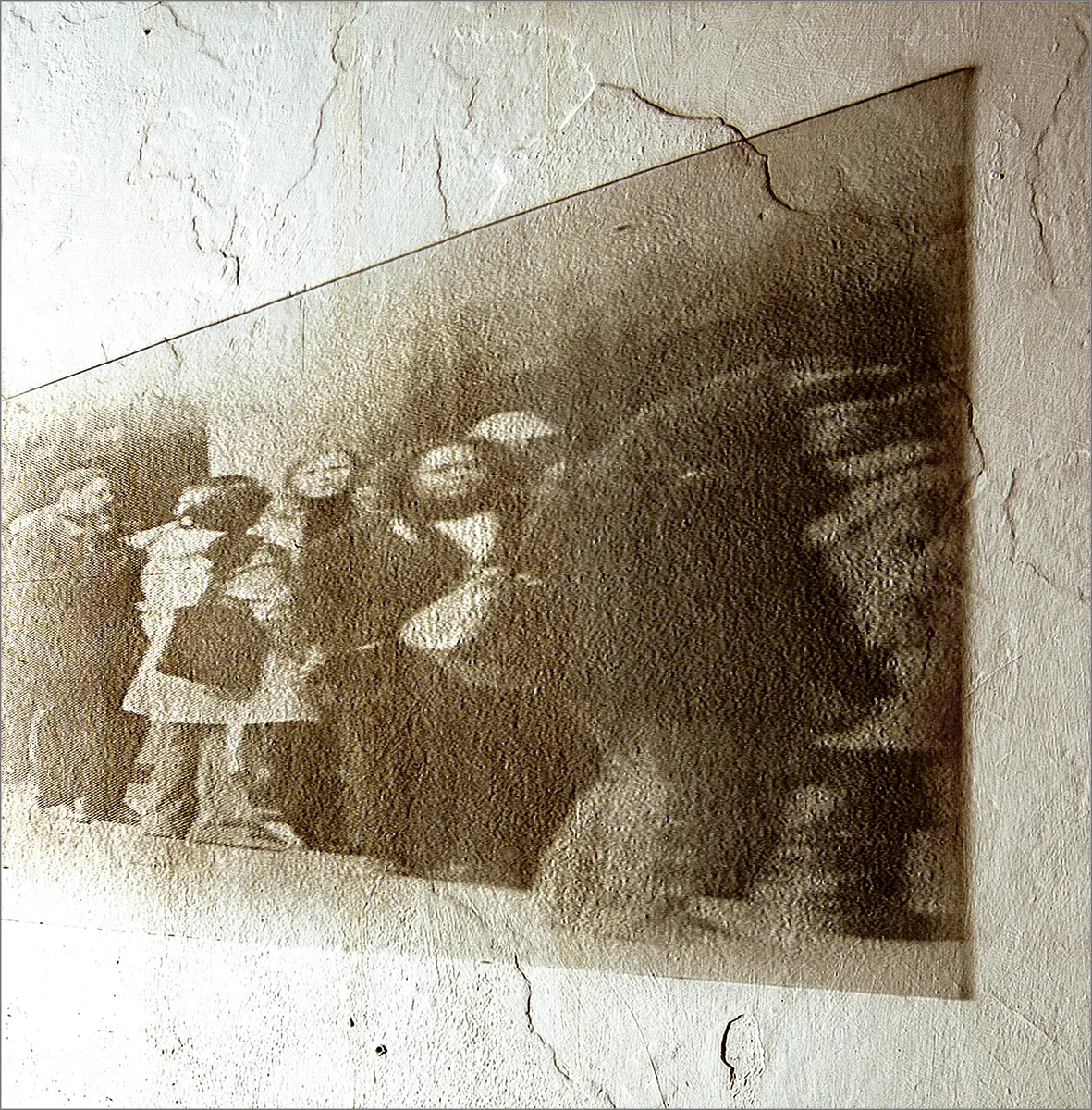
For this artist, reality is always in movement, nothing is fixed, everything can change, and light is an active metaphor for such mutability. A source of heat, the violence of the flash on our retina, we observers were absorbed by a disconcerting ambiguity between the real and the virtual; everything seemed incomprehensible and the blinding light became then an eye that interrogated us while changing the surrounding reality as it pleased.
This new show, modest in size but rich in conceptual and plastic complexity, was disturbing both for the impact of its suspended time and the immateriality of its images reflected on ochre walls. One started to wonder where one was, who one was. And then, as an air current made the lass sheets oscillate quietly, the image of their shadow moved, and magic settled in a permanent way, and one’s fleeting uncertainty was dispelled.
NOTE
1. Crazy River Festival, Toulouse (July 2002)
CHRISTINE FRÉROT