In his exhibition at Galería Enrique Guerrero, Héctor Falcón (Culiacán, Sinaloa, 1973) presented fragments of three series, some finished and some still in progress: Compressor, Link, and Registros vitales, as well as a live-action.
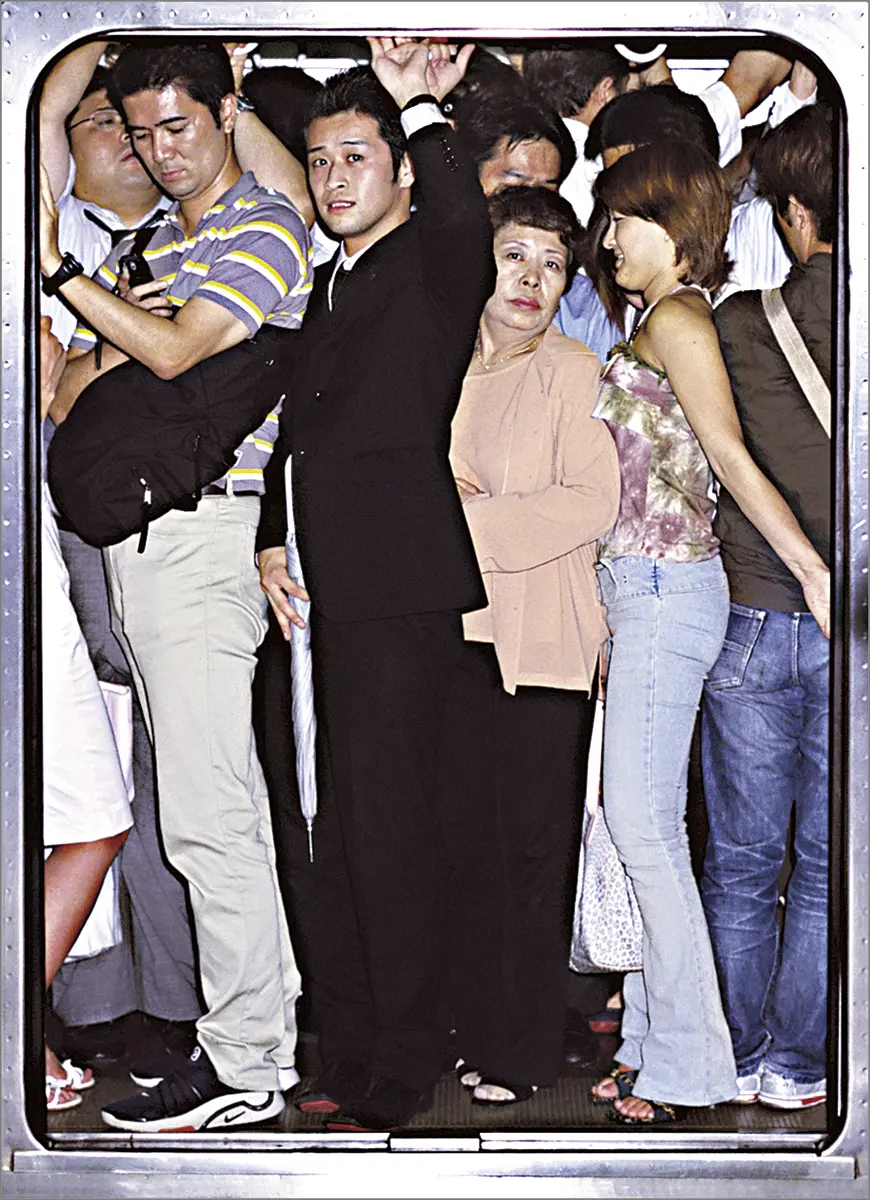
The Compressor series includes photos in the snapshot vein, taken as the doors open on an underground train in Japan. According to the artist, one of the reasons that drove him to think of and create this series was that when the coach doors opened, the drowned characters inside appeared to be framed by them. This natural frame compacting anonymous people played, since the original conception of the work, a crucial part in the composition of each image. In this way, Compressor is a portrait of people in transit, at a time when their vital space has been reduced to a minimum and is essentially located within a container, and, as such, inside a frame that can be anything from metaphoric to virtual.
Link is a search for unity between real characters on the basis of their accessories or body adornments, for example: joining a group of Japanese adolescents by their piercings, trying to complete a chain that would keep them all together on the basis of that symbol of individual authenticity that makes them all similar. Link is a work in progress that explores the union of bodies on the basis of decorative elements, which can also be taken to a metaphorical level by establishing relationships based on what makes us different, which at the end of the day is exactly what makes us similar as well, or which at any rate becomes a sign of exclusivity for a social group that quickly grows into a generational majority.
Registros vitales is a series of photographic recordings of the artist's body subjected to temporary and permanent manipulations in order to explore both canons and social concepts that have little to do with the body’s natural processes, being instead a social matter, and as such, temporary, localized, and historical. Although Falcón does not see his work as inscribed in the context of Body Art, his main instrument is the body itself. In this series, Falcón uses only his own body for modification and subsequent register. As examples of a permanent modification, a couple of tattoos on his feet’s insteps, designating the opposite side of what they mark (the left foot showing the word "right," in English, and the right foot the word "left"), or the word "pain," also in English, burned into the artist’s skin with a branding iron so that the word and the concept remain visible on his forearm. This piece was recorded in video, photography, and on Falcón’s body. In terms of temporary modifications, there is an extensive catalog of designs and alterations of body hair and chromatic games with the skin at different degrees of sun exposure, or thanks to tanning chambers, etc.
On the day the show was inaugurated, the artist orchestrated a live-action placing in the gallery’s main space two manicure tables, on which silicon nails were applied to five models wearing tiny skirts and white tops. The nails were later painted with colorful designs and linked one by one to the models to form a chain based on these artificial extensions. After the action, the chain of models posed for the remainder of the inauguration cocktail as one more piece in the exhibition.
Falcón’s interests are as varied as the media he uses; there is, however, a particular interest in what is considered beautiful, aesthetically, and socially acceptable. His work is a portrait of a present overwhelmed by too many models to follow and too many contradictory influences that complement each other by clashing.
FRANCISCA RIVERO-LAKE