
Luís Fernando Peláez has come to Madrid with a show at Fernando Pradilla gallery of ten recent works that, in principle, ratify in their apparent or real newness the artist’s commitment to —or, if you would like, his obsession with— architecture. Among contemporary Colombian artists, as is perhaps known, Peláez’s relationship with architecture is the most fertile and intense. Having been an architecture student himself back in his native Medellin, his work has always revolved around a handful of figures and topics such as houses, streets, plazas, benches, lampposts, and the kind of anonymous, miniaturized people —us— that characterizes any big city. These figures and topics do not enter Peláez’s work as paintings or photographs, but as sculptures that for the most part possess the size and scale of architectural models. Yet their appearance is a far cry from the white, aseptic look habitually demanded from the latter. Unless this demand is a thing of the past now that AutoCAD and its impressive virtual images have eroded the primacy of modeling (and of perspective) in the three-dimensional representation of projects.
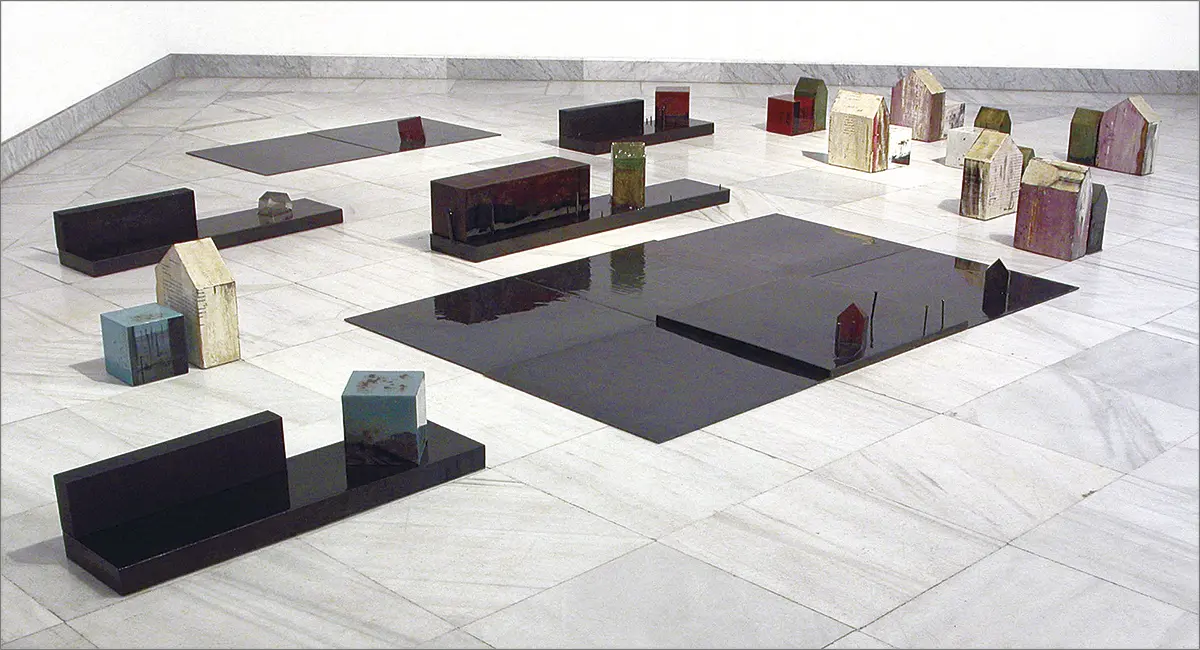
But even if one account for the inevitable devaluing of models, and the parallel between them, Peláez’s work still holds; Peláez’s pieces are usually done in scale, in metal and wood, and are covered by a synthetic resin film that gives them a disquieting look, between vaporous and viscous, as if they were completely inundated, each one of their parts soaked in rain. And although they are equally schematic as their architectural counterparts, such schematization becomes particularly unnerving in Peláez’s houses, simplified to the point of being reduced to a blind volume covered by a roof. Houses that would be just like those built by American artist Joel Shapiro, if it weren’t for the film that covers, estranges, and displaces them towards a territory of melancholy or nostalgia. In other words, that same undecided, in-suspense territory where all photographs are located, and not only those Peláez has started to print recently on his minuscule houses. A territory of loss, of forgetting, on the edge of amnesia.
In Peláez’s Madrid show all of these issues, all of these bets, were in play. But there were differences, and variations worth mentioning. Starting with the show’s title itself: Azar (Happenstance) is a term, a concept that condenses what has always been and continues to be, today more imperiously than ever, a defining characteristic of any large city, be it a metropolis or a postmodern, globalized post-metropolis. Our life in such a space is so firmly subjected to happenstance that nothing, not even the most comprehensive plan for political and urban security can guarantee our freedom from it. We are permanently exposed to the uncertainty of what may occur without notice. We are exposed to accidents, and worse, to catastrophes. I don’t know if this meaning of Azar is the one in Peláez’s mind when he chose the title for his new show, but I do know how he deals in these works with memory, one of the few solid points on which, supposedly, we can anchor ourselves as a defense against happenstance. That memory, or better yet, the space of memory, often vindicated by Peláez, becomes in his works, in his reiterated architectures, a ghostly, phantasmal object. A definitely sinister object. There is no possible cure we are offspring and victims of happenstance and Peláez offers us a warning.
CARLOS JIMÉNEZ