In October 2003, Galería Biaggi Faure presented an exhibition of abstract paintings by Puerto Rican artist Noemí Ruiz. The exhibition comprised 14 canvases in different formats in which the artist elaborates an abstraction of shapes in movement. Noemí Ruiz adopted this line of work in the 1960s, during a stay in Spain, echoing movements directed towards a break with figurative art. She started as an abstract painter in the geometric variant and later cultivated an abstraction of lyrical tones. This last inclination was to mark her painting for the next four decades, and on that basis, Ruiz has created a body of paintings that privileges irregular shapes of precise, neat contours, defined by the counterpoint of contrasting colors and tonal variations. Her compositions are in some cases defined by shapes that cluster together and shrink in eccentric areas or at the center of the pictorial plane. They are distinguished also by a clean execution that leaves no room for risk or chromatic blurriness so that transparencies and layers of color are not compromised by impurity.
Formally, Ruiz’s art relates to the modern vision; I am referring to the historical avant-garde, with a kind of painting that is absolute and pure and has no relation to objective reality. Nonetheless, her works, accompanied by descriptive titles, do not seem to assume abstraction as an independent, autonomous universe, but as one that is anchored first in a specific place and then in a specific time and history.
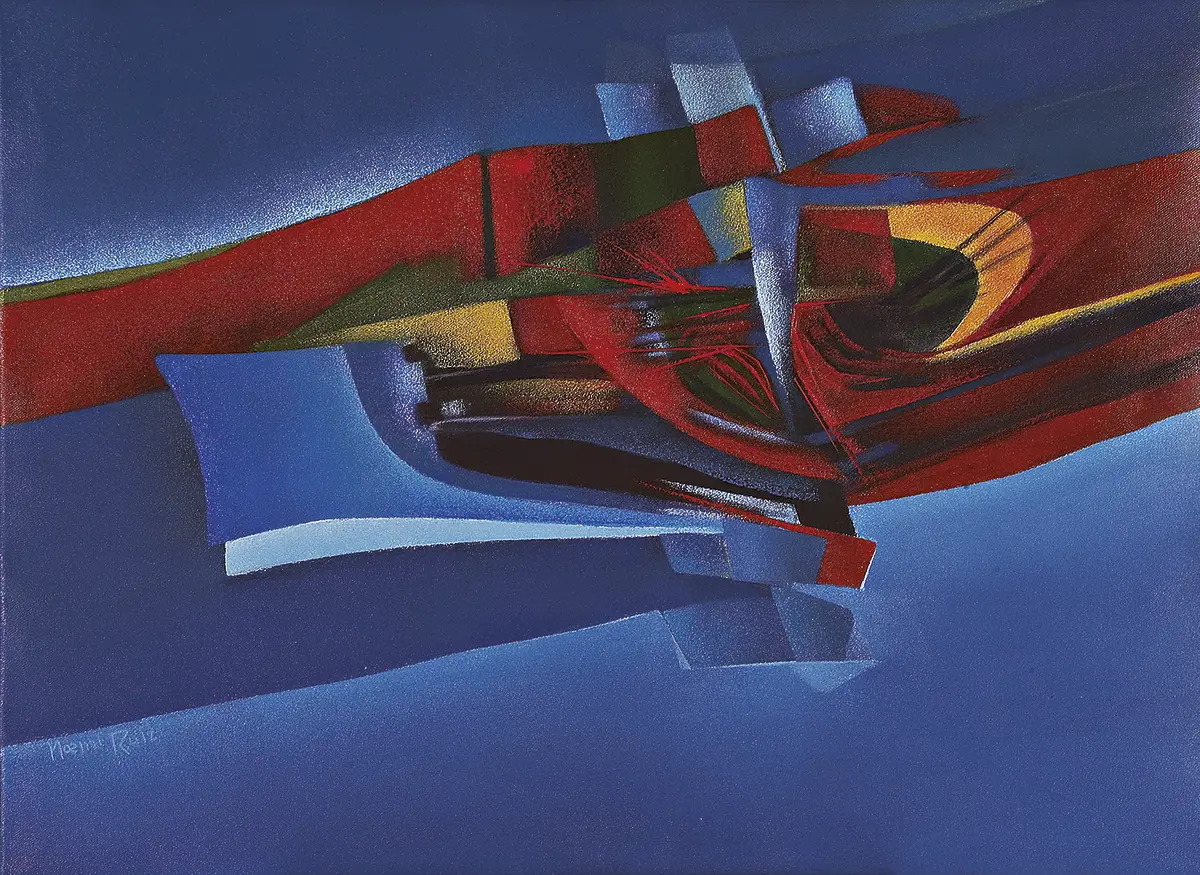
The show’s title reverberates with its emphasis on geographic and historical coordinates, which are moreover personalized with a possessive pronoun, mi. In a previous show, titled Presencia caribeña, the clues in the title announced a “presence” defined as the Caribbean in the abstract image it delineated. A local critic pointed “the list of works in the catalog confirms the artist’s intention to associate her paintings to geography and to the ethos of origin."1 The critic continued by adding: “The artist’s passions for a way of acting have passed through the sifter of purity by way of design, color, and light.” The critic seems to suggest that the text is neutralized by passing through the sifter of design, color, and light. This implies that the purity of abstract art, which in its origins was equaled to form, works as a filter of all contaminating elements that would compromise its truth. It seems to me it is precisely this that poses a conceptual incoherence, an antinomy between the title (texts) and image. Such an operation is not conceptually naïve. The problem does not reside in the artist’s freedom to do things one way, or to impose certain associations on the basis of certain personal experiences, but in the fact that the way in which things are done compromises the formal autonomy all abstract art aspires to, subverting the relationship —established in the beginnings of abstract art by painters like Kandinsky and Malevich— between title and work” the impossibility of associating visual language with a referent and a textual language.
The titles of Ruiz’s paintings, such as Tierra Caribeña, textura y calor (Caribbean Land, texture and heat), El intruso coquí (The Intrusive Coquí), Paisaje cambiante (Shifting Landscape), El paisaje de mi isla no siempre es verde (The Landscape Of My Island Is Not Always Green), operate as descriptions and impose on the images an association with geographic, cultural, and ethnic referents that assert to the observer an origin and a function for this art.
The freedom longed for by the historical avant-garde and the movements of art-for-art’s-sake are not assumed by Ruiz’s painting as an achievement, but as something that could compromise its loyalty to a vision of local art. That vision is imposed with authoritarianism and insists on claiming that in order to be authentic, all art has to be authentically Puerto Rican. Derived from this tendency is the establishment of a bridge between abstract form and context. El paisaje de mi isla no siempre es verde, Tierra caribeña, textura y calor seem to respond to a need for specificity that situates Being in a topos from which it can define itself in an essentialist way. Ruiz’s art seems to be saying that in the face of a globalized artistic context and the assumption of an empty, generic landscape that erases differences or incorporates them all, the tile of a work of art is a kind of guarantee against the radical possibility of having abstraction refer to nothing. According to David Carrier, “abstract paintings are self-sufficient entities, they refer to nothing outside of themselves."2 The need to singularize, to determine the specificity of an art through what is legible reverts into a practice that is deepened by the disappearance of metanarratives. If form as a visual language assumes its universality and transcends national boundaries, the meaning that is assigned to it through written language situates it within the parameters of an unshared singularity. According to Louis Marin, the first reading of a painting as “name,” as title, pre-announces any possible “reading” of it. In the case of Ruiz’s painting, the reading of a narrative guarantees that the abstract form originates in a known referent, a referent that is native, distinct, and distinguished from any other precisely by not being universal, by being from here. Contrary to the avant-garde feeling that culture was strongly rooted in tradition, Ruiz seems to insist on a communicating vessel between her art and her native culture.
The function of her titles would seem to be to compensate for a deficiency of the form. They would compensate for what is assumed to be missing in an abstract form, which remains mute about an objective reality that can nonetheless be accounted for through words. The titles frame abstract form at the same time they operate as a deferred contemplation of what without them we would possibly not see in the image. Textual language “connects” and “corrects” the image, with the words on the title as our best guide to the painting’s meaning.
Ruiz’s exhibition, interestingly, harks back to the history of abstract art in Puerto Rico and to the debates about its relevance to the local context, even though it has been said that whether one chooses abstraction or figurativism is no longer a problem for the expression of communication of a particular worldview. The matter seems not to have been entirely solved at the local level, even after the abandonment of artistic ideologies.
I think this practice points to a period trend in local art, a trend dominated by the anxiety to legitimate every artistic mode, particularly those without referent inside coordinates deemed acceptable by the imperatives of cultural neo-nationalism. There is also an interest to make acceptable to the public and the market an art that through the text reasserts its identification with the native, with an origin and a being whose spatial and temporal coordinates are assumed to be clear in the national ideological imaginary.
The freedom reached by artists in the Modern period, the belief in the autonomy of art, doesn’t seem to be enough to justify this abstraction. Some continue to see it as a kind of art that turns its back on its “social function” and does not have the signs of the native. The environmental metaphor seems to be indispensable as a presentation for Ruiz’s art, which, although accepted by the local institutional apparatus and a wide segment of the public, even today provokes a certain discomfort.
Noemí Ruiz’s art has an important place in the history of abstraction in Puerto Rico. Its contributions can’t be questioned. Alongside others, Ruiz tenaciously cultivated this artistic style when it was not altogether acceptable. Nevertheless, at the beginning of the new century her art, an example of technical virtuosity, seems trapped in formulas and frozen in time. It would seem that the impossibility of assuming impurity, risk, and the “nothingness” of the non-objective has become an obstacle to artistic freedom to come alive. Ruiz’s proposition, like those of other abstract artists, is a clear example for the study of the conditions of possibility of this art in Puerto Rico.
*Edited version.
NOTES
1. Enrique García Gutiérrez, “Los colores del Caribe”. El Nuevo Día. Revista Domingo. October 26, 1997 1997, p. 13.
2. David Carrier, The Aesthete in the City. The Philosophy and Practice of American Abstract Painting in the 1980s, University Park, The Pennsylvania State University Press, 1994. 95.
INGRID MARÍA JIMÉNEZ