
In Parallel Lives, conceptual artist Pablo Helguera offers a theory of knowledge based on quasi-mystical congruencies among historical figures. These layers of arcane history and colorful anecdote pile on top of each other like a cosmological trifle. The resulting concoction is delightful, messy, and illuminating.
Parallel Lives is the latest phase in the Mexican artist’s ongoing investigation of historic eccentrics, namely: Florence Foster Jenkins, the early-twentieth-century musical dilettante; the Shakers, a nineteenth-century religious community; Friedrich Froebel, German inventor of kindergarten; Ward Jackson, Helguera’s former colleague at the Guggenheim Museum; and Giulio Camillo, a sixteenth-century hermetic philosopher known for his zodiac-influenced Teatro della Memoria.
What links these figures is Helguera’s touching conceit that all were misunderstood or ahead of their time. In fact, all failed in various ways to achieve or sustain their life’s work. However, each figure articulated a personal vision and useful methodologies that would be revived in new forms in subsequent eras. All were “late bloomers,” so to speak.
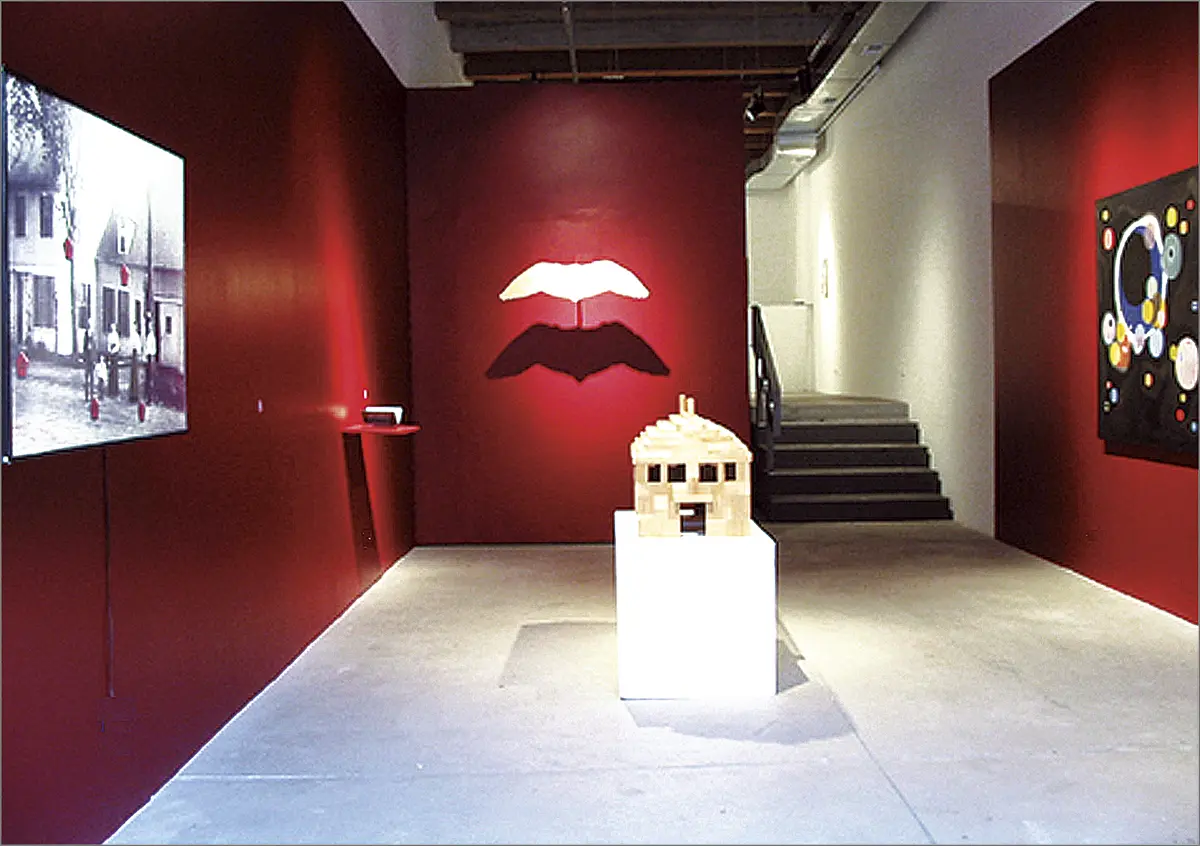
Helguera uses traditional exhibition techniques and a lecture-style presentation to convey historical data about these seemingly disparate characters. Simultaneously, the artist makes unorthodox leaps between the figures, imaginatively linking their lives and work. With sounds and images, these alternate parallel tracks subvert the more conservative structure of chronological time and assert new criteria for deriving meaning from history.
In the gallery component of Parallel Lives, the historical figures are represented by objects on pedestals. These include wings similar to those worn by Florence Jenkins during concerts, a Froebel kindergarten primer, and a model of a Shaker meeting house. The exhibition is accompanied by an Acoustiguide (narrated by artist Fred Wilson) that provides “five alternative readings for each object,” one from the perspective of each historical figure.
By overlaying these objects with multiple narratives Helguera’s project takes flight. Like a philosopher’s stone, the object displays and recorded texts serve as a dynamic intersection where aesthetic, social, and spiritual values are lifted free of specific histories or disciplines. Gallery visitors discover these golden nuggets of cultural wisdom on their own, as they listen to the colliding historical narratives.
Likewise, Helguera’s performance gained speed when links began to appear among the biographies. Structured as a sort of metaphysical PowerPoint presentation, the performance might have been mistaken for a “Fundamentals of Western Civilization” lecture, but for several bravura flourishes that stimulated the senses beyond the history lesson.
First, the artist sang four songs associated with the eras of the biographies. The songs were recorded on wax cylinders with an antique, horn-style phonograph. Other photographs were placed throughout the theater to play back these new recordings, along with a hilarious, ear-splitting selection from Mozart’s Magic Flute recorded by Florence Jenkins almost a century earlier. It was uncanny to hear the voices commingling across time, interfaced by an obsolete technology also operating “out of time,” culturally speaking.
Without acknowledging what was occurring, Helguera intensified this anachronistic feeling by layering the slide images: a Shaker spiral staircase was superimposed on Frank Lloyd Wright’s Guggenheim Museum; a portrait of Giulio Camillo over a page from the Google search engine website. Slyly, Helguera allowed audience members to perceive these relationships on their own. In so doing, he effectively demonstrated that the mind is a public domain where knowledge is meted out haphazardly but not without consequence—relationships between people and ideas are inevitable.
By the end of the presentation, a humorous, detailed, and somewhat spooky web had been woven around the individual biographies, suggesting a deeper, more spiritual affinity among human strivings than might be ascertained by facts alone. Helguera summed this up well, paraphrasing the hermeneutic German philosopher Hans-Georg Gadamer, “We all are others, as much as we are ourselves.”
Parallel Lives was presented at Julia Friedman Gallery, Chicago, October 24–December 6, 2003, and at The Museum of Modern Art/Gramercy Theater, New York, December 8, 2003.
JOHN EWING