
A way to think about Ajuste de cuentas, René Francisco Rodríguez’s individual show at the Museo Nacional de Bellas Artes, could be to find in it something of a pretended summary of his projection as an artist, implicit already in the exhibition’s very title. However, and beyond that balance, one of the show’s distinctive and integrating elements was the process-oriented character of Rodríguez’s discourse, as well as, breaking with the markedly self-referential character of his work, the critical perspective of his assessment of Cuban reality.
The moderate lighting reinforced the atmosphere required for a presentation that made important use of technology, placed in the function of documenting or fictionalizing —depending on the case— certain narratives, previewed by René Francisco, through images on a TV monitor, slide projections, or video.
The half-light established a territory apt for complicity between artist and viewer. The immaterial shadows of objects and people, at times, intermingled, acquired a place, and appropriated a value between the half-tones and grays that in material terms brought to mind the artist’s earlier works. The Museum gallery put aside, for a while at least, its habit of neutrality and its emotional neatness and made room for multiple dialogs of shifting intensities, in a space where shades (only in the scale from white to black) reigned in the physical space occupied by painting, especially the space where the different characters were placed.
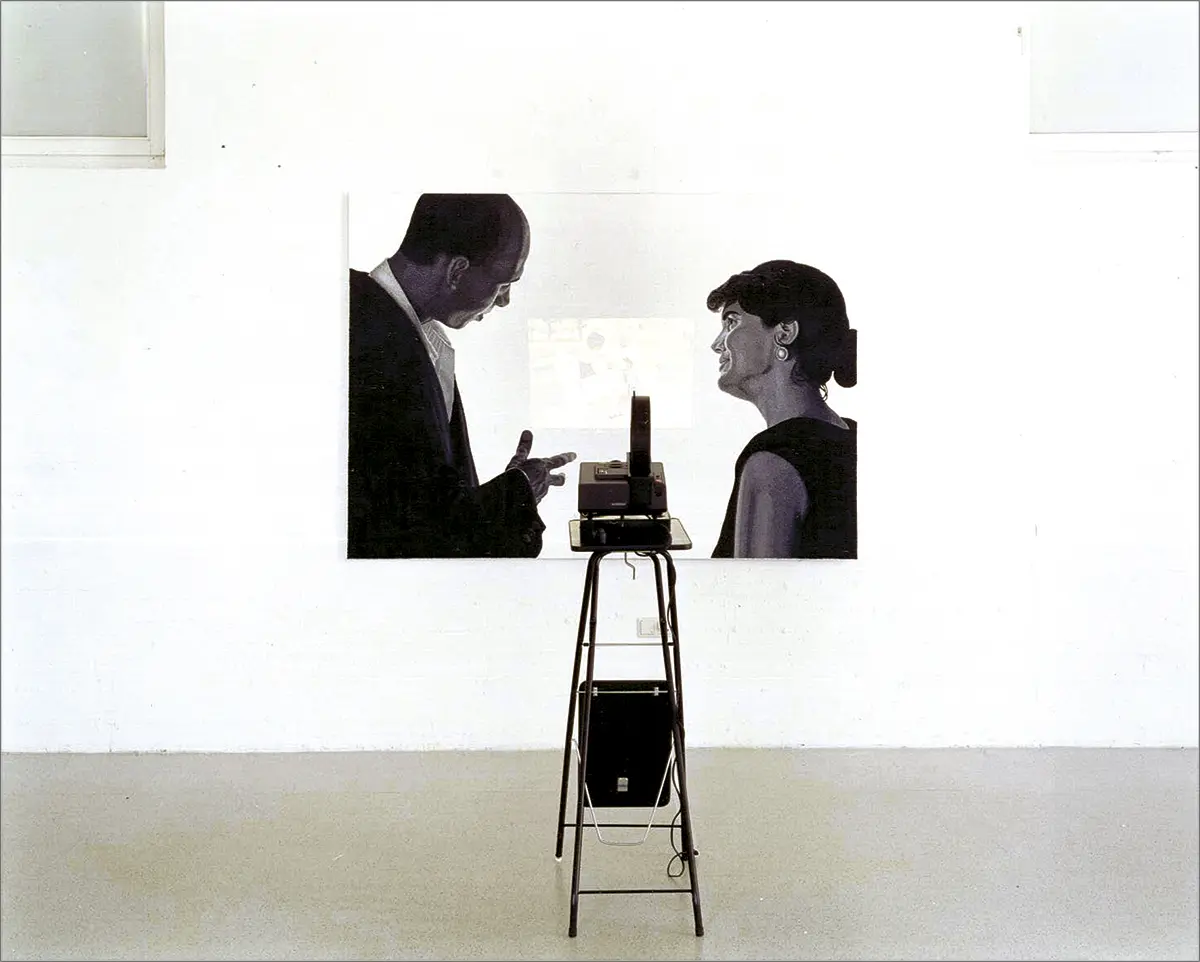
Almost all the white backgrounds painted on the canvases had been reserved to function as screens. Screens, and double supports —for the paintings and the projections— mediate to complete the details of the stories, but are capable of breaking beyond two-dimensional confinement, given the integrating relationship between the different parts of the group’s six pieces. The paintings lit by projection, the atmosphere that surrounded them, and the time (as well as the rhythm of the different narrations) in which they were carried out demanded that the viewer experience them as life is experienced, enjoying their implicit performativity, which satisfied the artist’s need to dialogue with the visitor.
A segment of René Francisco’s universe of relationships was exhibited along with his life experiences, of which, on being represented, he was an actor. His ties to art, his methodologies, the private character of those relationships, and, more than the public element, his work inscription and social commitment. Ajuste de cuentas emphasized some of the contexts in which individuality operates, in its constant flux and fleeting permanence.
In Los cuadros por encargo, gratis the artist presented, as part of a vide-installation of multiple symbolic statements, the film documentation of the relationship he was able to establish in 1990 with the inhabitants of a community in Santa Cruz del Valle, in Ávila, Spain, from whom he had created commissioned paintings free of charge. This interest in the social inscription of art, from an individual perspective, returned just at the moment when he had begun to sketch out a structure in his sociological reflection, above all in relation to the practice of teaching, imbuing with special energy his work at the Instituto Superior de Arte since 1989 with a project titled Desde una pragmática pedagógica.1
Something else that needs to be mentioned in this exhibition is the fact that it deals with the portion of the artist’s work that relates to the 10-year collaboration with Eduardo Ponjuán that ended in 1996. The installation titled Entropía highlighted, albeit not in a very anecdotal fashion, the conceptual rigor of that relationship, the exchange, and contrast of ideas it derived from the two artist’s strategic association as a particularly cohesive and enriching force in contemporary Cuban art.
At the same time, marriage as an institution was dissected —in a context where the machista gaze still persists— regarding the existence of double standards, unfaithfulness, and promiscuity in relationships, as well as to the roles assigned each of the parts according to a socially-established script and the transgression of moral and ethical boundaries. Filigrana was the set René Francisco put together for that purpose, in an operation in which his wife and daughter also participated.
Against the grain of the autobiographical tone in Ajuste de cuentas, in A viva voz the drawn location emerged from the visual patrimony we all share in Cuba today. A polemic imagination in its reading of the contradictory reality projected in the midst of an auction. A tension established by the reiteration of old American cars that, as a fixed motif, alternated with projections of paradisiacal beaches, landscapes with palm trees, exquisitely transparent waters, dusks, various city locations (the Gran Teatro, a drugstore, an empty lot, a drawing class, the ISA domes, a filthy and dingy bathroom) or a girl’s longing face.
In ca()a.persona.beuys (version II), the artist carried out what I would like to call a propitiatory work of art. It attested to, on the one hand, the artist’s methodology in his attempt to have art be relevant for the community, and, on the other, the proper solution to inscribe it in a coherent way in the exhibition itself. Besides the homage to Joseph Beuys —explicit here, implicit throughout the show— the viewer was turned into a subject of representation, while another work, a color serigraph on a light box,3 integrates itself to the artist’s pictorial action, functioning as a statement of the rules established for the action already in course.
Following a survey he conducted in the humble Romerillo neighborhood in Havana, the artist determined who was the neediest person in the community, and that this woman had devoted her life to the service of others, René Francisco undertook, with the necessary funds, what in his research he had called “an act of reward.” In his video installation A la ca()a de Rosa, a canvas presented the portrait of an olderly woman named Rosa. The effect of the brushstroke on the canvas resembled the rough, cracked texture of an unfinished wall after the act of scrubbing. But what it represented could well have been the woman’s ancient skin, or perhaps the weathered envelope of her soul, which made it possible for her to survive abandonment in such extreme poverty. This painting, like others, was suspended from a hook, a construction instrument attached to the wall. The images on their rough surface bore witness to the process of reconstruction of Rosa’s house.
Ajuste de cuentas was not a period summary but an active dialogue of a whole operative working system in a permanent state of change. What distinguished it was its cohesiveness. A cohesiveness that went beyond the expositional fact in itself since it was, in essence, the result of the artist’s vital position, one he has maintained on a variety of fronts: painter, critic, performance artist, professor, and cultural activist for over 15 years. This ajuste of his is one of those highly illustrative lessons about how it is possible for life and art, tradition and change, the individual and society, to dialogue without opposition, with the consequent integration of genres and techniques.
NOTES
1. René Francisco’s pedagogical project, initiated with La Casa Nacional and brought back subsequently at different points during the 1990s. As example: Los Carpinteros, Fernando Rodríguez, Tania Bruguera, Galería DUPP (Grupo de individualidades.)
CARIDAD BLANCO DE LA CRUZ