
Among the ironies of our times, the progressive expansion of the sphere of action of artistic poetics such as Nelson Leirner’s is an important event. For several decades, more specifically since the late 1950s, this São Paulo artist (born in 1932) remained loyal to a kind of expressive marginality, opposed on various fronts to the institutionalization of art (what Jean Baudrillard denounced, in his way, as the “comedy of art”). Only in the last decade has Leirner achieved popularity —the recognition was already there— that actually corresponds to the nature of his work, which incorporates eminently popular elements, even elements from the sphere of kitsch, as well as all sorts of everyday commercial or industrial items. Just as on many occasions, the wheels of art are as close to the confidence game as they are to the museum (which has a perverse effect, favoring a populist cultural critique that defends old rigors as if they were a mark of artistic purity of blood), Nelson Leirner arrives at these times having found the difficult balance that by necessity a work of contemporary art must possess.
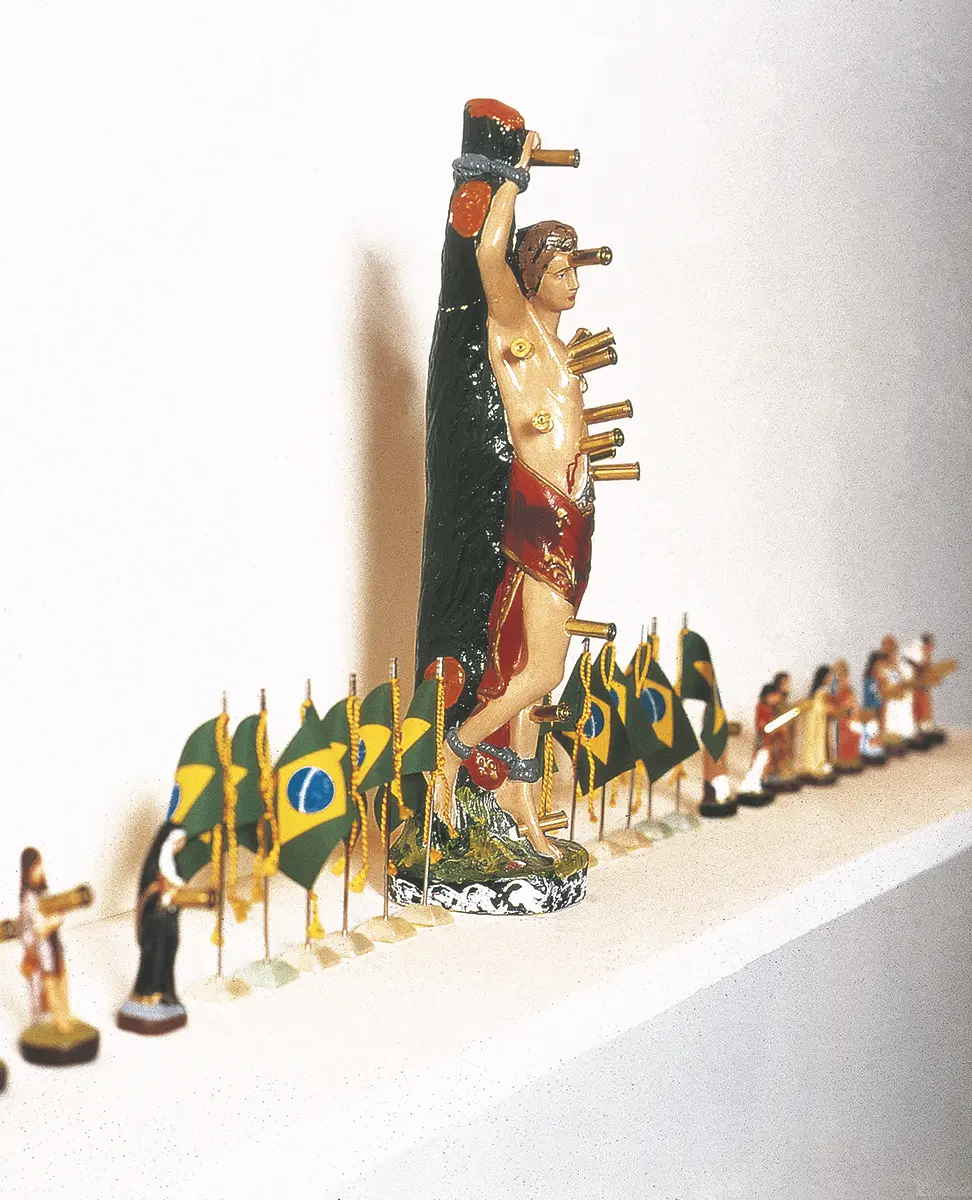
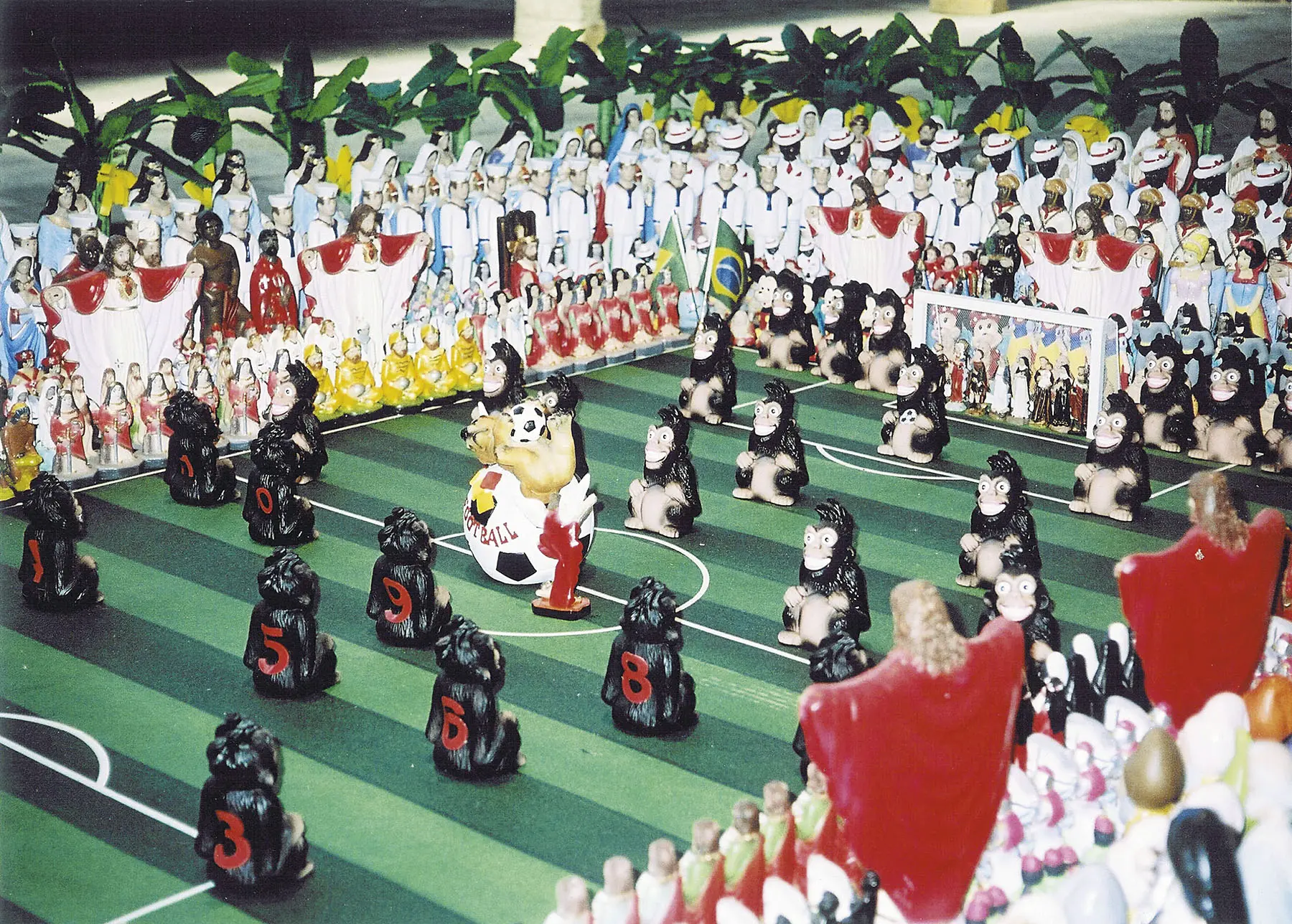
Even while Leirner’s oeuvre becomes more and more internationalized (the 1999 Venice Biennial almost marked a watershed, and signaled a critical update that continues to this day), few Brazilian bodies of work are better understood in Latin America than his. In part, this is because his poetics bring together linguistic and critical elements —an alliance sometimes forgotten in Brazilian art, in favor of more or less conceptual formalisms— and in part because it celebrates an intense and ever-active link between his two imaginaries, art, and culture, albeit the field so defined is, thanks to the polarization or mystification produced between those two categories, the field of an assumed conflict. Inasmuch as we inhabit a multicultural era, the work of Nelson Leirner also can be seen from the point of view of syncretism. In that sense, the spirit of antropofagia, Oswald de Andrade’s modernist proclamation, revived in the 1960s by the tropicalismo movement, is present here in a new form. Indeed, since the 1980s Leirner’s work has gained an iconographic largesse, ever more plural imagery, and a more syncretic horizon. There is a certain devouring joy, an abandonment of expressive prejudices that can be considered, undoubtedly, Macunaica.1 Many of his most recent works reveal a certain dispossessed state of grace; having seen darkened paths in the distance, they present a rare balance of tone between humor and critique, and, paradoxically or not, they steer away from drama as if from the devil. Also worth noting are the number of works in which the artist reflects on Brazilian identity, with strong symbolic mediation. The various pieces of Football or the different Great Parades are very explicit, as is one of his most recent series, Lost Bullets, 2001–2002, where Leirner incorporates images of urban violence into an object-oriented language; Saint Sebastián, Rio de Janeiro’s patron saint, of Adoration is one of his most intensely civic-minded recent works.
A first crop of works invested in revealing the crisis of representation with even greater clarity (Self-Portrait, 1964 and You Are a Part, II, 1964) was followed by several kinds of experiences: public interventions of a markedly political, performance-like character (such as Leirner’s activities at REX Gallery and Sons in 1967), and art projects that inaugurated a singular pedagogical line (the artist was a teacher for decades and his exhibitions dissolved the concept of authorship), and provided directions to create our own pieces of public art, as in Multiples, 1971. In terms of a re-reading of cultural icons, both Brazilian and international, a high mark is the series on Lucio Fontana that also displays a political economy and a transmutation of values. Homage to Fontana, 1967, a first prize winner at the Tokyo Biennial that year, substituted an industrial mark for the pictorial one, a zipper that de-mystified the relationship between art and industry (the artist, by the way, has a technical background). His later work on Brazil’s hegemonic constructivism in the series Countryside Constructivism, 1999, an ironic critique of pictorial models, especially those from concretism, comprises geometric compositions made on oxen hides. As a genre of expression references to the history of art are found in many works, in readings of, or interventions on Leonardo Da Vinci (Holy Suppers), Fontana, and Duchamp, for example. In fact, a true bestiary can be found in this poetics, as revealed by Leirner’s series Clonation, Sotheby’s, and all of his Great Parades.
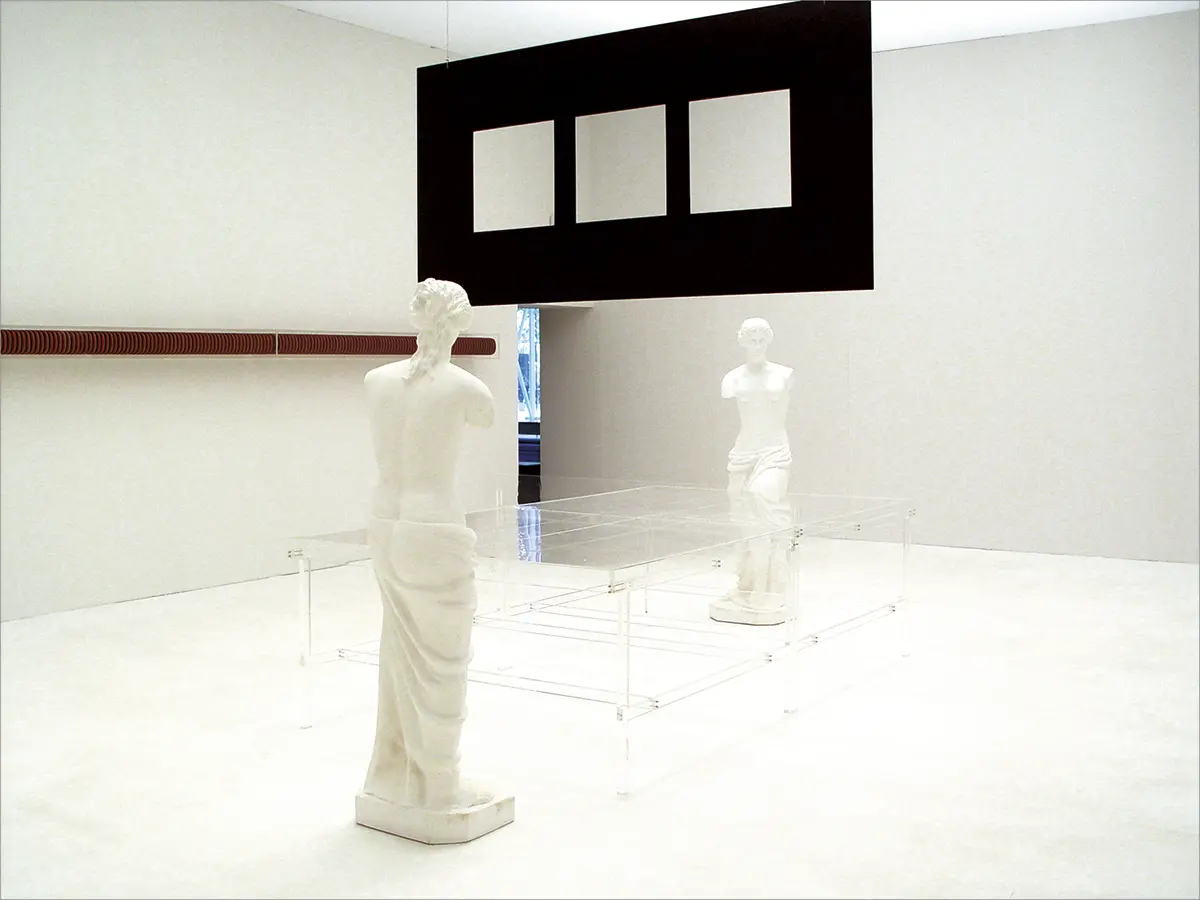
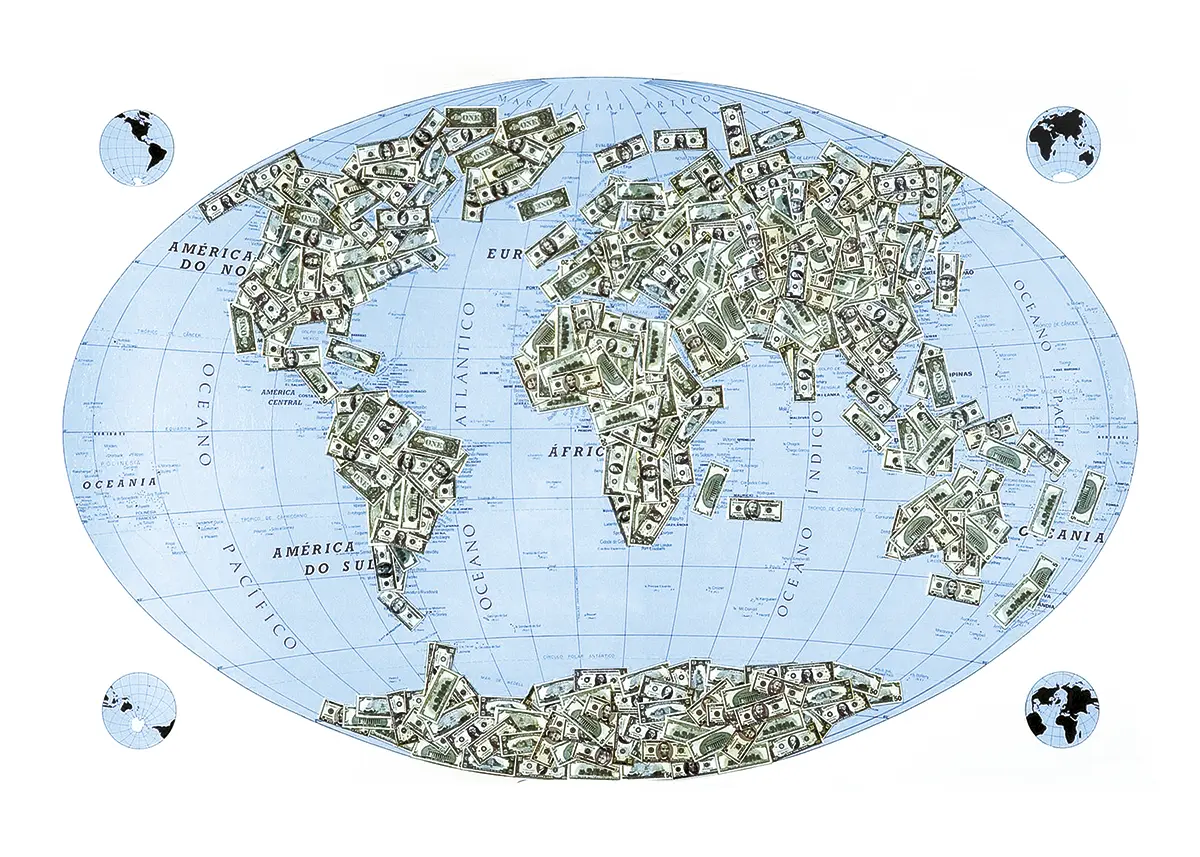
Some recent emblematic works deserve special mention, however, such as The Table and Its Belongings, 2002, originally presented at the last São Paulo Biennial. In its latest version, Leirner has added two life-size figures of Venus to this piece, which, besides creating a state of visual and cultural perplexity, generate yet another moment of visual suspicion. In a kind of minimalist serialism where the notion of play is suspended, the purity of certain materials (the Plexiglas table and the acrylics) arranged serially (balls and racquets) is completely subverted here and serves to reveal the game not as opaque but as transparent, and to point out that it should not end too soon: the returning ball is, somehow, always with the viewer. On the other hand, the recent series of maps titled Right You Are...If You Think You Are, 2003 creates a resignification: a transfer of meanings and symbolic negotiation amid cartographies that bring the game of representation to the fore. These post-colonial maps are a true cloning of current contemporary representation, both cultural and political; presented with an imaginary taken from the public domain and Pop Art, almost innocent in appearance, they are similarly removed from all ideological declarations but not from the possibility of critique: colors and symbols are interchangeable between the First and Third Worlds, and the maps are disorienting. Perhaps the most recent piece is Untitled, 2003 (according to the artist it is ideal to move around biennials, suggesting a public artwork that is not devoid of irony), the new Duchamp bicycle that receives yet another well-aired rereading and passes, and icon in movement, for a popular three-wheeled cart. In this case, the asymmetry is not formal, since in fact, Nelson Leirner’s four wheels roll their idiosyncrasy anywhere. And one does not doubt Duchamp would have enjoyed a little ride!
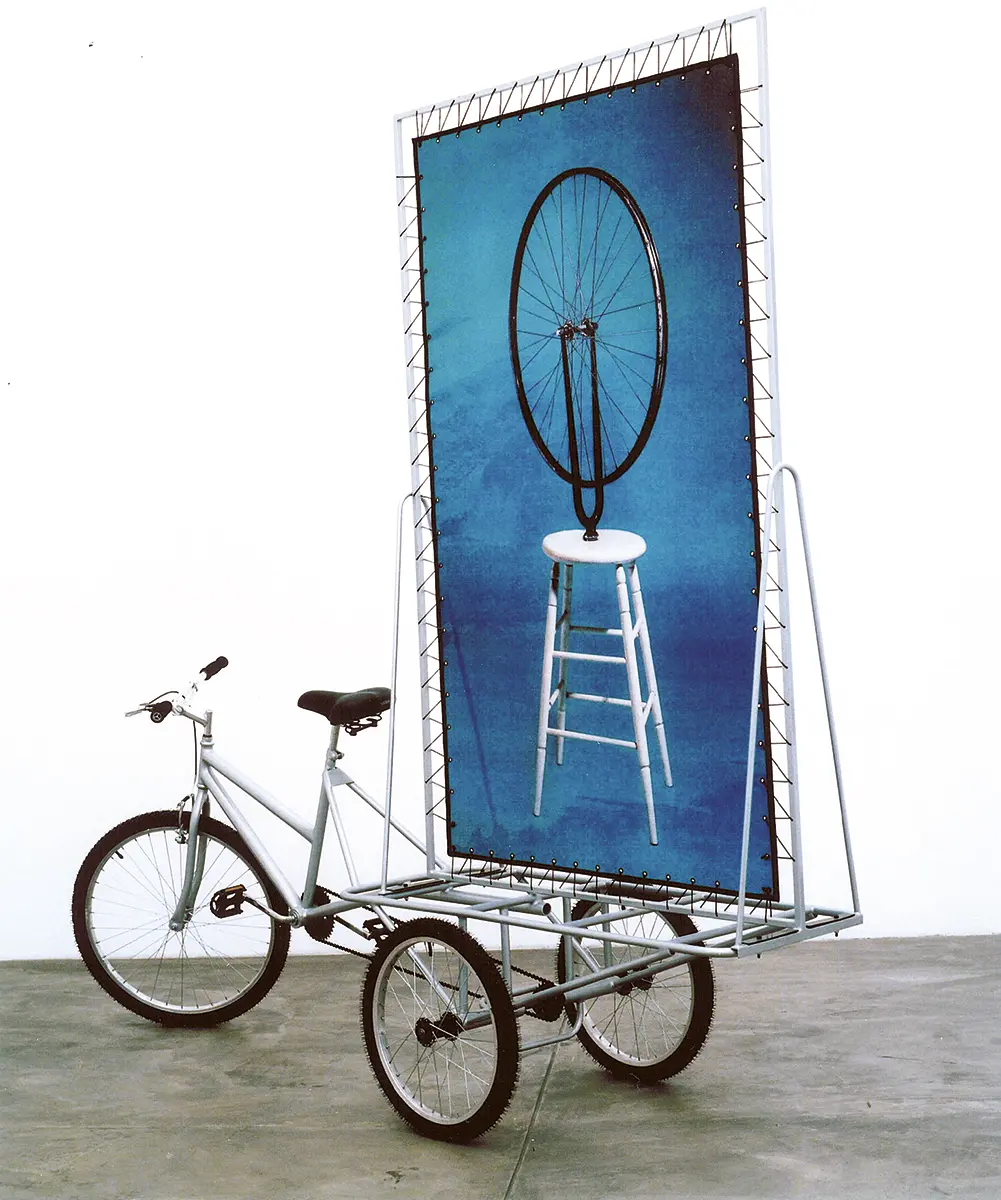
It can be said that Nelson Leirner’s work brings together a large number of artistic elements and keeps them in a state of continuous processing; it can be said as well that his trajectory is marked by the continued displacement of a modus operandi. But if one had to choose one conceptual triad, even if only to short-circuit its signs, it would be the one formed by appropriation-kitsch-minimalism. Irony —a key element of postmodernity and an “old friend” of the artists— is always ready to unveil the paradox at the core of all visuality.
As far as appropriation —the conceptualization of images on the basis of previous images, which is already in itself a critique of representation, and not only of the artistic variety—the artist’s intervention has established its own strategies, such as the “checkmate,” an encounter of mismatched elements or objects that is far from being neutral in its aesthetic clash. This is more so when the appropriation is allegorical when it is not exactly obvious. Even the ellipses in some of Leirner’s works point in that direction. We should not forget that the iconography of the appropriated works is often preserved in order to be subverted, both in form and content, as in his works on Duchamp, constructivism, and La Gioconda.
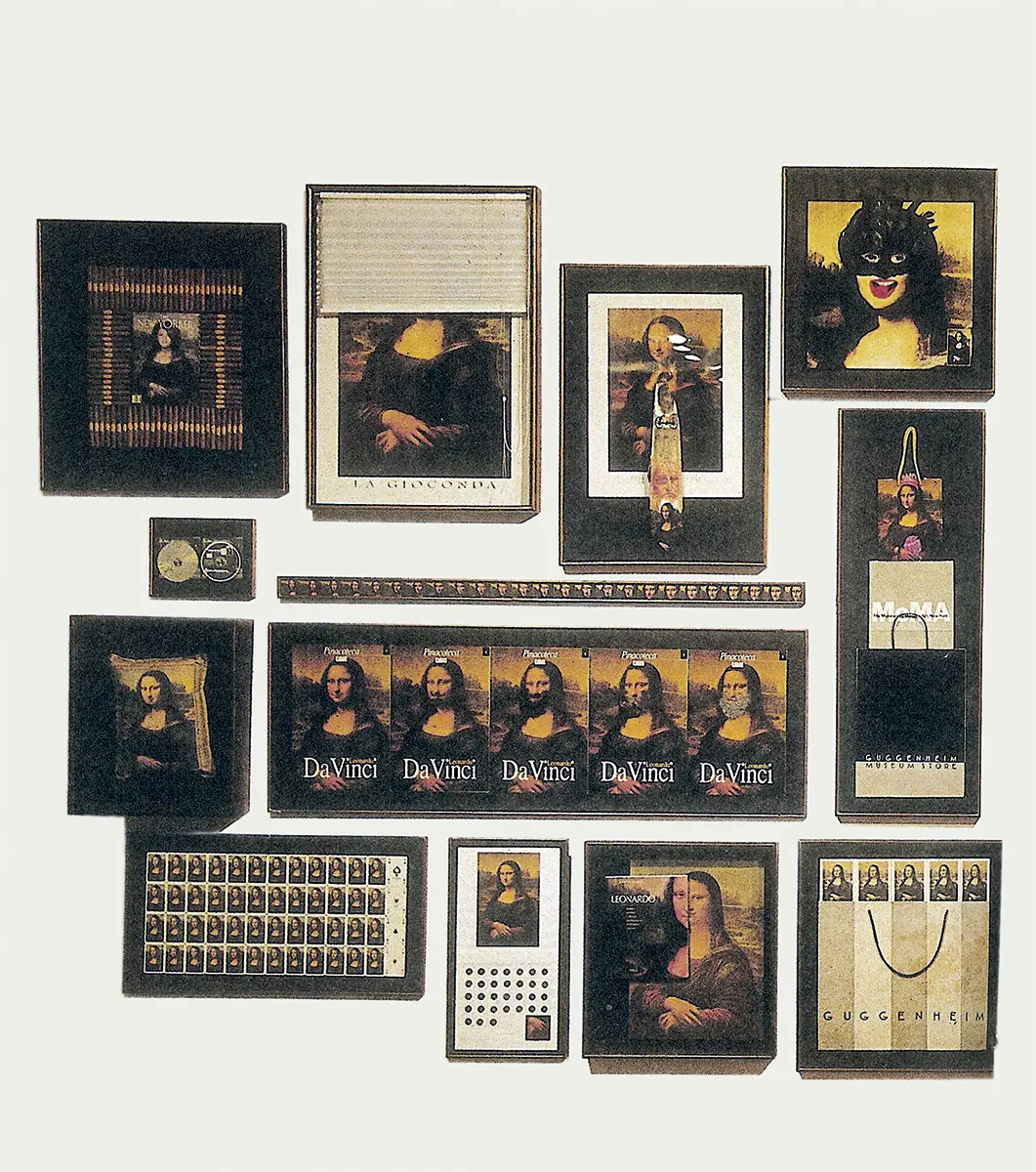
The historical avant-garde was already engaged in the practice of altering the sign of kitsch, but the practice developed in the late twentieth century —perhaps in the spirit of the times, which was full of imitations, falsifications, and copies— was a subversion of “good taste,” of the canonical. The generous examples of La Gioconda, 1999 show the way in which the path of appearances sometimes can take us to the spirit of the original work. Perhaps no single image has been so thoroughly “kitsch-ified” as Da Vinci’s painting. What works in this subversive use of kitsch is the application of its truth as falsehood, the immersion of the notion of aesthetic inadequacy with a style of its own to produce its deviation and to present alternative visual and aesthetic connections that explode the acritical position. The bottom line of Nelson Leirner’s oeuvre is the knowledge that to be modern is already to become kitsch, to become a cliché (Donald Kuspit),2 to become hokey (in Ramón Gómez de la Serna’s accurate assessment). The symbolization in his works is not alien to this operation of escape. The energy of the new courses through Leirner’s work, moving away from the standard and in fugue from an already consumed (and consummated) aestheticization where the transparent tyranny of seduction is placed above all else. Indeed, the true power of kitsch is exercised not only upon art but upon life itself in its standardization (and I assume that Leirner’s works about money point towards this wound, which other artists embrace as if art and market were already one and the same). If Nelson Leirner brings together high and low culture, kitsch, and popular elements, it is in order to ironize the convention of images —an aesthetic neutralization— to bring forth a cipher and escape from illusionism. This ironic maneuver is inherent to his playful and reflexive poetics. Irony is always useful in the transformation of codes. Finally, minimalism appears principally as a formal ingredient, because it is the minimalist form that is always betrayed: neutrality and the lack of compositional balance are not maintained, but repetition as a strategy of liberation and a certain order or geometry (albeit contaminated by objects and elements of a different temperature) are. All of this produces a re-materialization in Nelson Leirner’s works, which, added to their conceptual spirit, contributes to the dialogue of meanings, and to the construction of perplexities.
Mario Perniola points out that Benjamin’s opposition of the regime of the aura to the regime of mechanical reproduction hides a third possibility for art and for aesthetic experience, a regime characterized by reification, fetishism, and, more generally, by that phenomenon Perniola has defined as the “sex appeal of the inorganic.” The work of Nelson Leirner can be seen as inscribed in this third way of “materiality and abstraction,” as the solid face of contemporary art.3 If, as we know, simulacra have supplanted reality, here we face a simulacrum that still hopes to achieve reversible representations of the real, one that still aspires to attach itself to a relationship with life and its reflections (society, sports, art, for example). Leirner’s hybrid object-oriented oeuvre leads us to reflect on what we understand as art, outside of art. While originality as a myth of modernity is somehow deconstructed, common places are also sabotaged. This poetics is always attempting a difficult balance of forces; it spins and produces permanent displacements that serve to de-characterize, to step out of the systemic narrative through which a work of art is institutionalized and its nature is made prisoner. In that sense, the many titles in Leirner’s oeuvre that include an invitation to participate, such as You Are a Part II, 1964, or You Have Hunger for What?, 2001 work as strategies of complicity as well as reticence, as in the cases of Answer...If You Can, 1965, A Hard Line... Does Not Endure, 1978, or Right You Are ...If You Think You Are, 2003, which drives us to participate as well as to question and doubt.
* All images illustrating this article are courtesy of Galeria Brito Cimino, Brazil.
NOTES
1. Macunaica is the sense of being in the path of Macunaíma, Mário de Andrade’s emblematic 1928 novel celebrating “the hero without character” as a Brazilian identity, which inaugurates antropofagia in the realm of narrative. There is an interesting film version of this work, directed by Joaquim Pedro de Andrade in 1969, as well as many theatrical versions.
2. Donald Kuspit, Signs of Psique in Modern and Postmodern Art (Madrid: Ediciones Akal, 2003), p. 323.
3. Mario Perniola, Art and its Shadow (Madrid: Ediciones Cátedra, 2002), p. 74.
ADOLFO MONTEJO NAVAS
Poet, translator, art critic, and independent curator who lives in Rio de Janeiro.