
At first sight, Roney Fundora’s Impresiones, was recently presented at the Schwarcstein Gallery. Can be understood as a well-applied reinterpretation of the principles of signic painting and of spatialism. And they would be just that, if it weren’t for the subtle ambiguity (or irony) with which Roney attempts to dislodge any precise meaning, both regarding each of the work’s contents and the theoretical compartments in which one could place them. Such a purpose does not refer only to a kind of chance game that, on the basis of formal explorations that are not pre-conceived, would carry us to a well-trodden multiplicity of interpretative planes, but also to the forewarning that every trace, every shade, every asymmetry possesses an individuality that impacts choices that are made for no reason other than taste. A parable of that uncomfortable space between silence and word, so difficult to salvage when a neutral judgment is demanded about something that was, or is, dear.
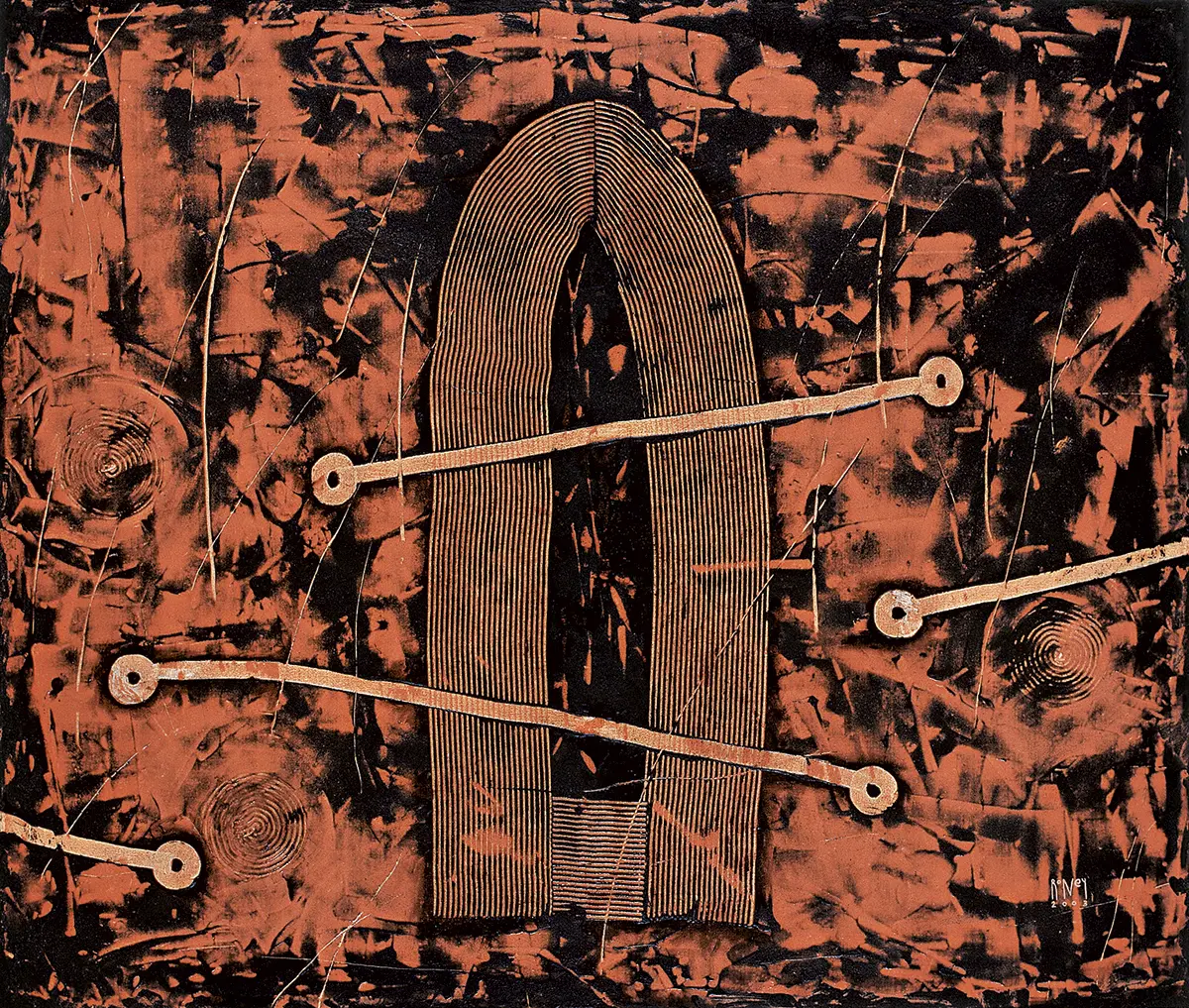
Any qualification of Roney Fundora’s Impresiones is challenged by a similar ambiguity. His works seek out, above all, that unpredictable moment when immediate and private tastes identify with certain shapes, certain contrasts, or depths of shading that transform color into space within itself. To try to reduce to words the way in which Roney formally conditions such circumstance illustrates, on the other hand, that truism about reproductions never being the same as the original, a truism that in the case of this show can be assumed to be decisive, but it also implies questioning (self-questioning) to what degree the professional sine qua non that dictates one must never speak on this basis or mere taste is, really, sustained.
Surprisingly, the gallery’s small space was a favorable environment for such a push towards the undefined and such an attempt at questioning: the work’s textural and chromatic cohesiveness became, in their montage, an uninterrupted surface on which— more than framed artworks— what seemed to be on exhibit were zones of light. Works in large formats using vegetal coal, acrylic paste, boxes, and other objects such as printable patterns, each one of the 18 pieces on exhibit was characterized by gradations of a single color in the shadow of the vegetal coal; gradations that generate the sensation of electric tones, flows of neon in a night space, and which at the same time offer a detailed course though the potential of each one of the colors employed and through the textures and spaces created by transparencies and depths that occur as the surface is worked on and pressed. There is plenty of unpredictability here, plenty of leaving the material to do its own thing, but there is also an equilibrium reasoned with simplicity, which in some cases could be imagined as emerging from that very unpredictability. The sparseness, the fluidity with which Roney Fundora allows for these relationships to emerge turns, perhaps, into the show’s main theme, and it also makes it impossible for any of this to be described as only form.
Impresiones responds also to the spontaneity Roney Fundora expects from our approach to his works; thus, his titles seem to behave not as definitive dictates but as just one more possible option. There is, evidently and in conjunction with the space extracted from the materials, yet another suggestion, solved with equal simplicity: references to natural or constructed spaces. Many works of art, because their own richness allows it, are compulsively used as wells of interpretation, as background exercises for the word; evidently, the pieces in this show could also be used that way. Yet, their distancing from or their indifference towards the possibility of such territories being contextualized within a specific environment, or identified as universal symbols of ecumenical relationships, assumed as maps, or reflected upon on the basis or the signs implied in them, is part of the eminently playful mechanism set up by Roney Fundora to “empty us out” of our learned meanings.
EMILIO GARCÍA MONTIEL