
The Recoleta Cultural Center presents, in its Cronopios gallery, a 35-year retrospective of the rio platense artist Adolfo Nigro.
Rioplatense because of his formative links, in the 1960s to the school of the great master Torres García, under the tutelage of José Gurvich, one of Torres-García's disciples. From Gurvich, Nigro learned how to use “free space as an infinite field of possibilities.”
Of his Montevideo experience, he retained, as an indelible seal, a deep relationship with handcrafts and with being Lain American, belonging to the South.
Nigro, born in Rosario, Santa Fe, in 1942, gave the protagonist role in his painting to the land, water, and skies of his native region. His most recent exhibition displays for us 250 objects that invite the viewer to walk through his oeuvre on a different path.
This is, indeed, curator Liliana Piñeiro’s most successful move here: organizing the show around thematic and formal nuclei.
This has allowed the show to reach its maximum potential, incorporating into its design the structural and qualitative features of Nigro’s own work.
Festive, exultant, heterogeneous, forcefully alive, full of movement and grace, the exhibition proliferates into dissimilar objects that are re-signified poetically, wrestled from banality by the hand of the artist.
Everyday objects, things that surround him, things he has used or found, return in his work, in a strange and significant intersection of art and the artist’s own life.
No little twine, ticket, wood, net, cardboard fragment, envelope, postage stamp, playing card, or nail remains untransformed; they all dance to the music of that vertiginous vent that is Nigro’s work.
This salvaging of the everyday object’s fleeting and transitory precariousness in our consumer society has allowed Nigro to display imagination and creative ingenuity that seem inexhaustible.
Since the show has put aside paintings, we find both the tapestry and the clay pieces he did in his early period, and the ink drawings with o without collage, sometimes in watercolor, of Dominios naturales (1982,) where the artist’s hand tracings generate forms, outlines them gracefully, defines them wholly or fragmentarily, and enriches them with textures, scratches, dotted lines, graphics we found repeated over time, for example in his late-1990s series of Cosmografías, where he adds to those resources the strength of rhymed perforations.
There is also the series Los buscadores de almejas, where drawing, independent of color, plays with words and with the vast empty spaces, and Los candelarios, testimony to the recurrence of time as a topic, to his interest in the slippery flow of time.
And there are also the Cartas, with all their connotative force, the Juguetes, always capable of further transformation, and the series Barajando, where transformation is already consummated and sticks and shapes crisscross proving that everything can be something different than what it is.
A large number of small pieces of wood turned ships, fish, and unusual fishermen; the pieces of twine forming kites on the beach; an unexpected rumor of reeds —all announce the constant presence of water around his native city, as well as Buenos Aires and Montevideo.
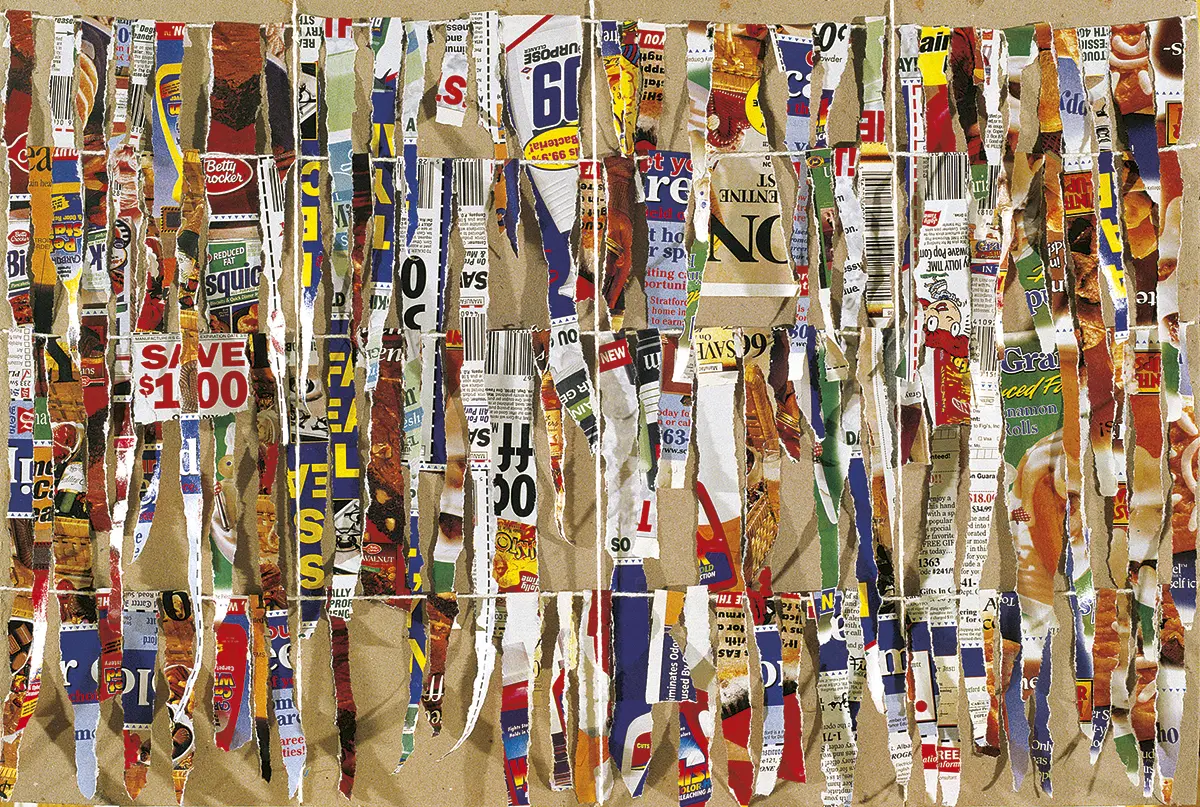
The last series exhibited in Jironadas (1998-1999,) strips of US magazines ripped vertically during his stay in North Carolina, which, in their many colors, sheens, and qualities barely organized by reiteration and contiguity, capture the viewer’s senses with the same playful spirit of the other objects.
Another curatorial decision was to arrange some pieces in a very large mural, and others hanging in a room with special lighting, as these structures reproduce the variegated multiplicity and polyphonic vitality of an artist who has been able to carry forward with independence from institutionalized circuits.
NELLY PERAZZO