
When Gilles Deleuze looks at the art of painting, he points out the existence of a whole preparatory labor that belongs entirely to this field and that, however, precedes the act of painting properly. This preparatory labor, he says, is silent and yet very intense, so that the act of painting emerges as an “after” in relation to it.
We are talking about linear tracings, blotches of color that unleash a catastrophe on the canvas. These are irrational, involuntary, accidental, free, and haphazard marks. They are non-representational, non-illustrative, non-narrative, a-signifying traces whose function is to “suggest.” In a language closer to Wittgenstein, they can be said to introduce “possibilities of fact.” The diagram is chaotic, a catastrophe e—from which the painter will try to emerge— but it is also the beginning of order or rhythm. It opens, as Bacon says, “sensible domains."2
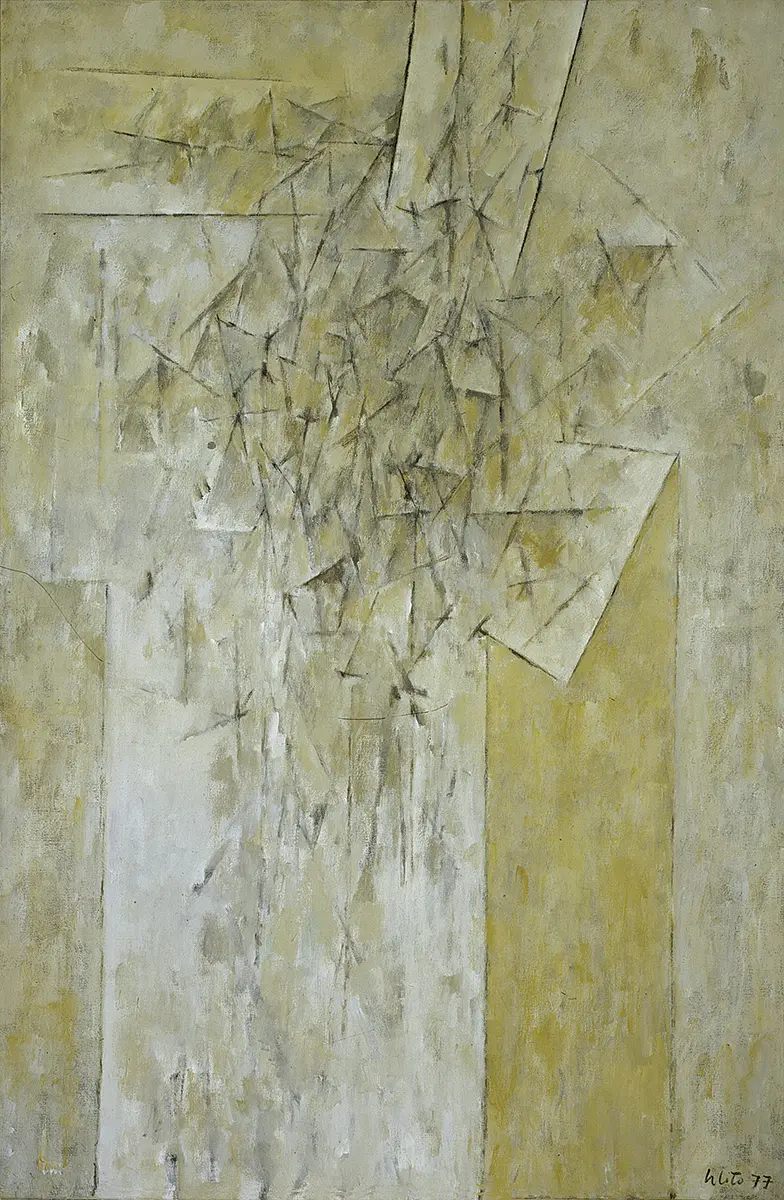
While studying the great Argentinean painter Alfredo Hlito, particularly upon reading some texts that refer to his work, I had to find a link to these writings by Deleuze. Hlito says: “The image, the painting, is not something one projects before setting out to paint and which ends up being just a matter of execution. For me, the image is almost always a finding on the basis of expectations that the acts of painting can belie, enrich, abolish, or transform. It is these acts that decide, by opening up expectations. [. . .] The type of painting I try to do, and which I sometimes actually accomplish, is not the product of a serene calculation of the possibilities and resources at my disposal. Nothing would be more opaque to me than the insertion of those achievements into a prior conception of the act of painting. [. . .] To make painting be something like the crystallization of the processes in play, and not something previous to them."3
It is not only with regard to the painter’s tribulations in facing the canvas that we can find links between Hlito and Deleuze. In one of his late-1970s notebooks after noting the baggage with which he confronts the canvas, Hlito writes, “How can we ignore what we already know?” He constantly brings up “the moment of interiority in creation, which the artist can not attribute to sanctioned formal criteria under penalty of sacrificing a considerable part of himself.” Deleuze, in turn, has written about the error of assuming that the painter works on a blank, virginal surface. And he adds: “The entire surface is virtually invested with all kinds of clichés, with which the artist will have to break. [. . .] The struggle against cliché is a terrible thing.” But this is not the time to analyze in greater detail the correspondences between both authors’ thoughts; the previous observations are sufficient to highlight the artist’s theoretical work. Not often do we find, in a single artist, a pictorial praxis and a theoretical intervention of the same high level.4
In truth, Alfredo Hlito, along with Tomás Maldonado and Edgar Bayley, was an intelligent spokesman for the Asociación Arte Concreto Invención, founded in Buenos Aires in November of 1945.5 These artists have been included in important exhibitions in many countries because they integrate the prominent efforts of this association, the geometric-abstract avant-garde of the 1940s, along with Madí and the artists of Perceptismo.6 Given this situation, Alfredo Hlito is better known internationally for works created between 1945 and 1955, than for his extraordinary later work.
It must be said, however, that the period mentioned was particularly brilliant not only in Hlito’s career but for Argentinean art in general. The action of the aforementioned groups was revolutionary not only aesthetically, but, given the context, politically as well. The environment in which they acted was from the beginning one of political effervescence. Although the avant-garde journal Arturo had been published since 1944, the historical events of October 17, 1945, when the masses took to the streets to defend the doctrines of Juan Domingo Perón, had taken place only a month before the founding of the Fundación Arte Concreto Invención.
The concrete artists, however, did not adhere to Peronist ideology, which at the time was thought to be a combination of Argentinean nationalism, and interests organized through the corporate system that characterized fascism. Hlito, Maldonado, Bayley, Espinosa, Girola, and Aldo Prior signed a manifesto explaining the reasons for which why they were joining the Communist Party.7 Several articles published in the Association’s first journal in August of 1946 —“Our Militancy;” “Notes Towards a Materialist Aesthetic;” “On the Arts Published to the Revolutionary Necessity and the Art of Concrete Invention”— gave an account of their solidarity with the idea of turning so-called Social Art into a central concern and relating the creative impulse to political awareness by understanding the work of art as a revolutionary undertaking.8 Harmonious relations with the Party would not last long; nevertheless, the movement’s fundamentally critical character continued to point towards the possibility of change in an extremely traditionalist Latin American society.9
One of the most important aspects of the action carried out by the Asociación Arte Concreto Invención was the dialogue with valid interlocutors, not only painters and sculptors but also industrial and graphic designers, architects, musicians, and poets. They were building events related to the needs of contemporary praxis. Both Hlito and Maldonado were members of OAM (Organization for Modern Architecture) alongside —among others— Horacio Baliero, Carmen Córdova, Jorge Goldemberg, and Gerardo Clusellas.10
Concretism (concretismo) in the visual arts related to “the search for sobriety in modern Argentina’s culture and architecture. The cultural action of the group around the journal, Nueva Visión, didn’t limit itself to its publication but expanded to University teaching, to the publication of several collections, and to criticism, and drove forward a wide spectrum of artistic activities."11
In 1949, Alfredo Hlito collaborated with the second issue of Ciclo, a journal of art, literature, and modern thought (it was to be the journal’s last issue). He also designed many catalogs, among them one for the “Artistas Modernos” exhibition in Amsterdam. He was in charge of the graphic design for the Nueva Visión journal and founded, with Maldonado and architect Carlos Méndez Mosquera, a graphic design company. The first issue of Nueva Visión carried an advertisement created by Hlito that warranted the following comment: “The Plastiversal advertisement (Plastiversal was a company directed at the time by the engineer Uribe) makes graphic design history in our country; while revealing the influence of Rodchenko and Malevich, it also demonstrates knowledge, inventiveness, and research."12
Later, during his stay in Mexico (1963–1973), he was in charge of the Graphic Design Department at the University.
Hlito’s theoretical work during this period is notable for its acute and innovative turn of mind. “The Situation of Concrete Art” and “The Theme of Space in Current Painting” are good examples of this. In the latter article, Hlito advises —without naming names— against the already widespread linear and schematic reading of modern art proposed by Alfred Barr.13
In the same article, he explains in detail the artist’s association incursion in works with shaved frames, and the reasons why they abandoned it. In 1957 Alfredo Hlito participated in the first Contemporary Art Meeting organized by the Social Institute at the Universidad Nacional del Litoral. He participated as a painter alongside Manuel Álvarez, Líbero Badii, Mauricio Berú, Vicente Forte, Mauro Kunst, Miguel Ocampo, Ideal Sánchez, Eduardo Serón, Jorge Souza, Clorindo Testa, Gregorio Vardanega, Virgilio Villalba, and Zigro and as a designer (the meeting’s proceedings were published by the UNL the following year with a design by Hlito).
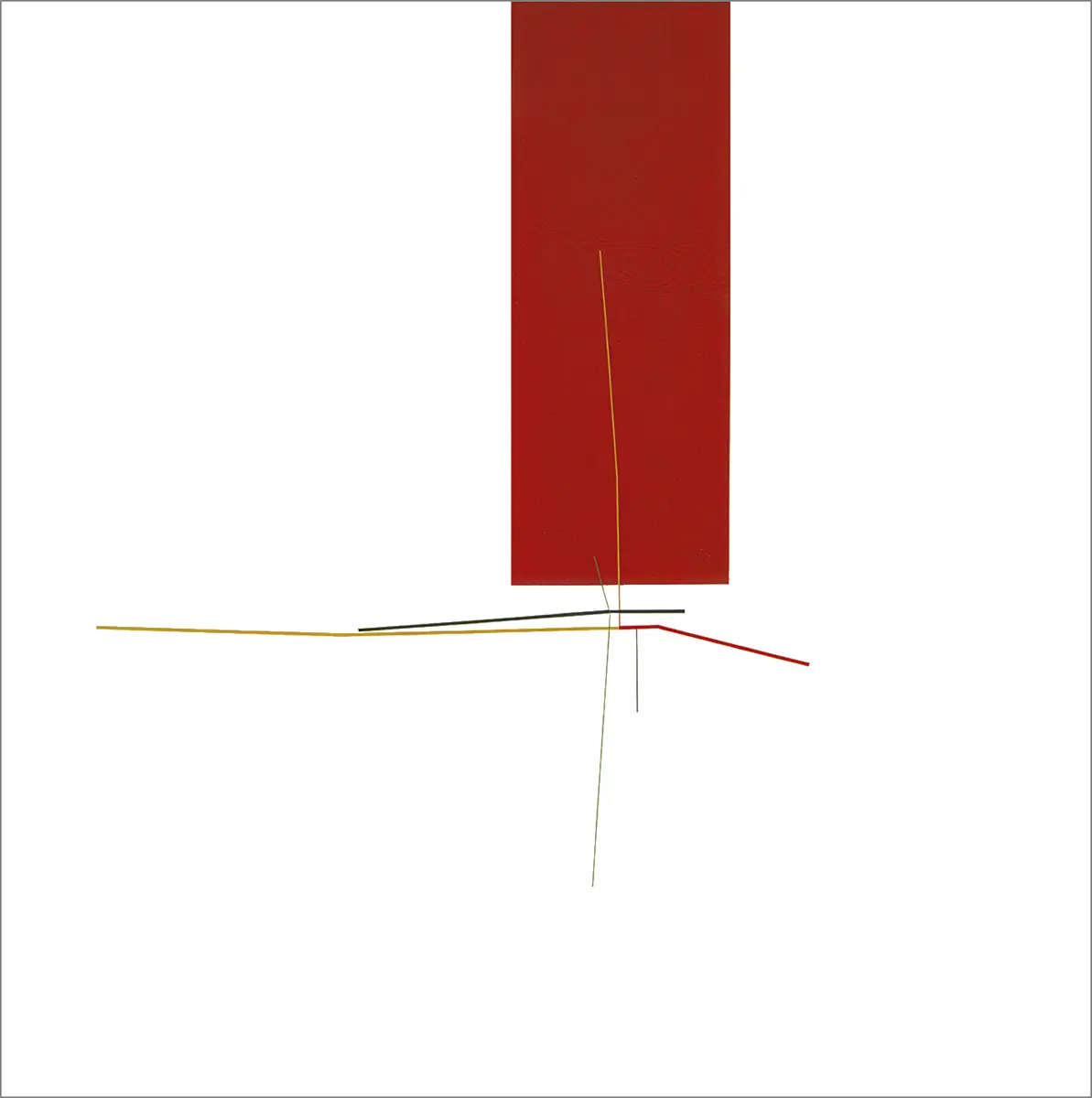
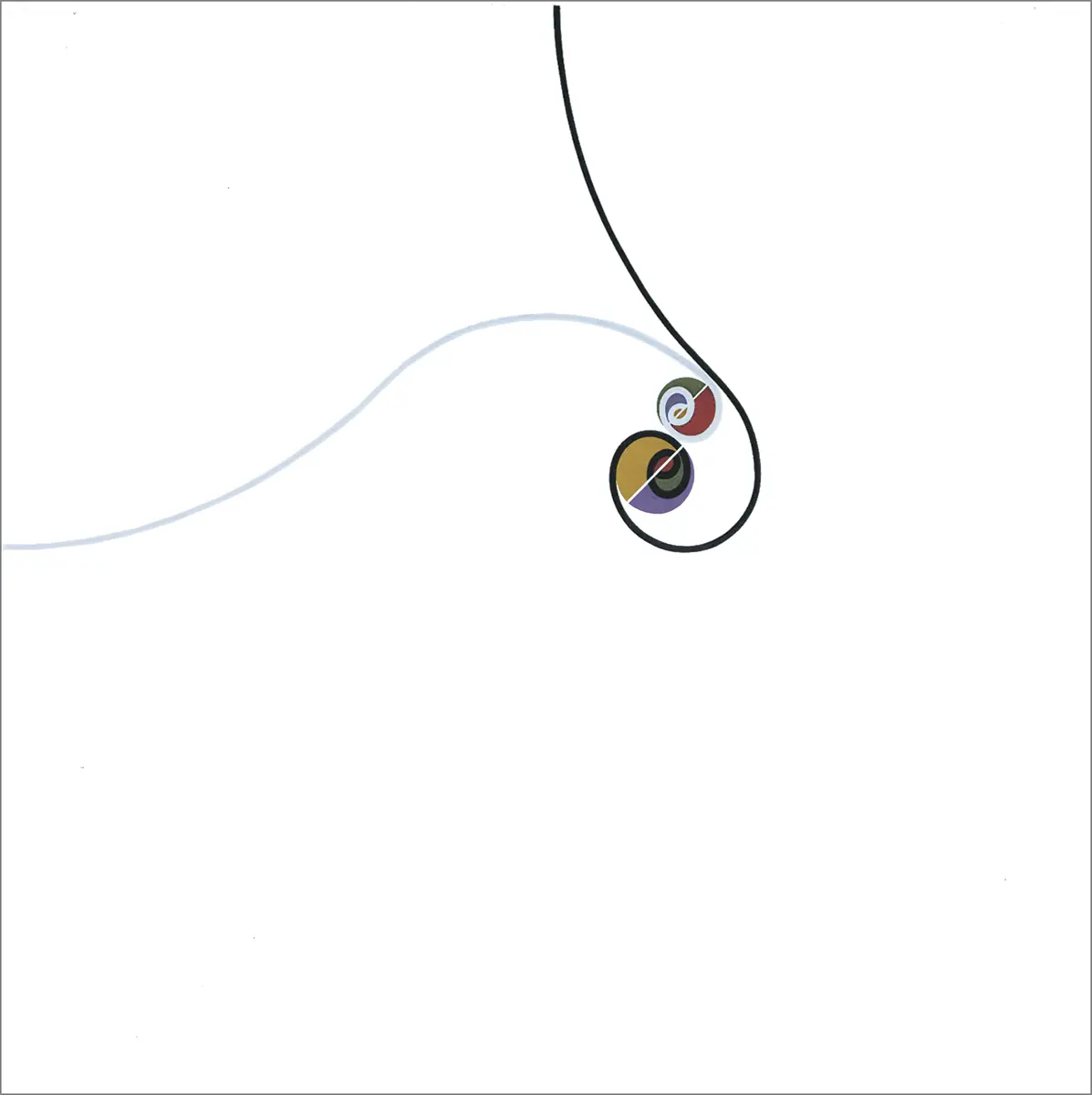
It was a high-level meeting that brought together architects (J. M. Borthagaray, Francisco Bullrich, Horacio Baliero, and Jorge Goldemberg), musicians (Francisco Kropfl, Virtú Maragno), poets (Edgar Bayley, R. G. Aguirre, R. Alonso, A. Biaggioni, R. de Casasbellas, M. Castilla, H. Gola, L. Lamborghini, F. Madariaga, Susana Morla, M. Trejo, A. Vanasco), theater people (A. Rodríguez Muñoz), writers (T. E. Martínez, J. C. Portantiero, A. Prieto, David Viñas, O. Bondoni, F. Birri), and special guests (Carlos Drummond de Andrade, Juan L. Ortiz, and Juan Carlos Paz). It was a privilege for Argentina to bring together personalities of such professional weight and of such forward-looking ideas. To find so many important specialists congregating for a common project is a testament to the human potential in Argentina at the time. Alfredo Hlito participated in A Two Circuit Theme and Three Tangent Themes, both in 1954. The closed or free curves in the latter work reveal the artist at work on what he calls “the theme” on wide, monochromatic surfaces that give flight to the forms opening to space. Formal refinement, the appreciation for empty spaces, and the exaltation of a plane of color to highlight the activity of minimal elements: the economy of media is all constant in Hlito’s concrete works.
Arthur Danto has said that the only true path for those artists whose careers began in the 1940s was the path of abstraction. Alfredo Hlito belonged to that generation. They were not only figurative but from the beginning also were obliged to analyze and reconsider their own praxis many times. Hlito started to move away from Concrete Art, sliding towards ever-greater freedom and above all towards a personal elaboration of the theme of color with acknowledged roots in Cézanne and the Pointillists.
In 1952, the Argentinean critic Aldo Pellegrini created the Grupo de Artistas Modernos de Argentina, which included Hlito, Maldonado, Lidi Prati, Girola, and Enio Iommi, all of whom Pellegrini dubbed abstract-geometric, as well as the abstract-lyrical Fernández Muro, Sarah Grillo, Miguel Ocampo, and Hans Aebi. In this respect, he had already observed a true interaction among the group members: “The independents assimilated the concretist’s notion of rigor and sobriety [...] while the concretists received the salutary influence of the independent’s less dogmatic spirit.”
Diez circuitos concéntricos, of 1955, which uses contrasting color and value to dynamize space, is already painted with a pointillist technique, not with flat colors. In another painting of the same year, Línea tangente, now in the collection of the Buenos Aires National Fine Arts Museum, Hlito uses the same technique to give the spatial dimension the character of infinity and extends it to the frame, as Seurat did. “That brief period between 1946 and 1955 when one thought to have acquired a kind of all-risk insurance,” in the artist’s own words, was coming to an end. The series “Volutas”, and others with no title created between 1956 and 1959, already signal the new order of interests that would culminate in the “Espectros”.
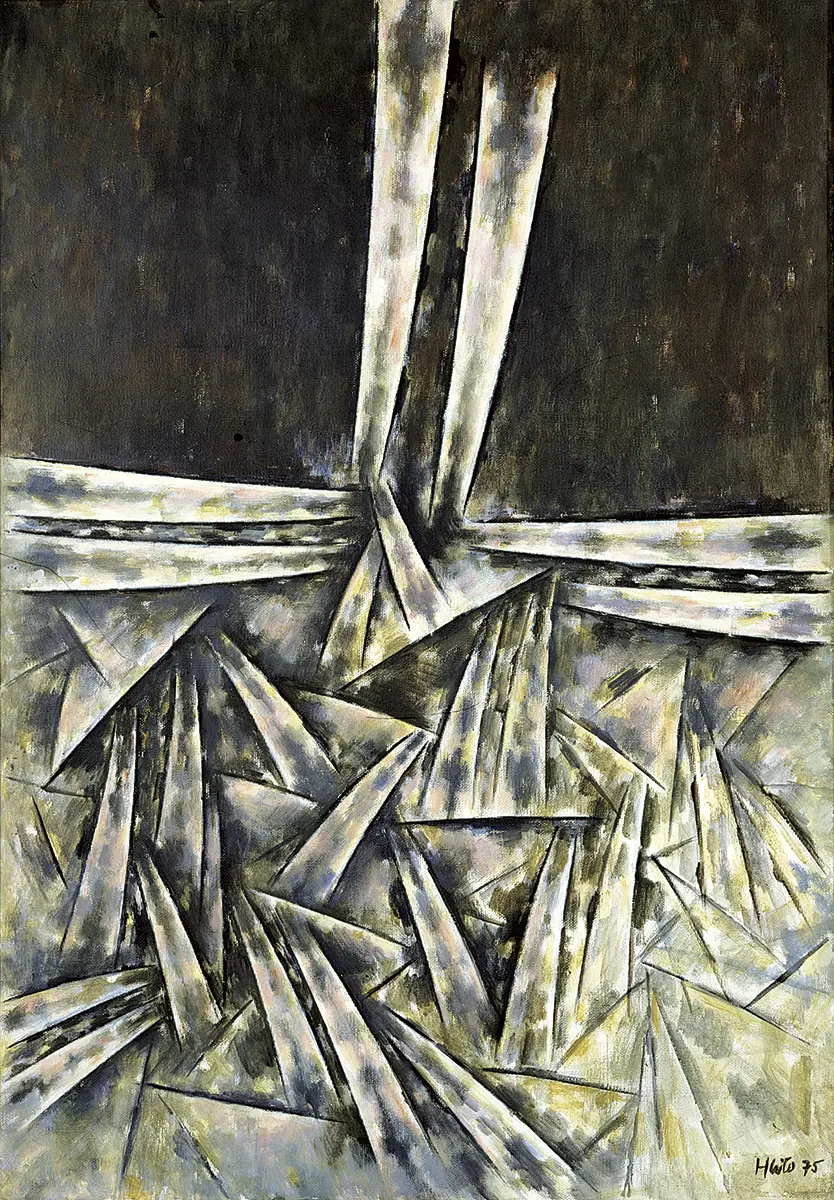
Regarding the relationship of background to figure, he started by making space flexible and moving towards increasingly more open forms that ceded centrality to color up to the point of occupying the base plane in its entirety with a continuum, a surface on which nothing came to the fore over nothing else. He wanted to flee “flat and opaque colors and their artificial eloquence,” in favor of pictorial creations that were illuminated from within. In other words, he wanted to use color only to invite the gaze to enter the canvas’s interior depths. He abandoned pointillism because it seemed, in the end, too mechanical, and the diffusion of veilings because of the accentuated effects. He found a technique where he could recognize himself: a visible texture, and the luminous transparency of color. These works juxtapose or superimpose small brushstrokes that are repeated systematically so as to free all their energetic potential. Space becomes transparent and vibrant, the small and reiterated brushstrokes are the same, and all that changes is their orientation. Hlito did not remain in this series of the “Espectros” for more than three or four years, exploring all the variations that the limits indicated.
Hlito had boundless admiration for Cézanne, and he analyzed Cézanne’s work rigorously. Deleuze notes that it was precisely Cézanne who placed a vital rhythm on visual sensations. The rhythm courses through each one of Hlito’s works from this point forward. By 1960-1961, that search is over. It is the moment of his 1962 move to Mexico, where he was to remain until 1973. These were years of University work; years of reflection and decreased activity. The slow and well-considered elaboration of Hlito’s aesthetic ideas continued after his return to Buenos Aires and coalesced in his “Efigies” and “Simulacros,” two key series in his oeuvre. The move from oil to acrylic also presented new possibilities for experimentation.
His research on the issues of background and figures found all kinds of resources. Sometimes they are open forms in light, whitish palettes that articulate dynamic fields on the plane. At other times they highlight a dark figure against a background that is animated by linear movements. In yet other cases we find figures anchored at their base and emitting structures that can be open or not, in diverging expansion. There are series in which Hlito superimposes a blast of vibrations on planes that are more or less defined. The name “Simulacros”, given to many paintings in this series, signals, alongside some of Hlito’s writings, the fictional character of the pictorial surface. The idea of an elusive, enigmatic reality, the presence of an absence, was to accompany Hlito and his work in times to follow. The names of his series in some way gather together explorations that sometimes coexist and do not admit labels or clear-cut chronological periods.
Hlito also possessed a sharp sense of humor, which he used constantly. For example, some works that we could surely place formally with the “Simulacros” he called “Efigies,” and vice versa. Is this a kind of game designed to tell us about the impossibility of categorizing, ordering, of labeling?
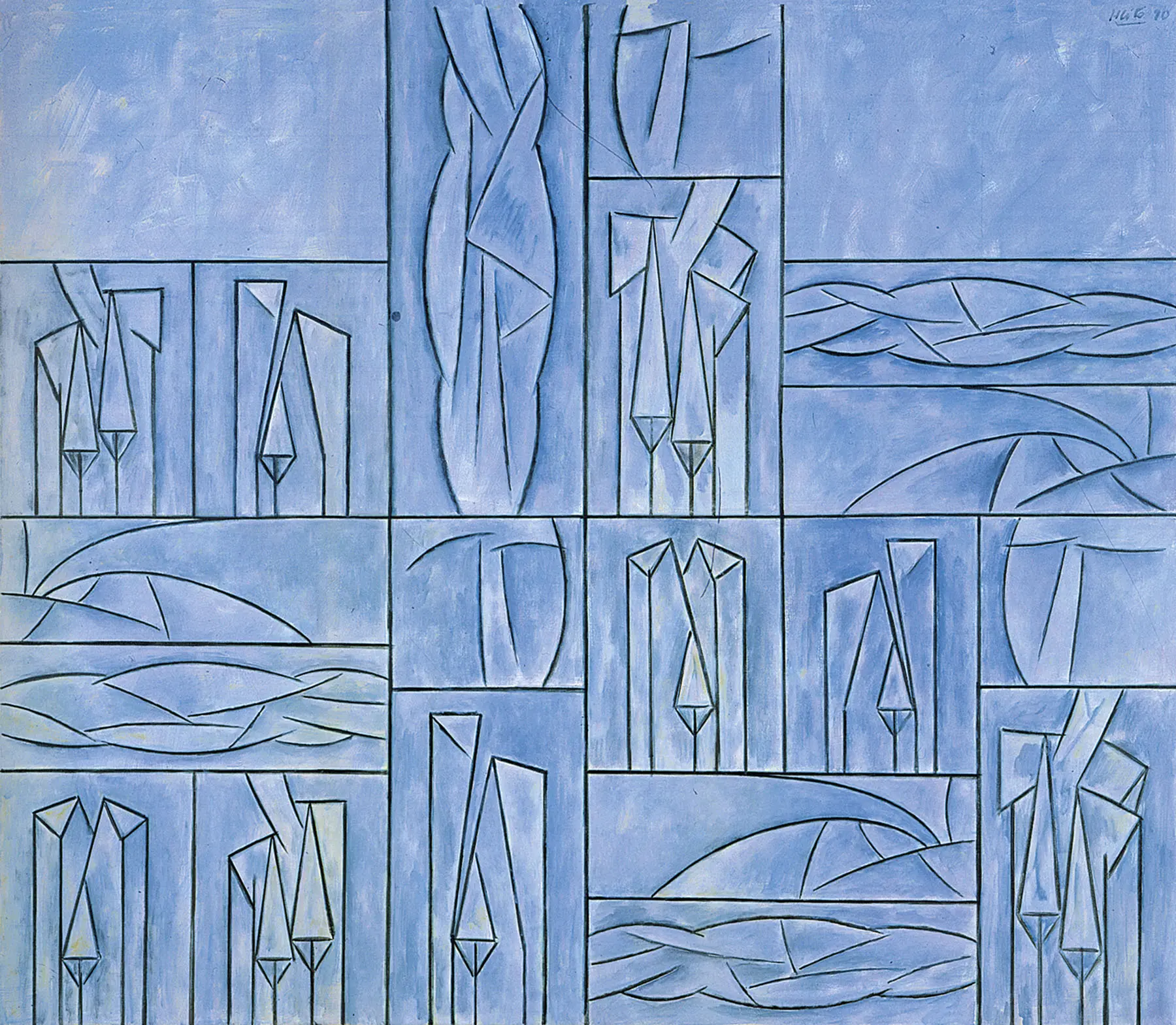
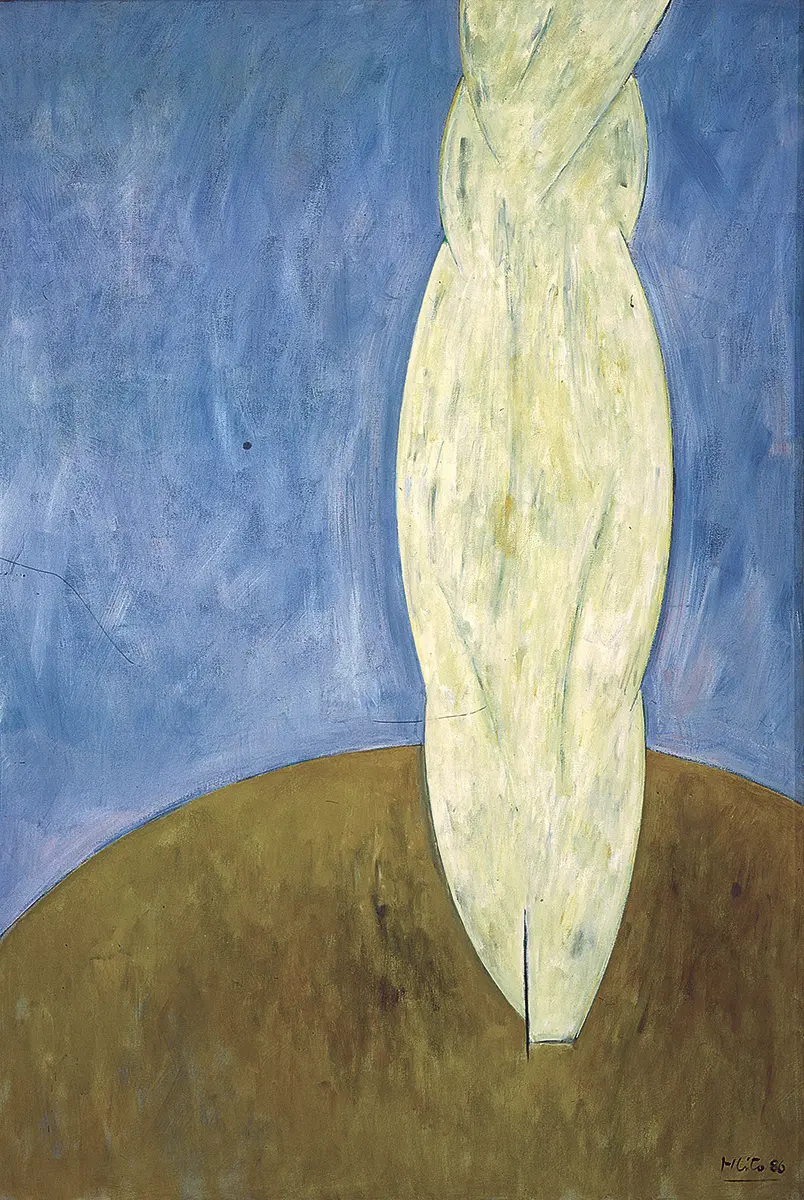
Hlito’s effigies were characterized by a contour that tends to close on itself to configure autonomous shapes. They jump off the background and fight with it. The painter wanted to create consistent, more solid forms, and to put an end to the floating, almost atmospheric character that surrounded and penetrated his open forms. Dense shapes, firmly anchored to the painting’s base, emerged in this way and began to evolve. Hlito distinguished in this process of configuration two undercurrents: a geometric one and an anthropomorphic one.14 The anthropomorphic line acquired a greater definition and became central, in a very peculiar way, to Hlito’s pictorial work in later years.
Referring to Deleuze’s work on Bacon, Calabrese15 points out the theoretical opposition between the figurative and the figural. Figural dispositions tend to return to figures their value of autonomy, while earlier figurative painting made them dependent on a mimetic relationship, and abstract painting limited itself to deny that dependence, negating figures entirely. As we have seen, the figural in Hlito has a more organic side and a more geometric side. Works in the first line are more frequently planted in front of a single-color background, or of some planes worked with that vibrating stroke, with that sensibility for color, with that subtle mobility Hlito learned to dominate in the 1950s when he submerged himself in color. A curved space serves as support as if it were a hill, a segment that evokes the shape of the earth, or pure landscape abstraction repeated in many variants.
The geometric effigies also appear either solitary or not, always against regions of color that are unified or divided by a kind of horizon. The perspective is always frontal. Their heads seem to tilt to one side or the other, with a reserved, austere, almost mystical attitude. At a given moment, they become imposing figures organized in friezes or are included in a mountain in the foreground of strange and desolate landscapes.
During this period Hlito sets up a very subtle interplay in the articulation of figures that are reiterated, compose friezes, become horizontal, or are included in a reticulated pattern in increasing degrees of abstraction. The best known among these solutions is that of Iconostasis. Hlito found the word in an article published in the journal Sur about Russian painting of the fourteenth and fifteenth centuries and was seduced by it. The iconostasis is the name given to the screen with doors placed in front of a Greek Orthodox altar, which is closed during the consecration to hide the priest from view. They are large-size tableaux covered in icons and grouped around a major figure of greater size and symbolic importance. They are not scenes; each figure occupies its own niche. Hlito worked assiduously, abhorring a vacuum, and was finally surprised by “the ease with which the effigies were absorbed to the point of almost losing their identity, in a ceremonial disposition coming from an ancient and archaic place that is alien to me.” The iconostases are not the only forms adopted by these geometric effigies for their compositional organization. In some cases (Interpolación, 1991, Efigies con tema central, 1987) geometric and organic effigies appear together; in other cases, such as Pirámide con effigies, the group resembles a kind of crystal architecture. These geometric effigies have a graphic character, tending to a flatness tempered only by well-played oblique or curved lines or by smaller, closed motifs placed inside the larger forms. There are some, like Efigies and Efigie en equilibrio, that goes for maximum diversification, one completely abstract and the other “humanized.”
Alfredo Hlito died unexpectedly in March of 1993 while holding a show at Galería Ruth Benzacar. He was a reserved artist, a man of few words and sober expressions; expansiveness was a word not to be found in his vocabulary. He never spoke of his emotions, only of himself in relation to painting. Hlito’s reflective attitude permitted, starting in the 1970s, a relationship with the unconscious, with that place where desire is an unbridled force. It was a relationship that, on the other hand, did not change his ascetic and unprepossessing attitude toward art and life. There is nothing further from the Romantic hero than Hlito’s behavior or his idea of himself.
It is a fact that he was able to infuse his works with a severe but intense emotional quality. As he once put it: “I would like for it to be said of my paintings that they are metaphors of the visible."16
But they are not only that. There is in his works a sense —I will not say of the absolute, which would have corresponded better to a transit through the ideal territory of concretism— a sense of the sacred, of the enigmatic, of the inaccessible, of the unsayable. As Wittgenstein put it: “that of which we can’t speak can only be pointed at.”
NOTES
1. “Metaphors of the Visible” was the name of an exhibition held at Fundación Telefónica in Madrid, February-April 2002.
2. Gilles Deleuze, Francis Bacon: Logique de la sensation, (Paris: Editions Du Seuil, 2002). It is in this work that Deleuze analyzes the unraveling labor of the painter before the canvas.
3. Alfredo Hlito, unpublished writings.
4. A large number of the artist’s writings were published by the Academia Nacional de Bellas Artes in 1995.
5. The other members were Manuel Espinosa, Enio Iommi, Claudio Girola, Lidi Prati, Alberto Molemberg, Jorge Souza, Oscar Núñez, Juan Melé, Gregorio Vandánega, Virgilio Villalba, Antonio Caraduje.
6. “Vanguardias de la década del ’40, Arte Concreto Invención, Arte Madí, Perceptismo,” Museo Municipal de Artes Plásticas Eduardo Sívori, Buenos Aires, 1980; “Art in Latin America, The Modern Era 1820–1980,” The South Bank Centre, London, 1989; “Arte Concreto Invención—Arte Madí,” Galerie Von Bartha, Basel, 1991; “Argentina 1920–1994,” Museum of Modern Art, Oxford, 1994; “Abstract Art from Río de la Plata: Buenos Aires—Montevideo, 1933–1953,” Americas Society, New York, 2001; “Arte astratta argentina,” Galleria d’Arte Moderna e Contemporanea di Bergamo, Italy and Fundación Proa, Buenos Aires, 2002–2003; “Geo-metrías: Abstracción geométrica latinoamericana,” Colección Cisneros, MALBA, and Colección Costantini, Buenos Aires, 2003.
7. The manifesto was published in Orientación, Buenos Aires, September 1, 1945.
8. For further details see, Alfredo Hlito o el enigma de la pintura, (Buenos Aires: Centro Cultural Recoleta, 2003).
9. Alfredo Hlito, interviewed by Carlos Espartaco, Artinf 21, Buenos Aires, July-August 1980.
10. Jorge Francisco Liernur, Arquitectura en la Argentina del siglo XX: La construcción de la modernidad (Buenos Aires: Fondo Nacional de las Artes, September 2001).
11. Ibid.
12. Carlos Méndez Mosquera, “El diseño gráfico en la República Argentina,” in Summa, Buenos Aires, February 1969.
13. Alfred Barr, Cubism and Abstract Art (New York: The Museum of Modern Art, 1936).
14. Hlito, unpublished writings.
15. Omar Calabrese, El lenguaje del arte, (Barcelona: Ed. Paidós, 1987).
16. Hlito, Espartaco interview.
NELLY PERAZZO
Member of the Academia Nacional de Bellas Artes, and curator of the Colección Badii, Banco Francés Foundation (BBUV).