
In his Laoocon, or On the Limits of Painting and Poetry, 1761, Gotthold Ephraim Lessing says, at the beginning of the third chapter, that since the eighteenth century, “Artists could no longer seek the imitation of nature according to the restrictive path of beauty because their goal was much more ambitious and did not refrain from representing any expressive or true aspect, even if it seemed ugly or disagreeable.” It is interesting that such arguments retain their currency today, especially with regard to painting. I recur to a discreet review of the course of painting because the artist to whom these lines are devoted, Arnaldo Roche Rabell, belongs to the new contemporary tradition. In its gestation, format, and execution his oeuvre is ambitious and often heroic, as are his more introspective-spirited themes. Nevertheless, there is no didactic or dogmatic intention; on the contrary, it is merely expressive and remains far from all aestheticizing intent. Curiously, his efforts coincide with Friedrich Schiller, who also expounded on the same topic and explained that “art,” at the time painting, drawing, graphic arts, and sculpture, did not have to tell a story anymore, much less an “exemplary” story, nor did it have to be subject to following measurable canons, because the new canon was that of freedom, and the exercise of freedom implies not accepting dogmatic determinisms of any kind.
That freedom Schiller spoke of has sustained the positions of contemporary art. Arnaldo Roche Rabell, for example, uses languages of his time and of times past, such as nineteenth-century Symbolism, to communicate his own experience, not as a narrative but as a testimony, one —I insist— that is above all an expressive form. In terms of contemporary languages, he uses the alteration of action painting, turning it into a kind of ritualistic performance in which the limits of creativity dissolve between painting, frottage, and collage.
If we examine a painting from the series Solutions, by Sigmar Polke, we will find a group of arithmetic additions of the kind we know and learn by heart in elementary school, although we will also notice that all these equations are solved absurdly: one plus one equals three, two plus three equals six, and so on. What the artist wants to show us is the contradiction that exists between the imposed, authoritarian form, and the violation of a rule, not only because of the tension thus created or how disquieting it is, but as an act of deconstruction that becomes, in turn, an act of liberation. In the same way, rules do not exist for Polke, they do not apply to Roche Rabell’s work; his pieces are metaphors of attitudes expressed at many levels in different sectors of society and culture, but especially in art.
In this show, Surviving Insanity, Arnaldo Roche Rabell takes us through paths where “the mind creates innumerable images in order to cure itself and to survive."1 With these words, the artist expresses his preoccupation with collective suffering and fear, and the insecurity of living in uncertain times, beyond the individual reference implied by his private life. In painting, Arnaldo speaks not only of the existence of painting itself but of the existence of human beings, inasmuch he wonders on the surface of his paper —What room is there nowadays for a painting that attempt to solve, beyond a problem of perception or an anecdote, a problem of suffering?
It would be natural to start by recapping the diatribe about the end or death of painting, but I will limit myself to pointing out some useful details, because after the birth of photography more than 150 years ago, the issue is unavoidable, as much as Yve-Alain Bois’s essay “Painting: The Task of Mourning"2 that refers to the concept of the “end” of painting and, necessarily, to “the beginning of the end” and the potential that remains; obviously this stance is linked to historicism, specifically the history of modernism. For Bois, there are three fundamental factors regarding the predicament of painting and the need to develop new models.
1. The invention of photography, which competed with painting’s representative function;
2. Industrialization, mechanization, and new techniques of reproduction eroded the appreciation of and the need for the hand-made;
3. The fetishization of consumer goods that is inherent to capitalism, and which reached the work of art.
The dawn of the nineteenth century saw the emergence of an art market consumed with the search for the “unique,” the “authentic,” “supply,” and “demand,” and the natural rise in prices (we should say value). The pressure exerted by these factors caused the emergence of the concept of “modernism,” which attempted to escape its hold by assuming the existence of an inner, hidden truth under the painting’s strata, a truth that had to be uncovered by peeling those strata off, like layers, until one found the very essence of things.
Yves-Alain de Bois says that this linear model implies its own end, “Indeed the whole enterprise of modernism, especially of abstract painting, which can be taken as its emblem, could not have functioned without an apocalyptic myth."3 Artists themselves often announced that the “end” was near; Duchamp, Rodchenko, Mondrian, Reinhardt, and many others believed at one point or another they had found “the ultimate truth” and had thus reached the very goal of knowledge.
There are two answers to the question of the death of painting: yes and no, and both are satisfactory because both make sense and both are true. We can easily adopt the position that says that painting is no longer necessary because the painting has exhausted all its possibilities and the great masters have done it all; or that the functions of painting are now covered by electronic media, advertising, and the mass media in general. However, the alternative also holds, and this is proven by Arnaldo Roche Rabell, who like many artists continues to paint, and attract the attention of critics and of the international market by developing his own paths and exemplifying the variety of possibilities, almost endless, that can be found in painting today, and how painting creates new norms and goals, among which we can find the impulse to imitate different media or languages or simply to renounce its own tradition. From a certain distance, we could say that “the end of painting” is not a catastrophe, nor does it leaves us with an unending emptiness; it simply signals the end of a way of painting that obeyed modernism’s linear and —why not— dogmatic principles.
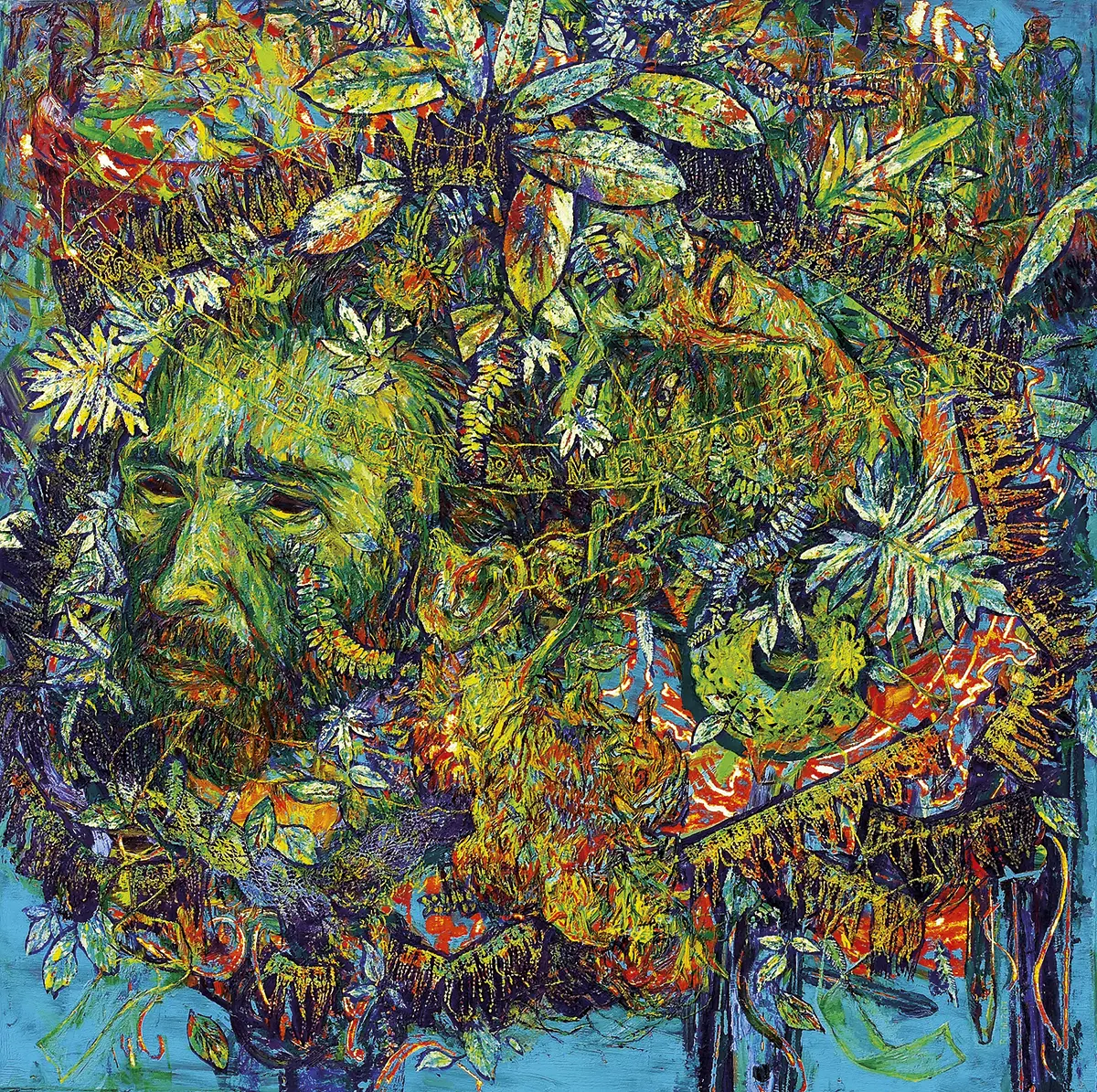
Arnaldo Roche Rabell emphasizes the individuality of his creation, but he also shows us that he shares the interest in questioning the principles that defined modernism and abstract expressionism as he incorporates strategies, techniques, and themes his predecessors would have considered a threat or a contradiction, such as the recycling of images; the confrontation of subjects; and a diachronous dialogue, unafraid and without loss, with the Great Masters; as well as the tautological de-personalization of the pictorial act through collective —almost ritualistic— work established between the model, human or not, and the painter.
In each one of his works, Arnaldo Roche Rabell shows us that it is no longer possible to attempt to give obvious answers to the same questions; on the contrary, his work tells us that the answers are found in the search for the enigma and not in the search for solutions, so that often the enigma, the questioning, the doubt, become the very motivation of his art. To reach his objectives, he begins by questioning his own work and the pictorial genre, and despite the great level of freedom he has reached, continues to hark back to universal themes.
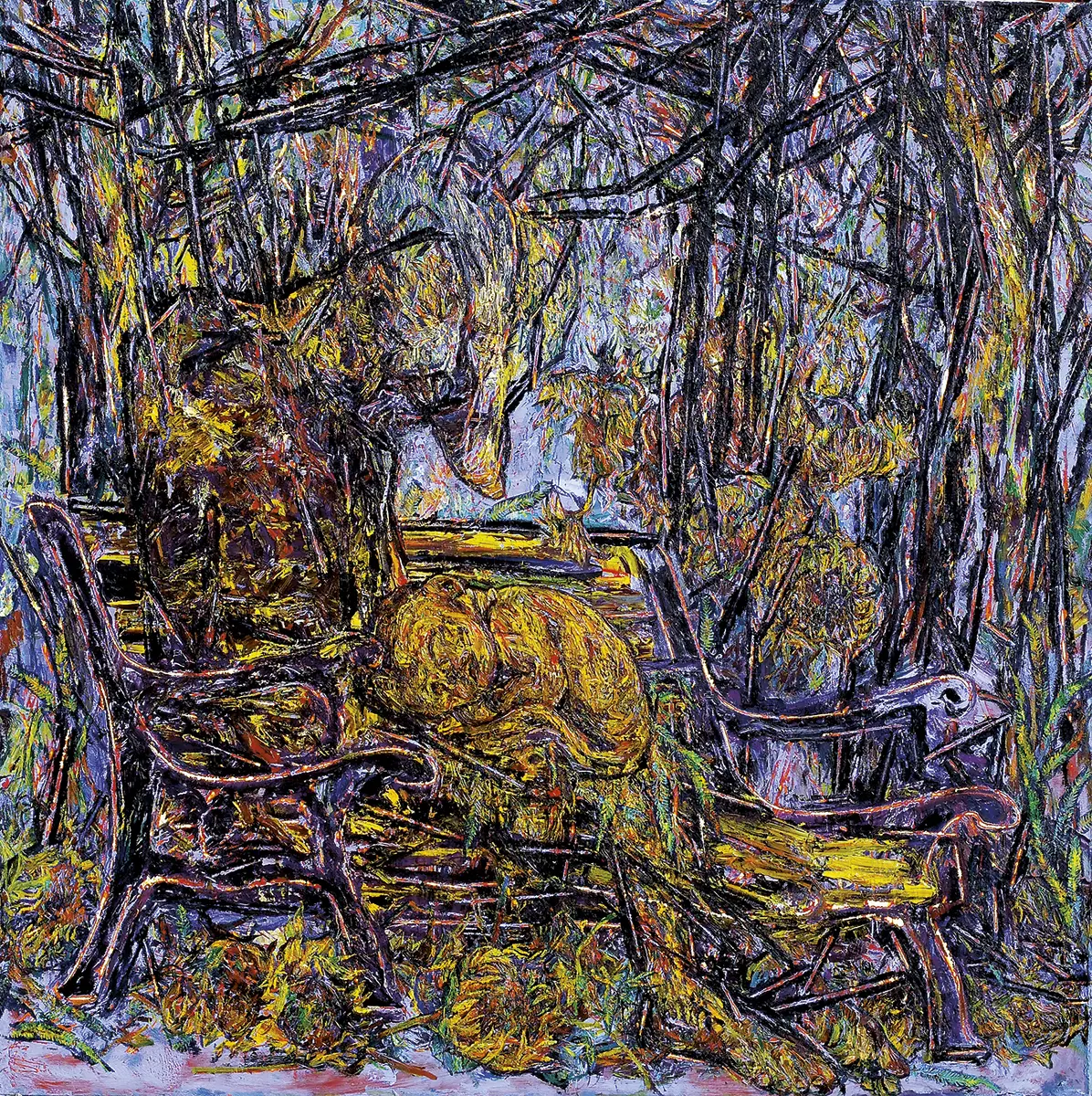
In Arnaldo Roche Rabell we find the proximity of nature, both human and vegetal, in a symbiosis of tension and equilibrium where they recognize and welcome one another, mixing sensations and feelings, as if being part of a universe of delicate physical and emotional stability. As in Brotherly, this new production filled with symbols tells a personal story that refers to the past but uses as its metaphor the life experience of two artists in two different periods, but a common tragedy and a common genius. Both are reflections of the need to comprehend nature and the emotions so that they will not escape or be erased; they are the spiritual effort of sweating and smelling creativity, sweats and smells that tense up the body of the doer, of the producer, to please the admirer.
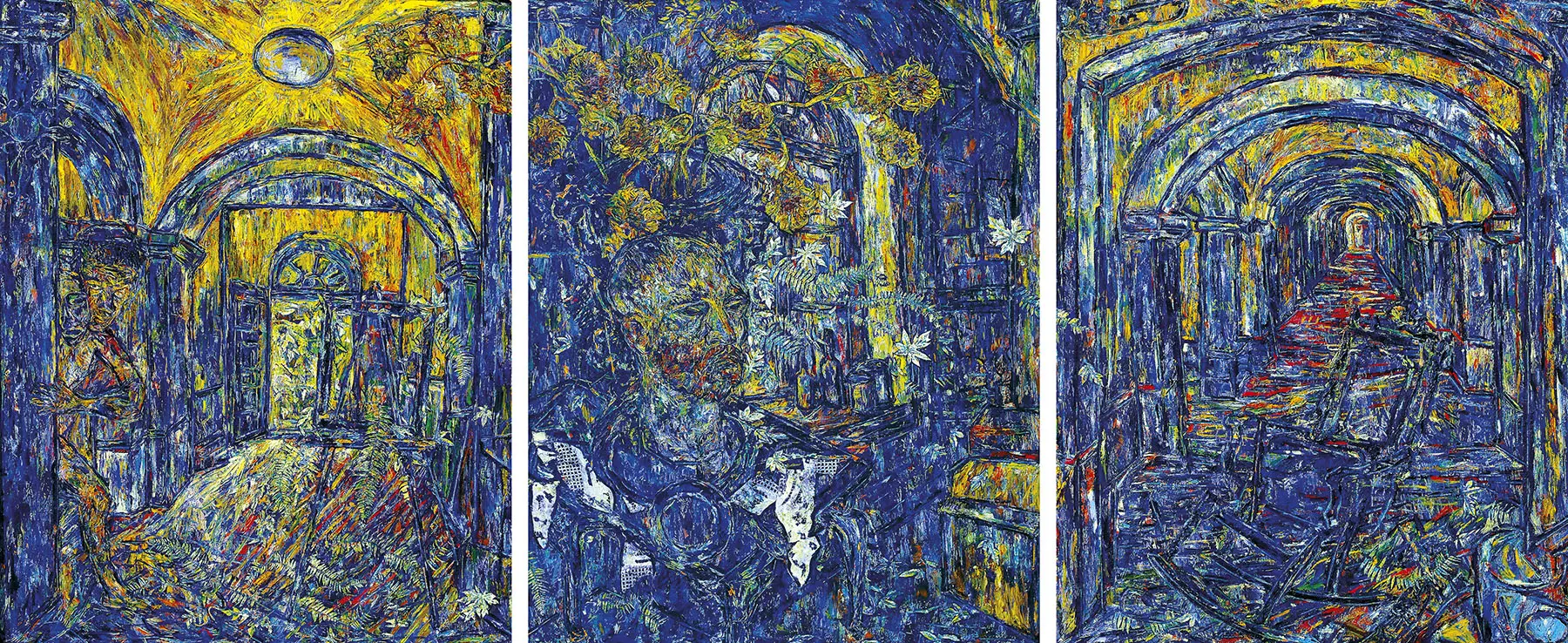
I can now clarify my interest in differentiating modernity from contemporaneity; because I find in Roche Rabell an inextricable dialogue between both positions. On the one hand, his oeuvre is filled with the references and quotes of a historicist personality, but they are expressed as a contemporary conceptual position; they are not present as a display of useless erudition, or pointless knowledge, but on the contrary, they are a resource used to question painting itself in its historical development. In Believe Me, I Bet on Everything on this Table, the artist reviews several traditions; the two chairs at each side of the character, Roche tells us, “represent two modes of painting (Van Gogh/Gauguin)” to which the gesture of his brushstroke pays tribute. The chair, he continues, “reminds me of Goya’s image of how when conscience sleeps monsters are created.” Undoubtedly, the modernist avant-garde is also present with the displacement of the plane and the multiple observation that alludes to Cubism but are always permeated by expressionism that is as exuberant as nature itself and that overflows even more in the artist’s mind. Another obligatory reference would be gestural expressionism, but the palette comes with all the violence of fauvism, adjusted not through contrast but through harmony.
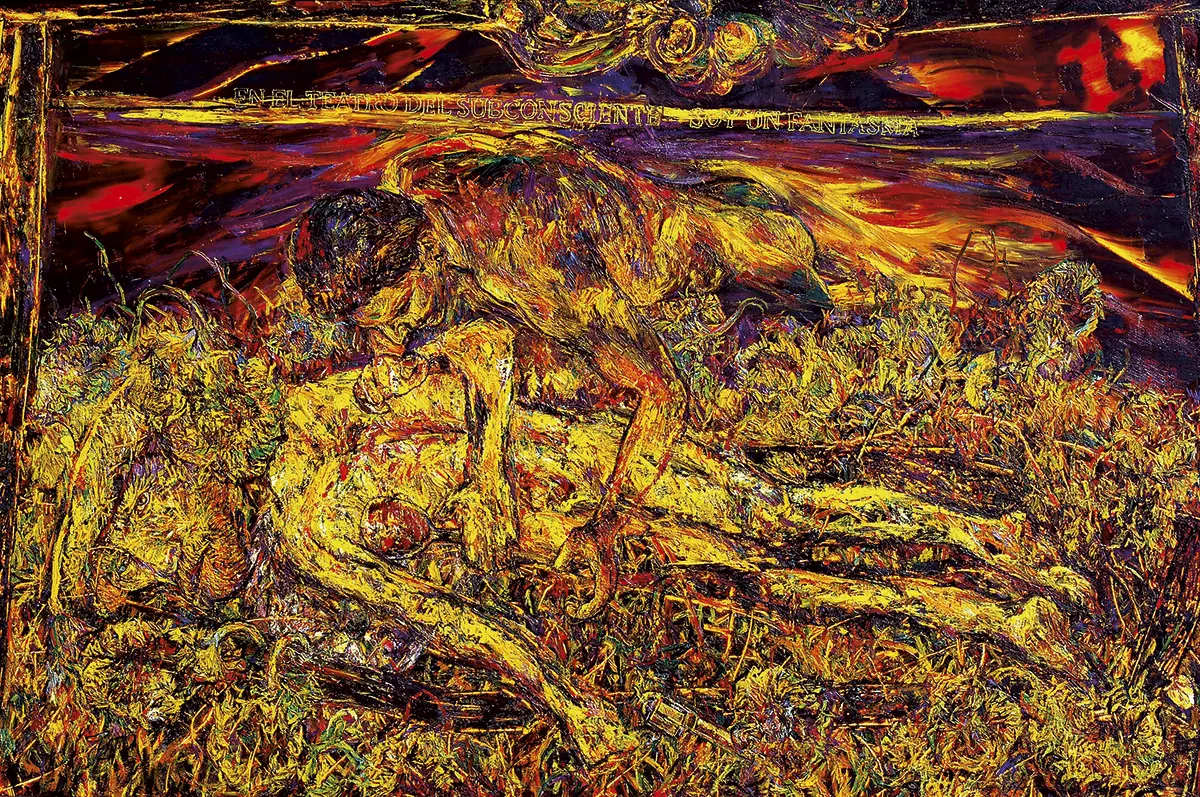
In this series, as in others, Roche Rabell will narrate passages of his personal life. “As I drew we heard explosions... In an act of constriction, I dove into the ground and tried to draw my brother’s face...” The quote alludes to the tragic events in which his schizophrenic brother killed their sister with a revolver. I am not interested in analyzing what he is trying to say here from an ethical standpoint or from a psychological one, but I do want to point out that painting becomes a vehicle to exorcise pain, since there is a decadent art that links contemporary efforts with the symbolism of the late nineteenth century; it bears pondering whether the artist displays his pain as an intimate testimony, or whether he uses it as a mean to compare the present to the past and bring us closer to a vanishing utopia and the loss of hope.
In these works specifically, we find the key to revelation from someone who is an enlightened and exquisite postmodernist. The allusion to Van Gogh and Gauguin is precise, since both “judge their creations particularly captivating, decidedly modern, and singularly symbolist (a term used for the first time in relation to the July–November 1888 canvases). For Van Gogh, the first symbolist pictorial attempt is Le Semeur. . . while Gauguin explored the symbolist path with a religious painting, La Vision a prés le sermón ou la Lutte de Jacob avec L’ange. The coincidences between these three artists are more than remarkable, since, beyond direct quotes such as the appropriation of the farmer, which in turn, Van Gogh had taken from Millet, Roche Rabell gives his character a red shawl, (sea of blood, sky at dusk?) just as Gauguin does to create “the landscape. . . that exists only in people’s imaginations"4 as he puts it in a letter to Van Gogh. On the other hand, the three of them “innovate at the level of form: in particular, they use color’s power of evocation to dispel anecdotal realism and orient themselves towards a more direct and universal purpose."5
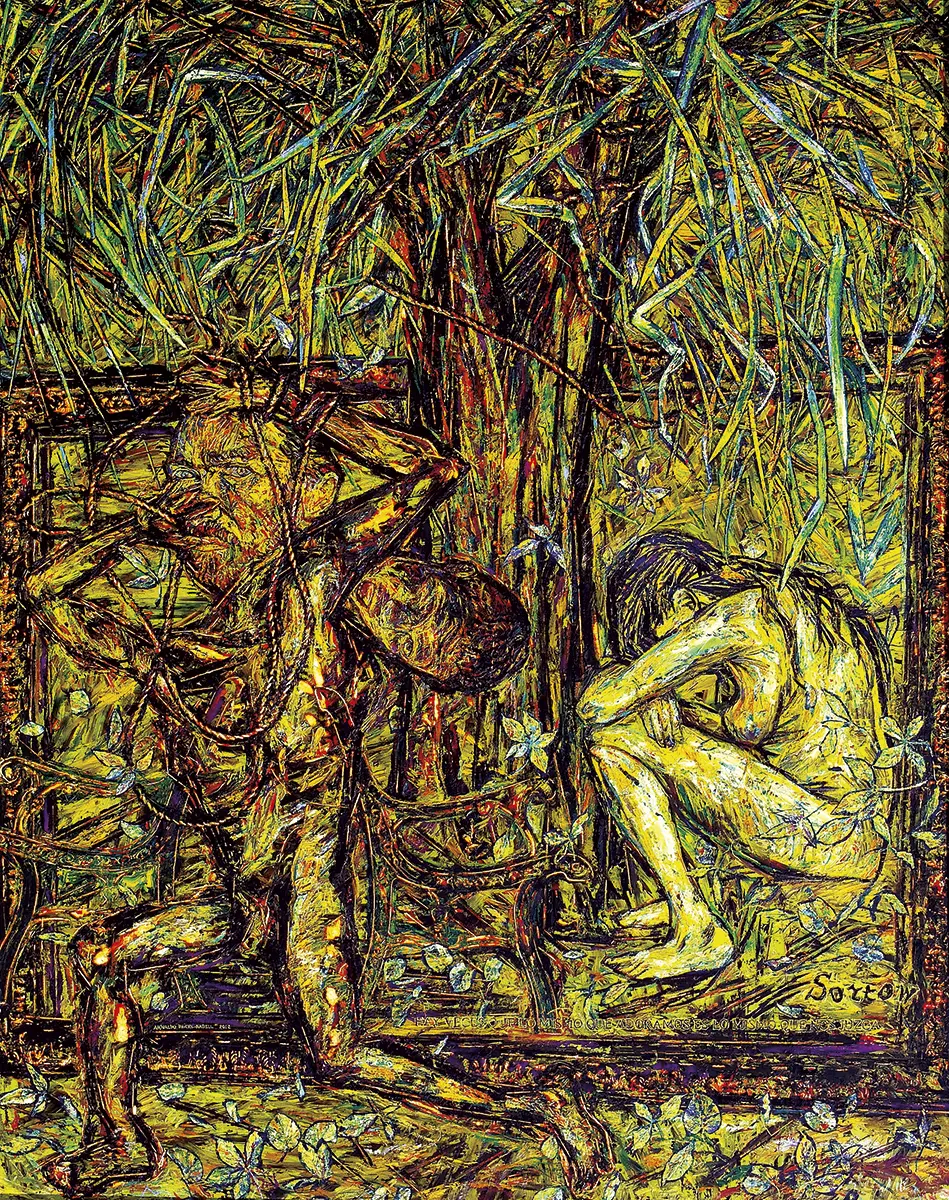
Regarding Lies and Paradises, Arnaldo Roche Rabell says that “we share a fascination with nature despite the fact that our paradises are separated by time and geography. Our paintings nonetheless don’t tell our stories fully. As men and as artists.” Indeed, he always displays a passion for nature, an essential element in his work, to the point of occupying the place of a mother goddess, generator of life, in his private pantheon; the animist sense we encounter in his paintings, where figures are composed on the basis of delicate but energetic frottage, especially in relation to the flora of his native place, comes from a Christian tradition mixed with magical Afro-Antillean traditions. Like the symbolists, he gives his work the meaning of mediation with the divine. It is important to point out the mysticism of an artist who works long non-stop sessions, reaching an ecstatic fervor, almost a synthesis of the antagonistic positions that, despite their closeness to one another, the French geniuses expressed. Thus, while Gauguin attempted a transcendental idealism and Van Gogh sought to concretize the sacred, Roche Rabell makes concrete myth and tragedy in his canvases as a means of sublimation to achieve specific goals of higher spiritual planes.
Arnaldo Roche Rabell's pictorial exuberance is comparable only to that of nature and its productive capacity; we can think of him as a prolific artist who gives continuity to his own existence in each of his paintings; in reference to Nature has to Forgive the Insane, the artist says that “I see myself tied to nature by a life cycle I haven’t completed. I bend like a sunflower ready to let its seeds go even knowing that I have no children. I think I am not fit to wear Vincent’s uncomfortable boots in remembrance of those who sow and reap their fruits. . . .” As a source, we could mention both Van Gogh’s sunflowers, and again his sowing farmer painted in Arles. But the bottom line is more profound: it is the symbolic value of the image, which established new communicative parameters and became a path to redemption through aesthetic enjoyment. On the other hand, Roche’s written and spoken word would require a separate study, but I use it here as a link between his discursive intention and the fantasies of the collective imaginary, since in their inability to understand or classify the artist’s work, to which I referred above, most people have built a whole mythology around him. It is said he feels possessed by Van Gogh and it is anticipated that he will cut off his ear. On the basis of the analogy of suffering caused by tragedy, Arnaldo Roche Rabell uses appropriation and recycling to develop his own language, one where visual references are broken not only in the shift of form but also in the medium; Roche Rabell’s pictorial virtuosity is obvious and beyond questioning, and the point is not to emulate the achievements of his referents, because he doesn’t need to prove anything. His technique possesses an unbound richness, his gesture is quick and confident, his palette is indescribably complex and is built on dense, short, frantic applications of pigment; the dragging derived from the frottage of the model’s body against the canvas, in color, as if in a “shroud” where sanctification is given in the mystical act of transformation of flesh into image.
We could quote one after the other the paintings that comprise this show, but it seems to me much more important to compel people to their contemplation, to the establishment of an emotional relationship between viewer and artist; this gives me the satisfaction of knowing that painting has not died and will not die as long as there are artists like Roche Rabell.
NOTES
1. Textual quotes from Roche Rabell come from personal correspondence with the author between November 2003 and January 2004.
2. Yve-Alain Bois, “Painting: The Task of Mourning,” Endgame: Reference and Simulation in Recent Painting and Sculpture (Boston: Institute of Contemporary Art, 1986), reprinted in Yve-Alain Bois, Painting as Model (Cambridge, Mass./London: MIT Press, 1990).
3. Ibid., p. 230.
4. Marla Prather, Charles Stucky, eds., Gauguin, A Retrospective (New York: Parklane, 1989), p. 84. “Groups of Brittany women pray in very intense black costumes. Very bright yellow-white headdresses... A dark purple apple tree crosses through the painting... The (pure vermilion) land... The Angel is dressed in violent ultramarine blue and Jacob bottle green... The angel’s hair chromium two and orange flesh-colored feet... In this painting, I find that the landscape and the fight exist only in the imagination of the people who pray after the sermon...”
5. Robert Goldwater, “Symbolic Form - Symbolic Content,” Acts of the 20th International Congress of the History of Art, vol. 4 (Princeton: Princeton University Press, 1963), p. 91–133.
AGUSTÍN ARTEAGA
Director of Museo de Arte de Ponce, Puerto Rico.