
Carlos Amorales’ work to date has been an interesting convergence of formal and conceptual tropes and strategies. He works with finesse and aplomb in numerous genres including performance, video, sculpture, photography, and works on paper, and is one of the most interesting Mexican artists of the post-Gabriel Orozco generation. And most importantly, he has escaped the aesthetic of the Orozco matrix. Amorales’s emergence was initially propelled by a series of works that revolved around lucha libre, or Mexican wrestling. This series culminated with the well-known Amorales vs Amorales in 2003, where the artist took the wrestling masks of his face —originally devised as artistic devices— and had them worn by wrestlers in the ring who competed against each other. Rife with humor, Amorales vs Amorales was infused with philosophical, psychological, and cultural meaning. Certainly one can detect relationships such as the contest between the mind/body, conscious/unconscious, internal/external, and a host of other dichotomies that converge in the locus of a masculine vernacular.
Although the roots of Amorales vs Amorales go as far back as 1996, it is compelling that the artist has offered a different model of the artistic persona. As a “low culture” artistic personality, Amorales’s artist-as-wrestler resides within the trajectory of others who developed the role of the artist in altogether unique and interesting ways: Joseph Beuys and his role as political activist or shaman; Lygia Clark’s transformation from artist to a therapist; and Andy Warhol as artist/celebrity. But Amorales has gone beyond the parameters of the wrestler in a myriad of formal and conceptual directions, and his debut one-person show in New York is a testament to that.
The exhibition, titled The Bad Sleep Well, included an installation; a video work; a slide projection with audio in the form of a triptych; digital prints; and five made-to-measure suits embroidered with text. The largest work in the exhibition was the installation Everything Louder than Everyone Else (2003). The installation consisted of ravens that hung from the ceiling in a Calder-like mobile, which was surrounded by what appeared to be blood on the walls that seemed to drip upwards. The installation, the video, and the slide projection had an apocalyptic air that may have been engendered by global events such as September 11; by more localized phenomena such as serial killings, over-the-top existentialism of a world gone mad; or by a deep meditation on death and renewal. Part Edgar Allan Poe by way of Edward Cayce, the three works were also made in collaboration with the psychic John Edward, although his relationship to the exhibition was not clear. The photographs consisted of images of women in factories, and as such, they had a range of narrative possibilities. Yet within the context of the show, they may well have referred to the murders of more than 300 women in the northern Mexican city of Ciudad Juarez. A number of those murders have been attributed to a serial killer. The diabolical thread of the work and the exhibition could be construed as gratuitous, but it would be shortsighted not to give Amorales the benefit of the doubt. The most powerful piece, however, was the work that was also the title of the exhibition.
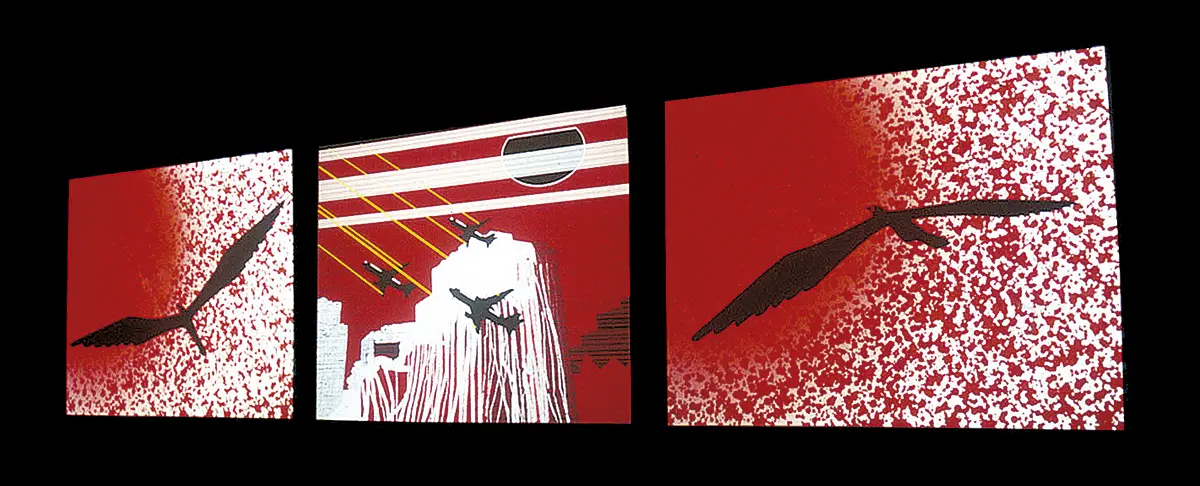
The work, The Bad Sleep Well, was a triptych consisting of a three-channel slide projection of graphic images in black, red, and white and that dissolved into each other. Some of the visual leitmotifs consisted of ravens already seen in the preceding installation, skulls that were also part of the video piece, airplanes, arachnid-type hybrids, and dark, silhouetted figures. The work consisted of 480 slides; although the images did not seem to repeat they produced a sense of recognition, of a schema that was nonetheless hypnotic. The effect of the visual elements of the piece was heightened by a soundtrack of quasi-atonal sounds that was marginally reminiscent of slowed-down house music, truly referring to a cousin of this musical genre called a trance. And it was this sense of trance, hypnosis, and other more sinister allusions that made this work riveting and the exhibition a highlight of the New York season.
RAÚL ZAMUDIO