“I am not particularly interested in discovering a place. Perhaps I can talk of myself as a Situationist, as someone who is more interested in speaking ‘in’ and ‘from’ one or several concrete situations…” Such was the answer, without holdbacks, given by Carlos Capelán to a question sketched by anthropologist Annika Köhler about the perennial nomadic status of the artist’s life. An impenitent condition of which no doubt is left after reviewing his multiple, almost whimsical itineraries. Born in Uruguay, Capelán has lived in many worlds and many symbolic landscapes, before which he practices a unique strategy of absorption cannibalism that, undoubtedly, is later reflected in his production as an artist, marked as it is by hybrid juxtapositions in the vein of Néstor García Canclini, a mestizaje of signs, a global transculturation, and a multi-culturalist language.
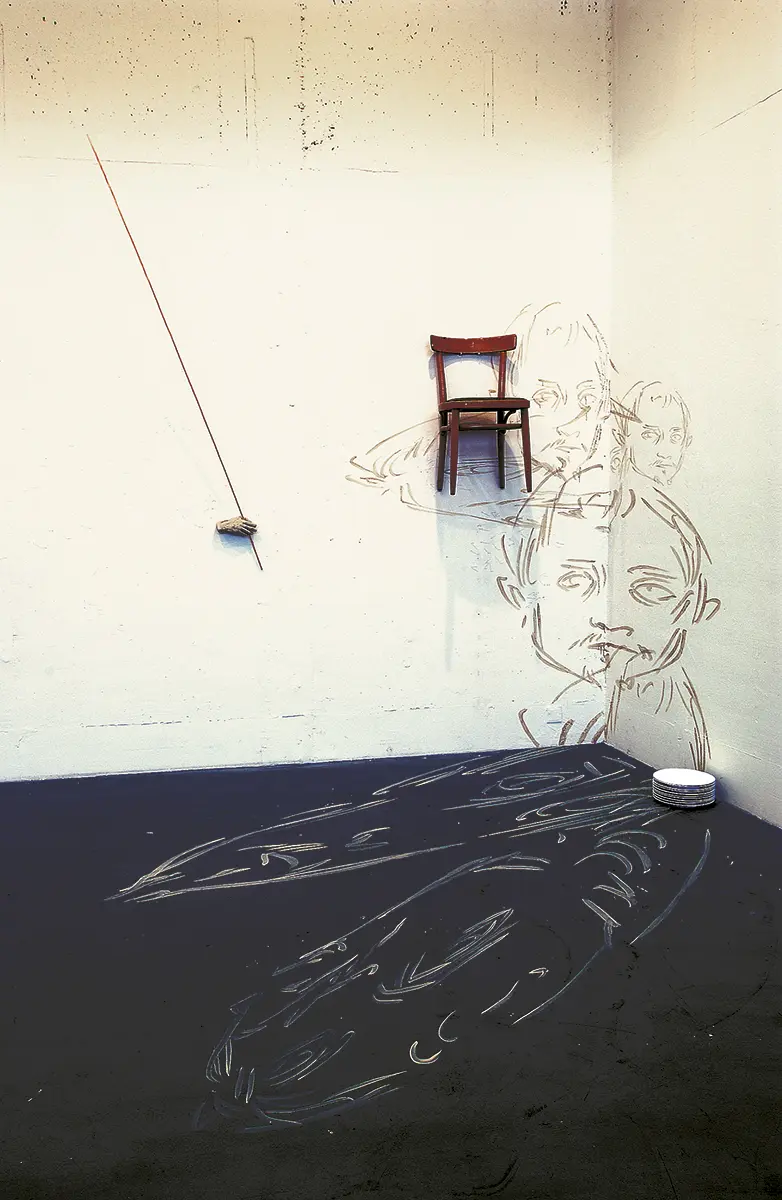
Any approach to his most recent show, at Galería Fúcares in Almagro, Spain, will reaffirm the presence of certain constants not only ideo-aesthetic but also morphologic, which make us think of Capelán not as an artist in the poorest, most modern sense but, at any rate, as an eloquent interpreter of a cultural contemporaneity of which he is a protagonist, role that unsurprisingly widens the rather rigid margins of those who limit themselves to inhabiting the sterile realm of the dullest representation, the modus operandi of current journalism, perhaps incapable of narrating an event. This exhibition in particular, but his work as a whole also, represents the rationalistic logos of a critical practice always apt to label everything, the obstacle of a nominative conflict of the highest order. It is already a cliché in the debate and the reflection about the contemporary practice to note the crisis of certain notions or categorical apparatuses in their use towards discerning those meanings or motivations that remain hidden in the work of art’s different textual fields and registers. This becomes even more complex when the artist’s own stated intention includes the idea of building symbolic compartments capable of acting, if at all possible, as performative acts in which landscapes of memory are tattooed. A kind of open scene that de-centralizes the tyranny of the literal/linear in favor of a new hermeneutical approach that supports co-creation on the part of the viewer.
In the show’s museographic narrative, an informed gaze on Capelán’s work will corroborate the suspicion that we are encountering a multifaceted creator who, like Faust, will not rest in the anxiety-inducing labor of finding answers, even if they are misleading. In this way, the doubt arises of whether this is an artist by virtue of the traditional canon, a compulsive anthropologist who understands art as one among many objectivations of culture, or a cartographer who traces hypertextual maps that cannot be identified with specific space. The bifurcations and juxtapositions of the objectual, the pictorial, and the meaningful ornament unveil the intention of gaining space for the configuration of a visual and textual archive comparable only to the oddity of a book whose writing enjoys dissolving the hegemonic pattern of authorship. The collection of paintings, drawings, and installations that support the show’s conceptual framework suggests the abstract presence of an illuminated text. In it, each page summarizes and condenses stories —the artist’s and other people’s—, narratives perhaps fossilized in the amnesiac front of our peripheral cultures.
It is in that sense that I find the metaphor of the spider web, which some critics have used in their approaches to Capelán, tremendously eloquent and audacious, because, despite the fear of error provoked by any writing-based exegesis of art, the artist’s current show is precisely a baroque weaving, through which those have to move who decide to access an imaginary free if authoritarianism and dogmatic points of view. Like that o post-modern ideologues, Capelán’s discourse banishes the rhetoric of centrality, graphing a plurivocal surface capable of accepting, from itself, the experience of all kinds of alterity. Center and authorial instance, as the sole power zones able to propose meaning, are here displaced in order to fix the site of neutral discursive writing that allows for dialog, the search for new meanings, and the possibility of participation that, on the other hand, demands the concurrence of more than a few epistemological instruments. Confronting the mirror of new artistic practices, where all too often simplifications triumph along with old formulas and the resources of effects, the artist places a visuality that is liberatory and inclusive but does not engender interpretative simplicities. His is a high-relief work that must be read according to certain conceptual maxims, a work that in no way lacks sharpness and cunning. Like many contemporary artists, Capelán’s work demands a particular analysis intent on revealing submerged clues in the cosmetics of appearance, in the simulating texture of the visible.
Like the hypertext of the mass media, Capelán’s cartographic essays exhibited in this personal show generate maps in continuous and determined succession, maps that combine the real and the fictional, past and present, in a prolonged game of linkages, arrivals, and departures. In them, we find, in abundance, a spirit of contamination, but not in the prophylactic sense, which is not alien to the fragmentary, mixed profile of contemporary culture. They allow for the most unpredictable oscillations and itineraries, altering the progressive, linear paradigm of exclusionary and transcendentalist statements. Thus the frankly durable character of his poetics and more…
ANDRÉS ISAAC SANTANA