
Clemencia Echeverri’s career has gone through several periods. In the beginning, right after graduating from the School of Fine Arts at the University of Antioquia (1983), she created large-format paintings in which she worked on the human figure with expressionist features; later, she left figuration behind and developed an interest in sculpture, at a time when the implantation of sculptural objects in the public space had acquired great relevance, especially in Medellín, where she joined a group of artists who opened new paths for sculpture in Colombia. Since 1997, after returning from London where she studied contemporary art history and theory and completed a Master’s Degree in sculpture (1994–1995) at the Chelsea College of Arts and Design, she has been committed to video installation, a medium that allows her to bring together the vast array of her artistic experience.
Her work in sculpture had already made evident an interest in incorporating the surrounding space as a matter inherent to the built object, an attitude that brings together elements from the minimalist aesthetics that will later make the installation possible. In this way, Clemencia Echeverri’s current interests find a connection with that prior moment of her career, while on the other hand, her video installations reveal a break with abstract language in a rather more formal order of things since her most recent works seek an insertion in and a connection with their socio-cultural context. That break is evident in what can be called the “narrative tone” structuring Echeverri’s Casa íntima (Intimate House), a piece that explores the meaning of home as a place that one inhabits, a place dominated by affections, and a territory closely linked to our everyday lives, to life, and memory. Echeverri’s insertion in the realm of culture is forcefully expressed in Apetitos de familia (Family Appetites) and later in Exhausto aún puede pelear (Exhausted but still Able to Fight), where her gaze slows down to contemplate, in the former case, family gatherings in which a cultural tradition persists, and, in the latter case, popular celebrations. Cal y canto (Lime and Song), carries forward her exploration of what lies beneath certain collective expressions: celebration and protest, but in this case focused on the urban element, on the social tensions that are created in the city; what emerges is a piece marked by density, both at the level of structure and at the level of meaning.
In a 1997 show titled La mirada expuesta,1 Echeverri, who was presenting video pieces for the first time, revealed a moment of rupture within her oeuvre. As the artist puts it, upon her return from London, after studying closely the work of Eva Hesse and Louise Bourgeois, she found a “need to say"2 that distanced her from the more rational design of her previous work.
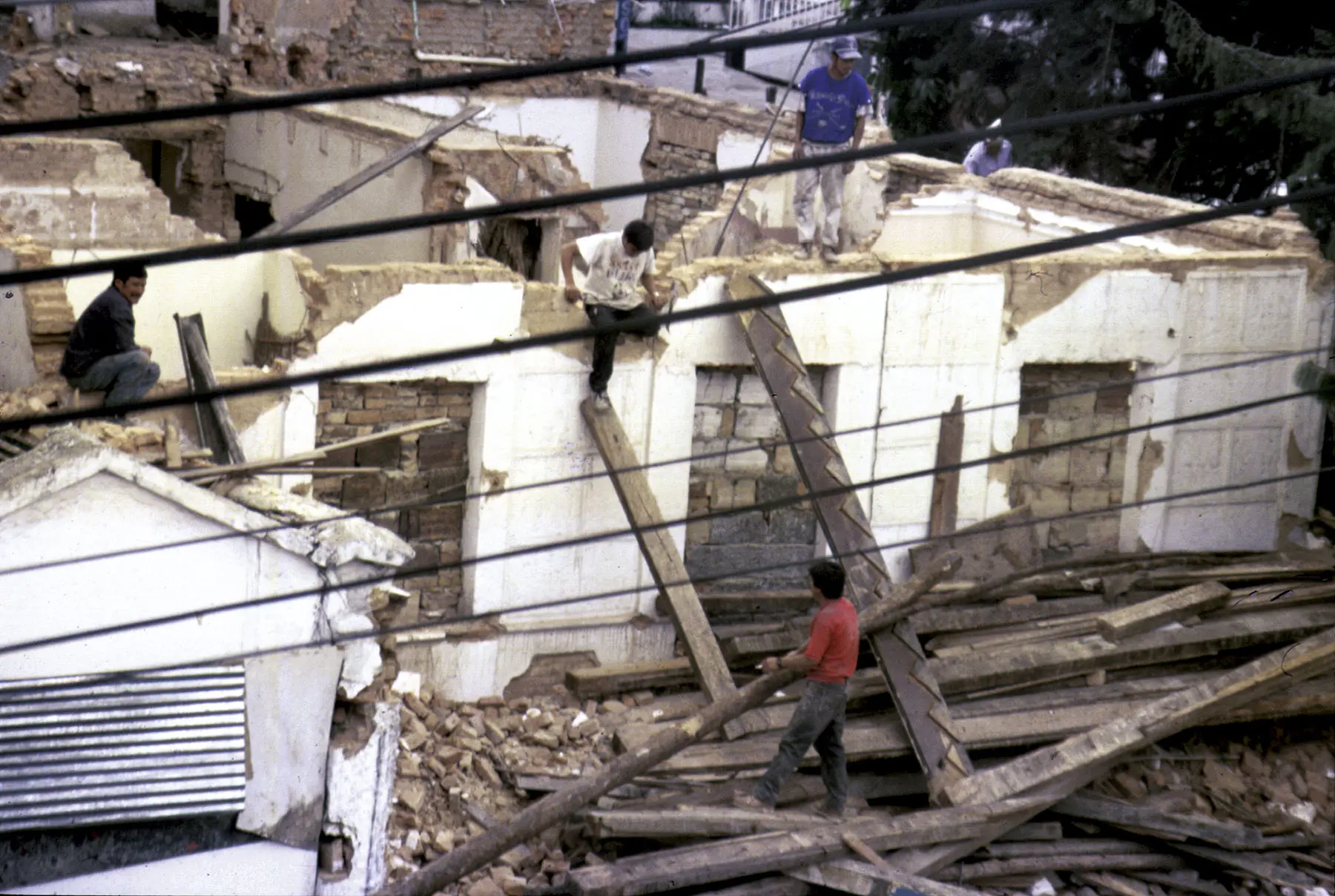
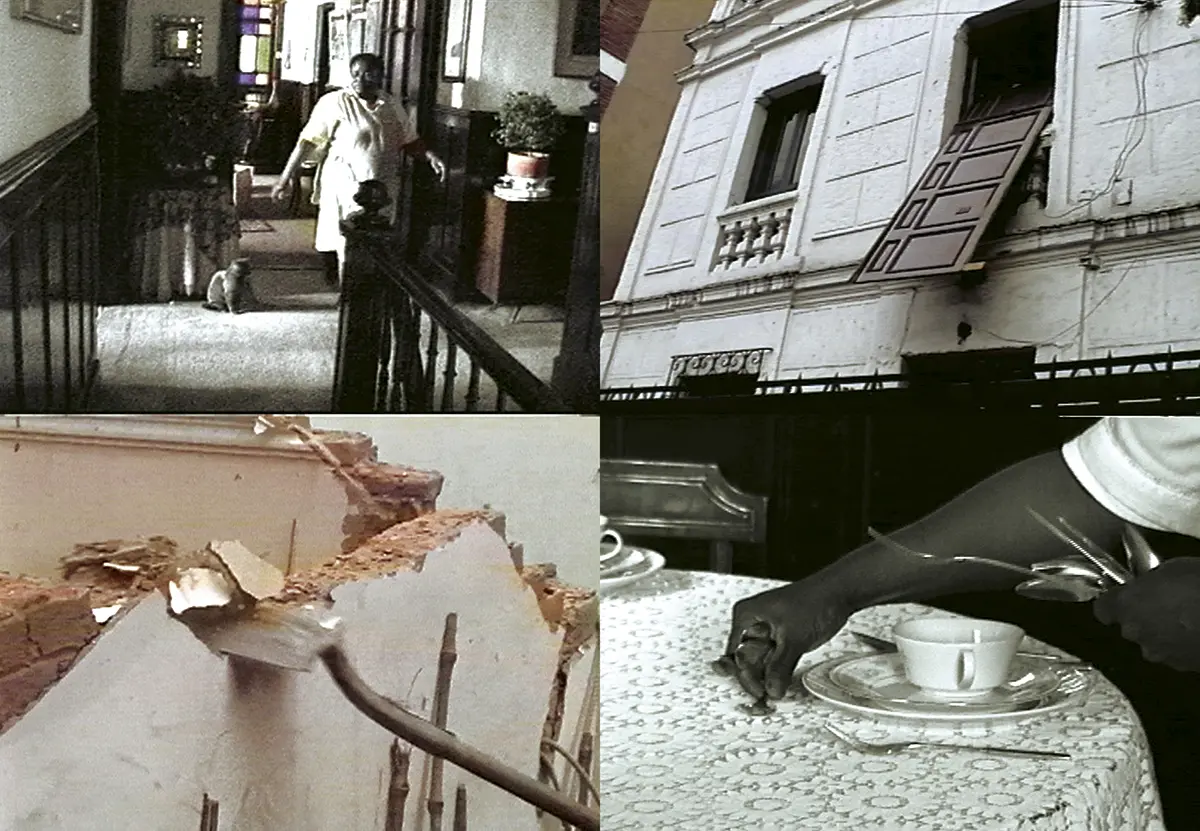
In Casa íntima3 of 1998, that impulse to say comes close, in a way, to “narrative,” in that the images and voices that comprise this video installation allude to a history related to three generations of a family who have lived in house that now, due to the expansion of a road, will have to be torn down. Domestic images, such as doing the laundry, setting up the table, cleaning various objects and places, acts that preserve and make possible our lives, alternate with others that refer to death, destruction, and tearing down houses. In this way, for twelve minutes, four screens show fragments of two counterposed experiences. The images are punctuated by intervals of silence and by female voices that speak about the house, of the life lived in it; voices and images point toward a process of demolition that destroys the history of one family.
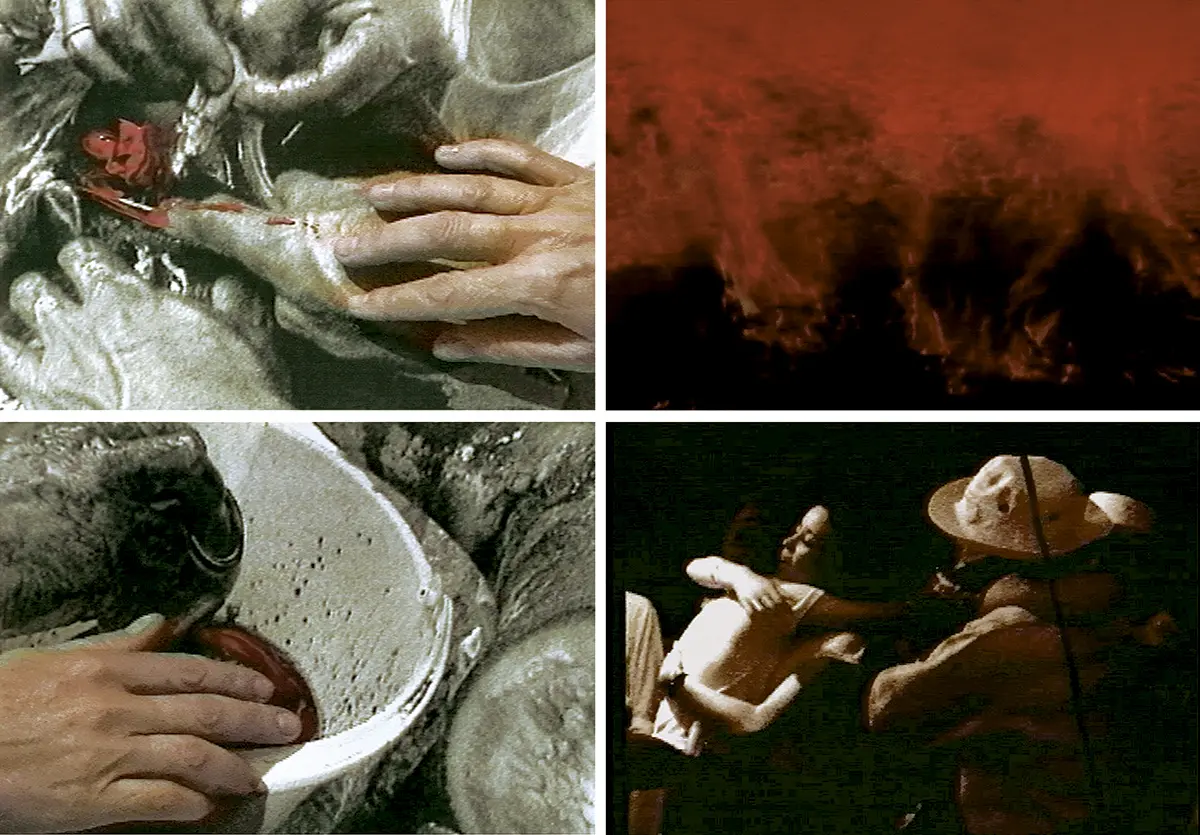
Apetitos de familia, of 1998–19994 brings to the fore Echeverri’s experience as a painter, since color and matter become indispensable elements that transmit meaning. For this piece, Echeverri takes as her point of departure subjective experiences motivated by traditional New Year celebrations in the regions of Caldas and Antioquia. Since long ago, it is customary in these regions to kill a pig on New Year’s and to prepare various dishes with the meat and the blood, which are then shared between family and friends. Echeverri was born in Salamina, Caldas, and these rituals were part of her family life while growing up. Echeverri conceives her careful and objective observation of this act, of this feast that combines animal sacrifice and the pleasures of eating, as a work strategy that, in her words, allows her “to see states that are calmed down and pacified by custom. On this occasion, it was a matter of seeing again, and again, looking into, and disentangling their state of normalization. At that moment all I wanted was to capture in a detailed way everything that happened and to see reality just as it is. Slowly, I started seeing beyond what I had always seen, and each moment generated in me a sense of estrangement, driving me to a first, rather slow appraisal and to an interest in capturing everything as if I were devouring it. To film all spaces and levels of action, to see each moment simultaneously from inside and outside, and to breathe the air created around these things. With my camera there, so close to the event, at that very moment, I intend to enter what’s hidden, opening paths and gaps with an eye that is used and familiar, penetrating into certain transparencies of the real, feeling how experiences devolve, start anew, intertwine in the moment of the event, and realizing that they were not lost . . . I wanted to see for myself things that I had never seen, generating a process of discovery of where meaning is, and to deconstruct that time that is devoted to celebration in order to capture and attempt to unveil what is hidden."5
This occult meaning is linked to the animal’s skin and blood, to the cut and the hand that executes it; it is also linked to the sounds that are part of the action: the pig’s growls, a heart’s beats, children’s voices, gunpowder blasts, and laughter. The images are carefully selected, and they are dominated by close-ups of hands as they prepare the dishes; we see in detail the preparation of sausages, the way in which they are stuffed, and the cooking of blood, all presented with a slowness that allows the viewer to discover things that go beyond the acts themselves, so seemingly normal. Momentarily the image becomes still, and the color fades into black and white, which creates a kind of distance, a freezing of the action, placing it in a different time. Then, slowly, a hand emerges in real-time and in color, touching those other hands in the photograph. In its trajectory, this hand colors the still images in the pig’s blood. Through these devices created in the workshop, we return to the events now from a reflexive distance that, in its estrangement, allows us to go over them.6 The editing is subtle, the sound is precise, and we are left with the impression that in this piece blood as matter, textures, and forms, as well as the tactile elements, acquire a peculiar strength so as to make evident a language indebted to painting.
The images that comprise Echeverri’s 1999 piece De doble filo (Double Edge)7 seem to hark back to certain experiences of her two previous video installations, along with some elements that announce her later works. The image begins with a hand that carefully draws a house on a white surface, and the audio reveals someone setting a table while listening to the midday news on the radio; suddenly, these household actions are interrupted by violent and menacing knocks, and then the drawing is torn. The next image shows another hand tracing the same image, with difficulty and tenacity, on a thick layer of mud, only to be interrupted after a while by a rain shower that erases the work: the house disappears and the mud dissolves to become a river, which acquires a red color and brings us back to blood. Through images and sounds, Clemencia Echeverri puts us in the same situation of uncertainty in which thousands of Colombians live, as she has put it: “. . . today in our country we don’t find the sounds of birds, we don’t find blue skies or open seas, sun, forests, ravines, wind, silence. There is no longer the smell of sugar cane, swings, the movement of coffee beans as they dry, cattle runs, the sound of horses through the mountains, furious tropical hurricanes, or hammocks. To me, reality sounds disturbing, there are cries, red colors, dark places, an excess of voices, lock-ups, sounds that tear things apart sound that cut, overflowing water, vertigo, loss, failed attempts..."8
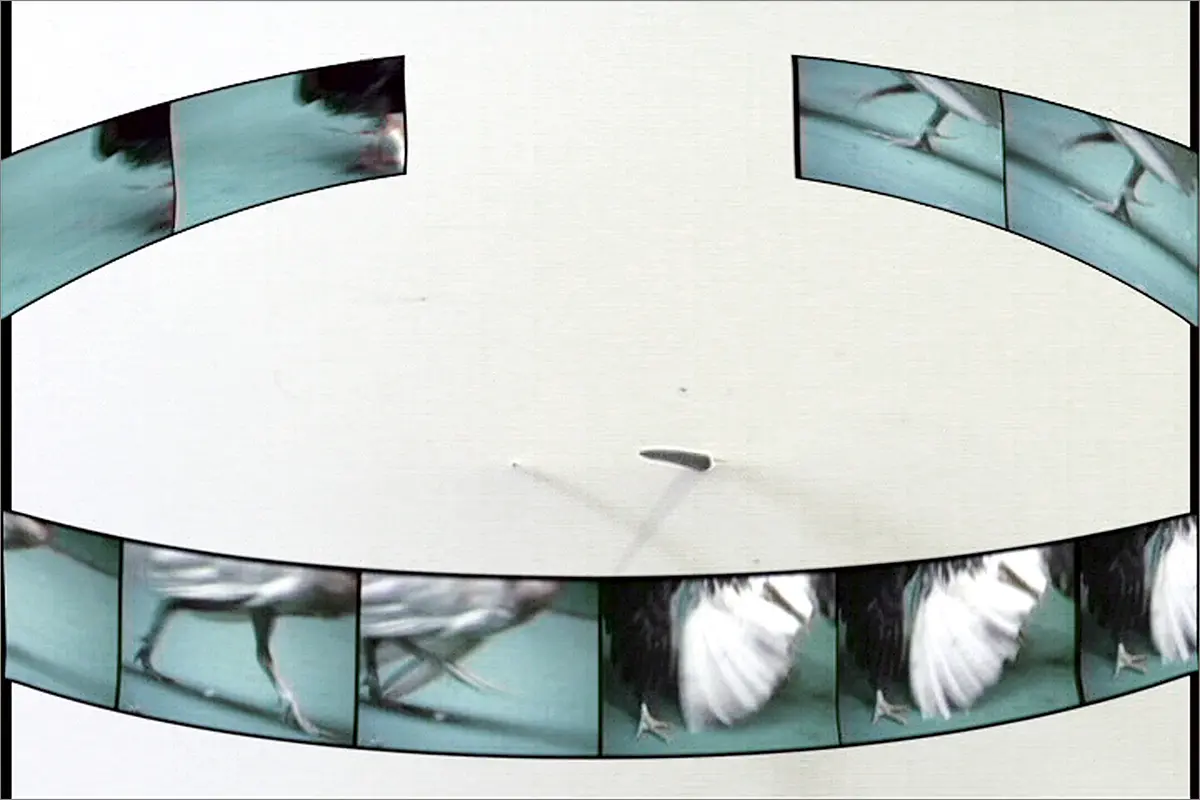
In her 2000 piece Exhausto aún puede pelear,9 Clemencia Echeverri studies the tradition of cock fighting so prevalent in many regions of the country, yet another violent event in which celebrations and fun are articulated around violence. In this case, the installation of four large-format screens creates a circular structure that brings to mind an art gallery, thus heeding a premise of contemporary sculpture: “Sculpture places. . .viewers center stage so that the work develops around them, not only at the time of its installation but in the creative process itself."10 To establish contact with the work, viewers must occupy the center of the space where roosters are usually located; in the installation, however, the animals appear as large images surrounding the viewer, an inversion of the order of things. Some images show in slow motion details of the animals’ fight, which is to the death. Others stop to contemplate a tense white sheet that is torn by the animal and a knife, which then emerges as a threatening element. The action is repeated over and over, accompanied by sounds that reinforce it; a disquieting atmosphere is created, situating the viewer in the midst of a cruel spectacle that belongs to popular culture and becomes a metaphor for the conflict in Colombia.
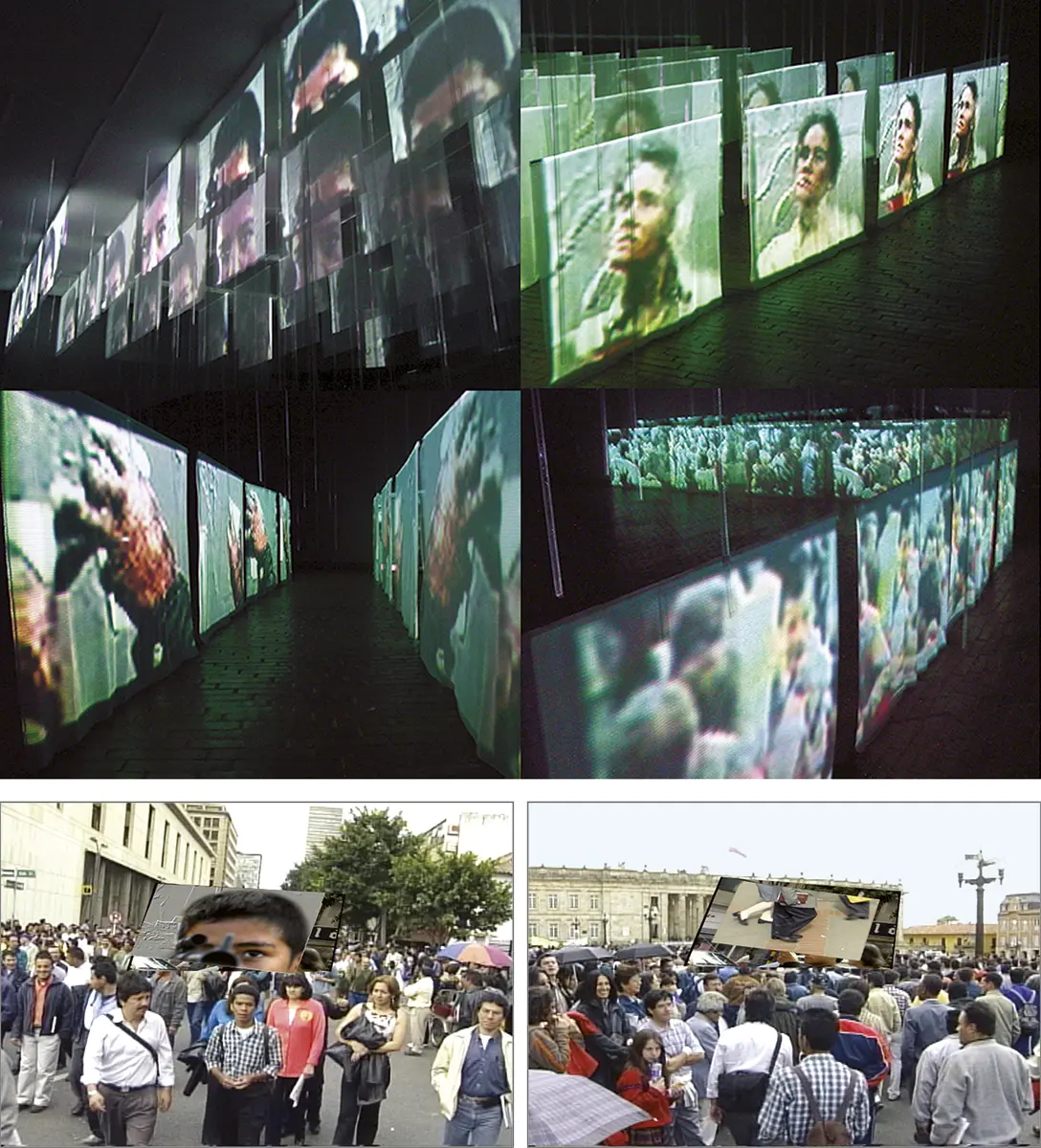
As the artist has said, her 2002–2003 piece Cal y canto11 seeks to reveal through images, “our social tone,” a tone that is extremely thick and complex. The installation consists of a dual space through which images circulate; the images are of a street demonstration and a group breakfast served by Bogotá’s Mayor’s Office in the El Cartucho neighborhood, inhabited by a marginal social group. As “matter,” the piece involves the dark rooms in which it is installed, the video images and the screens in which they are projected, and the audio that is heard as the images pass, formed by urban noises such as the cries of a woman who deals in bottles and paper. It is a persistent sonority that brings along the vertigo of the city, the overcrowded streets, places of transit in permanent flux where an amalgam of engine noises and human voices invade us without our being aware of them, a kind of urban opera or, as Echeverri calls it, a sound wave “encrusted in our memory.” These visual and audio elements make possible a spatial experience that also has a temporal dimension, determined by the length of the piece. The viewer is free to move around, following the trajectory of a woolen poncho dragged through the floor, a menacing knife, or the feet of the fiery masses that advance on the city. Both the protest and the supposed celebration of the city’s poor become urban gestures on which social conflict, unrest, and inequality converge. And it is in this conflictive, tight, and explosive region that Clemencia Echeverri inserts herself in the installation; she multiplies images as if in a mirror, so that they form a consistent, sculptural body that occupies the space and multiplies, like an echo, the signs of a situation of conflict in which we are all immersed.
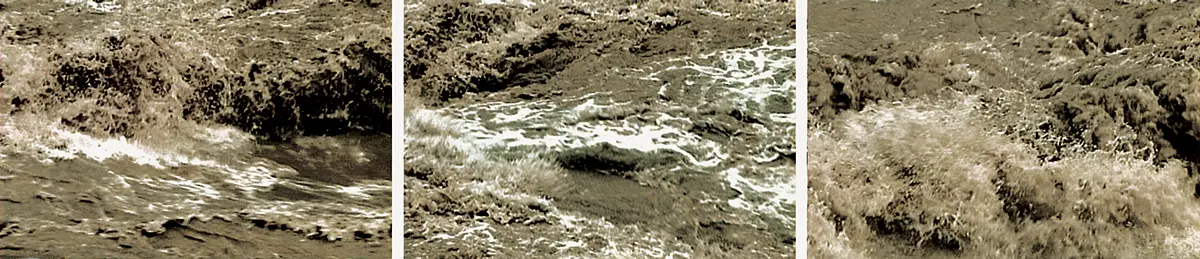
In most of these pieces, Echeverri begins her videos as a documentarian would: camera in hand, she registers everyday events that occur around her; she does close-ups and panoramic views that capture various aspects of those events. These shots result in material that is altered through painstaking labor of reflection on the images’ particularities. From such encounters with her visual matter Echeverri’s editing, timing, audio, and their articulation in space emerge. The final result has little to do with reporting, with documentary, and, for that reason, with narrative. The piece is articulated following the meaning suggested by the images, and in that way, it slowly unspools the hidden meaning of events that now become a visual, spatial, and sound experience that surrounds viewers and places them in a zone of conflict closely linked to the tense reality in which we live. In her own words, “The content of the work is formed in the process of creating images, not in the idea of representing reality. I am interested in incorporating what appears as a document to let the work slowly take shape. It is an open production of images that are inside themselves. It is a state of submerging one’s self in the shot, opening them up, and finding that which is hidden and expresses itself in a different way and is revealed in the turn, like an image-machine."12
NOTES
1. Galería Espacio Vacío, group exhibition with Trixi Allina and Rolf Abderhalden.
2. Clemencia Echeverri, private communication with the author.
3. The work was presented at the 37th National Artists Salon in 1998, and at the 6th Havana Biennial.
4. Sixth Bogotá Biennial, 1998.
5. Clemencia Echeverri, “Apetitos de familia,” in Letrazas (Sicoanálisis) magazine, Bogotá.
6. Juan Fernando Herrán makes the following comment regarding these images: “In this installation, Clemencia Echeverri uses the Christian images of St. Thomas, who needed to touch Christ’s wound in order to internalize and accept his suffering. This attitude demands a sensual approach that is contrary to purely visual recognition. From this point of view, Apetitos de familia alludes to eroticism as an experience in order to bring flesh, blood, and death alive.” Herrán, Project Pentágono (Investigation on Contemporary Art in Colombia), Ministry of Culture, 2000.
7. The piece was presented in the Arte y violencia exhibition, at the Museo de Arte Moderno de Bogotá.
8. Clemencia Echeverri, “Experiencia e imagen,” lecture, Culture Hall, Banco de la República, Manizales, Colombia, 2001.
9. The piece was conceived for the 2nd Luis Caballero, Awards at Galería Santa Fe de Bogotá, where it received an Honorable Mention.
10. Idem No. 8.
11. It was presented at the Museo de Arte Moderno de Bogotá, in 2002, and the EAFIT Central Library, Medellín, in 2003. Recently, the piece was acquired for the UECLAA Latin American Art collection at the University of Essex in London.
12. Echeverri, Pensando en voz alta, artist’s notes, written on the occasion of Cal y canto.
MARTA RODRÍGUEZ
Professor for the Arts Faculty at Universidad Nacional de Colombia, in