The mysterious darkness that dominates the brooding paintings of The October Cycle may be seen as a culmination of the deep intellectualism that has informed the works of Enrique Martínez Celaya throughout his career. Created for the Sheldon Memorial Art Gallery at the University of Nebraska, the twenty-two large (some up to ten feet wide) paintings now on view at the Museum of Art in Fort Lauderdale, are given new relevance in an installation that combines them with drawings, prints, sculpture, and a site-specific wall mural and a poem that serve as the introduction to the exhibition. The overall effect of the series is as much an evocation of imprecise, yet mystical content, as it is an archetypal statement about the romantic expression of emotions through the most minimal methods of abstraction. Limitless voids where the mere suggestion of figures, trees, and other objects are as much present as excluded, hint at transcendental experience and the modern approach to philosophical exploration that is the essence of the artist’s work.
Enrique Martínez Celaya was born in Cuba; his family’s forced exile to Spain in 1972 when he was eight has marked his life and work, and certainly contributed to the deep sense of introspection that is present in this series. Even the title October refers to memories of unfamiliar seasons of cold and darkness, and a life of poverty and misery that was as remote from the tropical island of Cuba as it was intolerable. Just as the early dusk of October ushered in the Madrid winter, Martínez Celaya etches thin rays of light like the last vestiges of warmth into his thick dark surfaces. The simplicity of the line invites the viewer’s further investigation into the depths of each work. The images, painted in oil and varnish on grounds of emulsified tar, may be further complicated texturally by embedded objects, natural materials, and layers of viscosity that locate the viewer at the brink of a resonant void from which palpable forms threaten to emerge. Black, like the specter of death that haunted his youth in Spain, hovers in tiers of dense, atmospheric silence. Martínez Celaya uses the primal duality of black and white as paths of emotion that strain against the canvas.
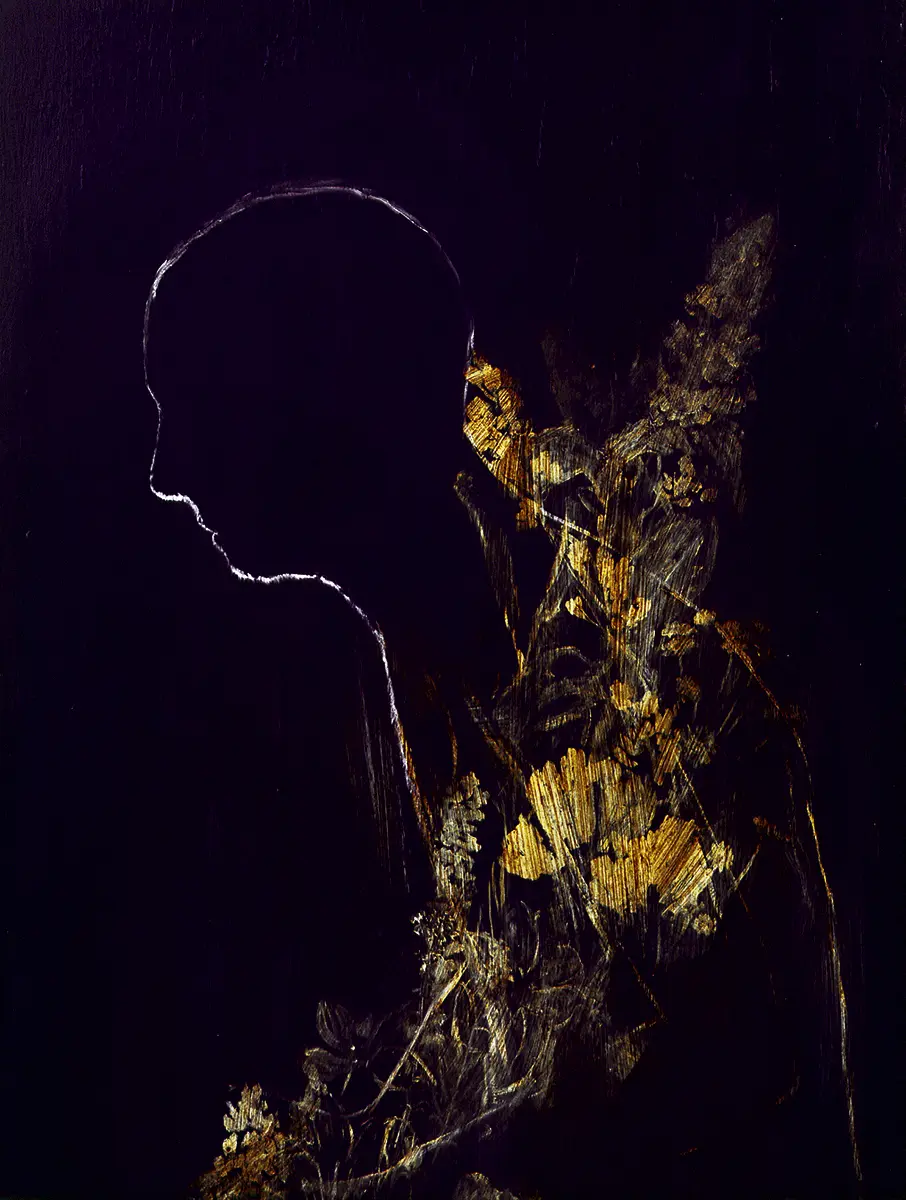
Such poignant interpretations of life come to the artist after an interesting academic and professional career that includes a degree in physics and graduate work in quantum electronics before earning an MFA in painting from the University of California at Santa Barbara in 1994. Always searching for a philosophical context for his artwork, Martínez Celaya sustains the focus of a scientist to explore theoretical as well as metaphysical aspects of art. It is not the mere outline of a head that is the essence of the painting, The Transpierced (morning), 2002. The spare silhouette emerges from oil and tar as if in metamorphosis from nature’s detritus and at the same time creates a contrast between the organic elements and the carefully drawn contour. Painting into and with tar affects more than the surface and the process: it affects the shades of black (and there are shades of black) that are both the background and foreground of every work and adds to the tension of the image as both ephemeral and defined.
While consistently existential and profound, the images of nature are complemented by those associated with his family, especially his two young children who the artist admits have changed his world profoundly. In Gabriella’s Laughter, 2002, named for his daughter, the ephemeral takes on a mystic presence as the outlines of a child and adult merge within a radiant light that is the most abstract, yet metaphorical expression of love. The quiet, luminous white evokes primordial sensations generated from the creative energies of natural light. His pursuit of the most irreducible image pertains not only to his personal relationship with the subject but to the universal substance of life itself. As it simultaneously dissolves and emerges, the image wavers between the extremes of an awesome, mysterious presence and its complete negation by light. Such implicit philosophical musings inform all of his works.
The visual richness of The October Cycle portends a somber, mysterious presence that should be sufficient to convince us that its images belong to an intense realm of experience that challenges our involvement. If we meet this challenge the rewards are inestimable and endlessly provocative.
CAROL DAMIAN