
Word was that for their February 2004 exhibition at Casas Riegner Gallery, a collaboration between Eugenio Espinoza and Lynne Gelfman, Espinoza was going destroy one of Gelfman’s paintings. Now, there is an act that a half-century or so ago might have produced a few transgressive thrills and outcries. The only thing shocking about the idea today is that two such vital artists would even bring it up.
Fortunately for us, Unravel (Desenredar) proved to be far from clichéd. But then, it was a collaboration only in the sense that a mortician collaborates with a corpse or a freight train collaborates with the penny it flattens on the tracks. It would probably be unfair to say definitively that one artist cared and the other did not, or one’s work favors innovation and the other’s the tried and true, but the exhibition looked as though Gelfman did a little housecleaning and Espinoza made something out of the castoffs. Ordinarily, that may not be her method, but it is most decidedly his.
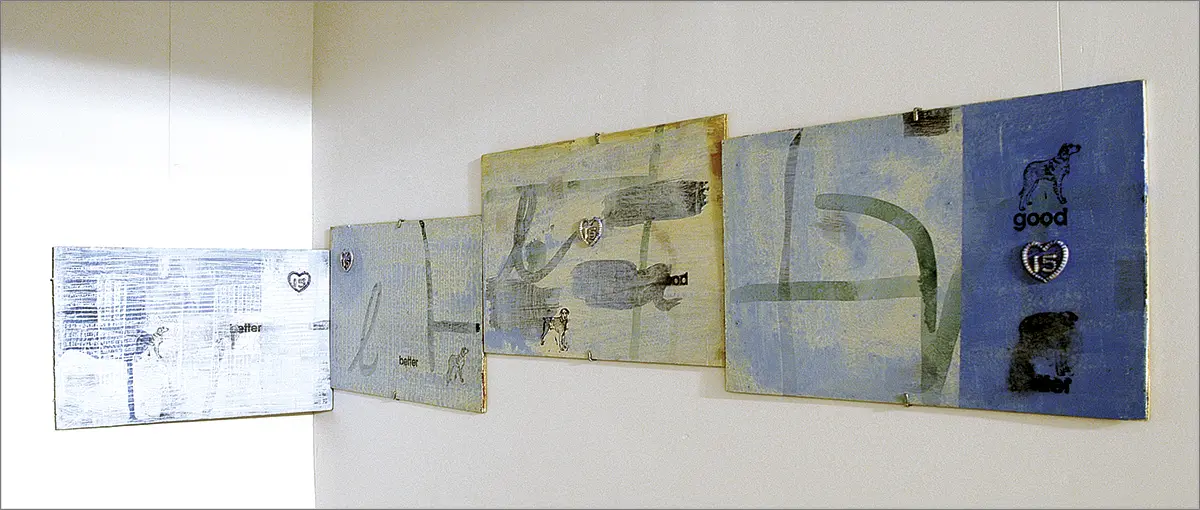
The paintings that Gelfman donated to the project were among the vast quantity of her small and not exactly liveliest ones. They were strikingly similar: mostly muted blues and greens with a grid motif that sometimes seemed, given the often aggressive illusionism of her best work, tentative and even enervated, as if she’d lost interest before she stopped painting. What if Gelfman had offered one of her giant beauties, or a number of her more luscious, incandescent smaller pieces?
But if one artist was going to actually demolish the painstaking exertions of another—and it turned out that it was only Espinoza who defiled Gelfman’s pieces—who could blame the latter for hesitating before taking the leap of self-abnegation? On the other hand, one doesn’t think of Espinoza as someone who ever blanches, holds back, or regards a project with anything less than a kind of rapt carnivorousness, and he applied himself to Gelfman’s little brushwork with his usual cantankerous aplomb. If he eyed the canvas and wood as if they were merely the materia prima of his latest project, there were moments when his own brush strokes followed the contours of Gelfman’s intuitive designs or worked with decisive angularity against them; the way he placed a piece of wood gave an illusion of curvature that echoed the implied depth of the painting’s a perfectly flat surface. But Espinoza spent most of his time obliterating, building on top of, or improvising with his own materials as much as with hers.
Perhaps the most satisfying aspect of visiting Unravel (Desenredar) was to witness very differently takes on what constitutes a painting. While for most of us, a painting goes by one or two names—a “canvas,” or the thing “within the picture plane”—Gelfman treats her works like objects, forsaking the frame and working the edges. But Espinoza’s conception is of an even different order. A painting might consist of strips of canvas, painted or not, dangling in the air, or glued or stapled to a piece of wood that happens to be a work of art. Such a painting might also be a kind of drawing, as when those canvas ribbons curve and loop back on themselves. A painting might be a drip of watercolor on a windowpane that runs to the gallery floor. It might be a tiny construction comprising an entire theater of abstraction, complete with proscenium and hand-painted backdrop. It might be a conversation with the dead.
It is possible that Espinoza intended no more than a commentary on Gelfman’s paintings, an artistic “dialogue” that loquacious, touchy-feely types are fond of blathering about over frothy coffee drinks. He trimmed several of Gelfman’s pieces with thin strips of canvas he’d painted and tied the strips together here and there, or sewed them with nylon filaments as if to say the paintings were knotty, full of conundrums. But so concisely and ingeniously did he impose himself upon these rather wan, possibly discarded pieces, so thoroughly did he derange their niceties, that the paintings he was talking about were his own. You may think these the impositions of a rampant ego, but Espinoza probably has no other speed. He is an inveterate fiddler; he believes it is his job to be somewhat disagreeable and he can never leave well enough alone. Whatever he puts his hand—and mind—to tends to be an upheaval, an overthrowing of the way things are. In this case, Gelfman did not so much collaborate as put herself in the way.
In spite of its studio floor aesthetic, Unravel (Desenredar) was a well-oiled machine, humming with perfect pitch. Its precision and rhythm extended not only to how far a piece of canvas might dangle, how its frayed edges might play against a smooth surface, or its bright, monochromatic yellow shine against that surface’s azure haze but also to where each work should hang on the walls and how one should follow another. The exhibition had a neat, circular scheme of interrelated parts: a section that might be described as pictorial, another that looked architectural, and a third whose tone was oratorical. This is only a guess, but the exhibition’s overall calibration also looked like the product of Espinoza’s obsessive tinkering, and in one of its most singular passages—around the toilet, where several of Gelfman’s pieces were tchotchkes slathered with plaster and rubber stamped and doodled on with historically tuned phrases—it seemed clear that the “conversation” was not between Espinoza and Gelfman, but among Espinoza, Martin Luther King, Yoko Ono, and Espinoza’s cohorts in Caracas and the amorphous “public” they set out to involve in their conceptual shenanigans. A conversation, in other words, with his spiritual mentors and possible heirs and any other like-minded souls, which would, in the end, include his friend Lynne Gelfman after all.
Irony does not appear to have had a place in Unravel (Desenredar), either in its stated intentions or its accidental results—although of course, having a result that differs from intention is the very condition of irony—but it was everywhere you looked. Best of all is the happenstance that the Venezuelan avant-garde of the 1970s is in vigorous bloom in twenty-first-century America, a peculiar reversal of colonialism’s usual arrangements and a perfect conceptualist bon mot.
JOEL WEINSTEIN