Ismael Mundaray’s recent show reveals continuity in the thematic and formal turn taken by the artist in the last four years. Under the title Horizontes, this painter develops a proposition whose roots are in the series Travesías, which in turn is part of the project From the Orinoco to the Seine. The project emerged from his travels in Europe, and it relates to his current way of life, reflecting his experiences between France and Venezuela as the intersection of the two cultures where he creates his art. According to the artist, this series “is a transition and relocation from one house to another. From the indigenous to the urban zone. In this relationship, objects become something else…”
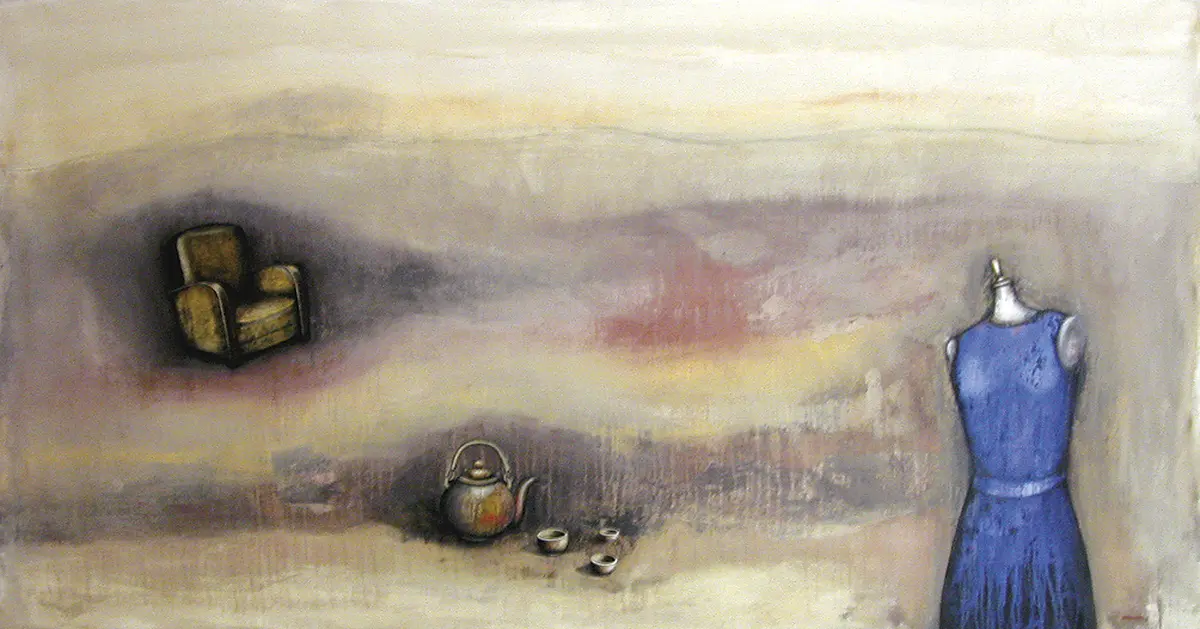
Mundaray’s painting has gone through several periods, but his work maintains a discourse imbued with varied symbolic connotations. From the first stages of his career in the early 1980s, Mundaray experimented with several techniques, which he has continued to refine into a language that alludes to ancestral and ceremonial forms, particularly evident in shows like Vestigios étnicos, 1987, Les animaux, 1988, and Ritual, 1989. His interest in achieving a primitive expression drives him to create paintings related to autochthonous cultures in an indigenous vein. During the 1990s the discourse became synthesized; while he started emphasizing color and working with serial forms, Mundaray’s forms became more schematic, his space more structured, and his drawing more linear. During this period his painting acquired primal features, with the mythic prevailing over the pictorial and the elemental prevailing over the visual. This universe of forms became eloquent in the series of shows Shabonos, 1992, Casas con corriente de aire, 1993, Maloca, 1994, Orinoco, 1996, and Proyecto Orinoco, 1997. The engraved spaces shown in those compositions are complemented by a feeling of suspended time. These features remain in his current work, but they have been transferred to new realms. From the mythical, the ritual, and the ancestral, Mundaray has moved to the domain of the every day, the familiar, and the transcendental. The artist has substituted a contemplative vision of contemporary man for the cosmogonic vision of aboriginal man. The superimposition of veilings, achieved through the skilled use of acrylic, offers suggestive visual effects. Layer upon layer, these veilings blur the borders of space and transform the environment into a climate of dense saturations that spill over the entire format, simulating a kind of chromatic sfumato that shades colors and diminishes contrasts. In this rarefied and ambiguous landscape, space succumbs to atmosphere and figures to illusion. Here, depth of field is achieved through the deployment of horizontal bands and the placement of images on first, second, and third planes, suggesting a perspective hidden through the ethereal colors as can be seen in the series Travesía-Horizonte, 2003, Sequeral I, 2003, Campo seco, 2003, Buscando el horizonte, 2003, and El silencio, 2002, among others. These mysterious and enigmatic landscapes refer us back to feeling, to a scene for the apparition—like involuntary memories—of isolated and de-contextualized objects. In appearance, furniture, handbags, bowls, scissors, shoes, and mannequins lack any ethical and moral content. Yet they represent the ephemeral transit of life and the vanity of the purely material. From this point of view, the artist offers a new version of the traditional genre of still life inserted within another pictorial genre, the landscape; the fusion of these genres gives the whole a metaphysical meaning. In his own terms, Mundaray has created what we try to imagine as a limbo of memory, a realm without a defined time or place. Only the object with its corruptible materiality constitutes the border that connects us to reality: inanimate objects that attest to animation, presences that unveil absences, foci that propitiate a secret tension between figure and ground, between the concrete and the diffuse.
Mundaray’s painting is a nostalgic painting; it uses exterior reality to take us into an interior one. While these compositions reveal some contrasts regarding Mundaray’s previous work, this is not beyond what all artists experience in the course of their careers as they attempt to develop explorations they find agreeable. In this respect, in the catalog for the Proyecto Orinoco show, 1997, edited by Galería Uno, art critic Víctor Guédez pointed out the following: “With these contrasts the artists seems to remind us that in aboriginal reality, as in the civilized world, dichotomies are mere appearances derived from our prejudices. In the world there are no irreducible alternatives or dilemmatic options: more than this or that, what exists is this and that; moreover, following Chuangse we could say that this is that.”
GLADYS YUNES