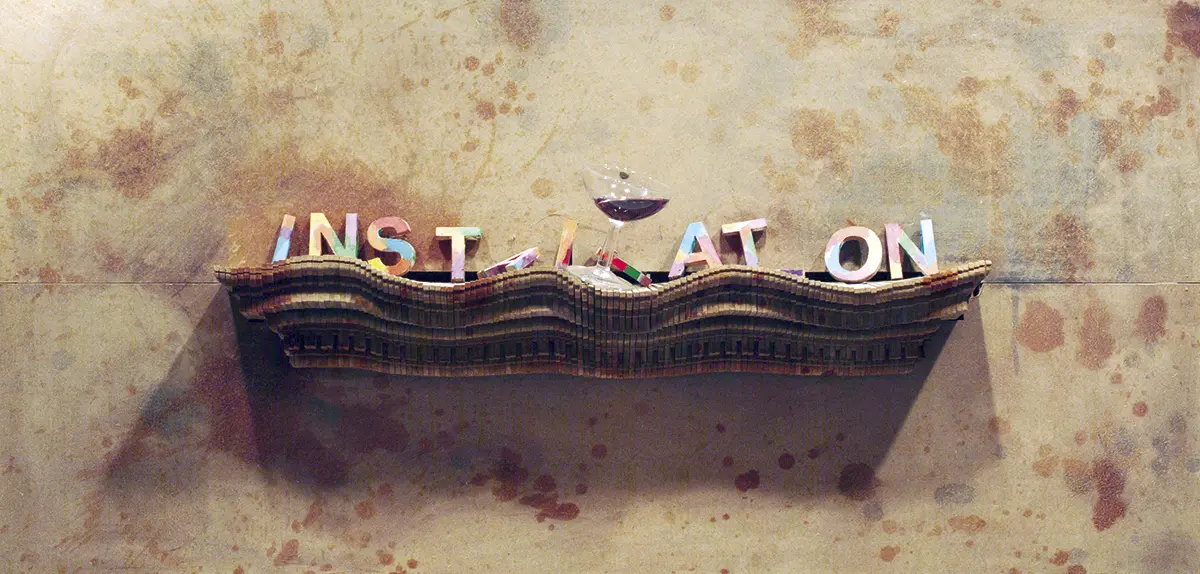
Although modest in size, this exhibition at the Galerie du Centre, comprised of 13 animated sculptures from different periods and 6 recent works on paper, offers a cohesive selection of works around the theme of cornices (with bottles and glasses) and ropes, as well as cut-out images taken from postcards and collages of fragmented infographic images. Installation (medium, glass, electrical mechanism), a very emblematic animated sculpture, opens symbolically the exhibition. The work consists of the presentation of a series of letters forming the word instalación (installation), some of which are in an unstable balance, and others fell on the undulating platform that serves as their support. An ironic wink to contemporary creation, to art’s vulnerable reality, to its fleeting identity? One thing is for certain: we are faced with a triple metaphoric redundancy, since the “installation” refers at the same time to the work itself, to the kind of work it is (and its instability), and, beyond the movement of the letters, to its inconstant, ephemeral character. A perfect introduction.
Jack Vanarsky likes opposition. Subtle and ineluctable, atemporal and poetic, like the artistic discourse he develops with love and humor, to stage in it a reality that is precarious and fleeting. Stable and unstable, fragile and solid, immobile and in movement, the instabilization (a neologism created by the artist for this show) refers us to the founding dialectic of his work, that of the immaterial dimension that makes the object to —simultaneously— be and not be. But in the end, it matters little to rationalize the evidence or to speculate about absence. What matters is the imaginary visual and atemporal journey the work suggests to those who observe it, whom it frees, like the objects in question, from gravity. The artist is a fine and wise observer of everyday life, and the selection of the most banal object becomes for him the pretext for a narrative that is visual as much as it is linguistic and reflexive. It can also be the motivation for various games that imply both words —neologisms or double meanings— and movements, boundaries, and borders. As for his titles, they echo the image, the meaning of which they prolong and interrogate. But what the artist interrogates, above all, is time. When asked about the meaning of the animated object, Jack Vanarsky evokes the memory of potential mobility and of the passage of time.
Vanarsky’s investigation moves in several directions. It is at the same time kinetic and static, philosophical, aesthetic, and poetic. Vanarsky substitutes metaphysics for the fantastic while dreaming of manufacturing ectoplasm. No more mechanics, no more matter, the breathing of a form in the vacuum. For him, “It is not a matter of representing the object, not even the object of desire, but the object’s desire. The objects I create exist because they move.” In 1968 the artist invented a mechanical system that cuts the every day into slices of varied sizes to create, for an instant, the illusion of life. Be it leaves, ropes, books, rulers, arrows, or bottles, he decided to set the object, or the cut-out and fragmented image, in real or virtual movement, recreating another image through this trope, a dream-like, phantasmatic reality where desire and memory, destiny and hope, mix, as well as the mockery of an improbable future. Inanimate objects possess for him an inner energy that makes them pulse, undulate, and dance before our eyes. In this seemingly limpid work, there is no anecdote, no story; there is nothing but uncertainty.
Jack Vanarsky lives and works in France since 1962. It was in those years that some of his compatriots and other Latin American artists relocated to Paris and embarked on the kinetic adventure. With their virtual or mechanical creations on the subject of movement, these artists, and especially Le Parc, Cruz-Díez, and Soto, initiated a new era in which Latin American art could not be seen in the same light. They prompted in France a shift in the hundred-year-old way Latin American art was viewed, congealed in exoticism clichés by virtue of which, for the critic and the historian, all things non-Western (that is, from outside Europe and the United States) are seen with condescension, with an ignorant, blind, somewhat dismissive distance from the Other. The kinetic artists were to help build, in Paris, a different view, imposing an artistic movement that would become international and would develop both in Eastern Europe and the United States. However, Jack Vanarsky did not partake in these interests and did not adhere to the formal theses of kinetic art as conceived by its theoreticians. He situates himself in a personal register of exploration and of plastic thought, in the playful spirit of the “new realists.” In 1974, Vanarsky declared that “movement, as just another parameter, is as necessary as any of them. Not to represent an action but as a source of expressiveness, of deformation, of preoccupation.” His “animated sculptures” are made of diverse elements. Besides the objects mentioned before or the figured parts of the human body —hands, ears, faces, breasts, buttocks, footprints, etc.— formed by grouped laminates and kept one next to the other thanks to a rotating axis powered by a hidden motor, there are the fixed elements that go from the support —cardboard, metal or wood sheets— to recycled elements, such as a door or a window, aged naturally or varnished by the artist. Notions of memory and time work incessantly to the work’s meaning and form. Vanarsky proposes a kind of praise of infinitude, accompanied by a parody of the dominant perfectibility that paralyzes our imaginary. With him, we are far from the cold and shiny robots, from the computer “brushes” that wanted to have us dream through synthetic images often devoid of all human dimension. His instabilizations can be “lived” as a “real-marvelous” challenge to space-time.
In Arte (2004),s a bottle painted in black and white comes and goes at the will of the mechanism/cornice, and the brush, soaked in white paint, rubs against a black surface. Here, the sketch of an abstract painting depends only on a repetitive mechanical gesture; mockery and humor combine also in Chin Chin (2004), where three half-empty snifters balance on an undulant platform and crash into one another, evoking the loud drunkenness of their imaginary consumers.
Sin título No. 5 (2004), is an exception to the rule of repetition. A wood plaque is thinly painted in white and adjusted on with the laminates to the mechanism’s surface; a small blue bottle is placed there and made to advance, at the will of the undulation, until it finally falls on a red velvet pillow placed underneath. This show presents the only case of a progression that could be called fictional, a beginning and an end since the characteristic of other installations has been precisely to produce unending movement. At another place, the viewer finds himself at the same time inside reality and inside illusion: the bottle is blocked by a top, thus leaving in suspense the position to which it was driven by the oscillation; or it may be held by visible nylon wires, as in Arenas movedizas (2004).
The presence of the animated ropes is dominated by the truly metaphorical installation titled La deriva de los continentes (PVC, wood, electrical mechanism, 1988) where two ropes, arranged on two painted panels that are separated by a kind of fracture turn on themselves without ever meeting. Beyond all that appears as a ‘’wound” and refers symbolically to the impossibility of encounter and fusion, or to the pain of rupture, this speaks of the ineluctability of opposition and difference. In his works on paper, which are not powered by a motor, Vanarsky substituted real movement for virtual movement. He cut postcards, for instance, a version of Velázquez’s Descendment from the Cross, or used the image of Joe Camel —four versions variously de-structured—, arranging in successive cutouts the inscription, in black letters against a white background, “Fumar mata” (Smoking kills), which since some time ago comes printed on European cigarette packages.
Jack Vanarsky is not out to trick us. He is interested in suggesting a reality that could have been but does not exist. A reality in flux, a utopia, a mirage, a phantom. In these little skits that invite us to unspool the thread of a forgotten history, or to reinvent it, sound plays an important role. Be it by shrieking, buzzing, rubbing, or screeching, the objects thus imbued with humanity are taken by surprise by their imperfection and unfinished quality. The repetition of movement, a possible source of anxiety, places us on the knife’s edge of our own consciousness. Our eyes are fascinated by that achievement, and afterward, they seek to reestablish the threatened balance, only to finally give in to the fatal final fall.
With Vanarsky, however, fiction never stops.
CHRISTINE FRÉROT