
For more than fifteen years, the Museo Nacional de la Estampa (MUNAE), located in the cultural heart of Mexico City, has been one of the few spaces where the graphic arts find a suitable locale for exhibition and reach a variegated public that includes both those who travel across the vast metropolis to review what is shown there and those who just walk by on a lazy Sunday afternoon and let themselves be drawn to what is on display. Whatever the visitor’s reasons, the MUNAE is among the most popular museums in Mexico City, and its offerings, due to the space’s own avocation, are often impossible to find anywhere else.
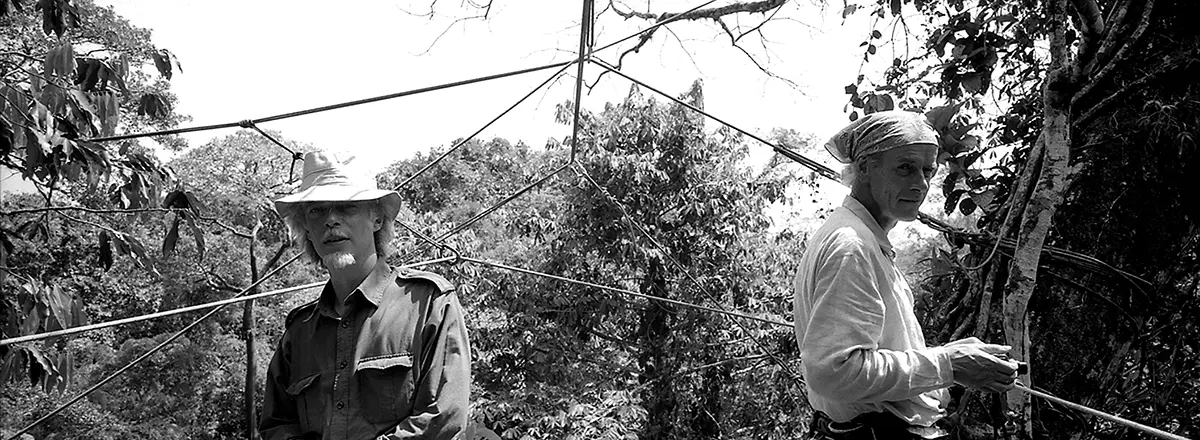
Such is the case of Botánica, an exhibition of works by Jan Hendrix and Miguel Ángel Blanco, perhaps two of the most representative figures in contemporary graphic arts. In both cases, we encounter a long-range investigation not only of kinds of paper, inks of different densities, and infinite combinations of materials but also of an artistic proposal that goes far beyond a mere boast of technical accomplishments.
The exhibition’s central premise focuses on works created on the basis of the primary nature of forms. Beyond evocation, beyond simply echoing those forms already prodigious in themselves, these works carry those ways of being into new areas in which, though names indicate the place of origin that they evoke, the artists have identified pieces that become a new way to approach what is seen in nature.
Each one of the objects found in Botánica, having already passed through Hendrix’s and Blanco’s hands is accompanied by a kind of précis informing us of all that exists behind what we see. The extended captions that explain each piece, particularly in Blanco’s case, become a sort of diary of discoveries that, once they have passed through the artists’ hands, change into visual works of unquestionable personality.
Take for example Libro 841. Zarzillos lacandones luminosos, 14 x 20.7 x 3 cm.; four pages in pochote and ixtle paper with digital prints of serigraphs and photolithographs; box with tendrils from the Lacandon jungle, fungus, resin gum crystals, and green oxide. This precise and detailed description also refers to Miguel Ángel Blanco’s adventures, and the artist, who even offers information as precise as the piece’s date of manufacture, would seem to be recording the course of his days. Part of this creative trajectory is referred to in the Forest Library, “my vital and sculptural project,” Blanco writes in the introductory text to Botánica, “is an oeuvre open to the amplitude of nature, created with the slow pace and the perseverance with which a tree grows, the symbiosis between a right angle and biological form.” The project he is referring to started in 1986 and comprises a series that use widely varied techniques, many similar to the interdisciplinary attitude that characterizes the book box or book object.
With his works, Jan Hendrix reaffirms one of the most solid careers in contemporary graphic creation and experimentation. In a brief text, he writes, “Leaves painstakingly examined, traversed, traveled through, are utopian maps of person. They are a punctual reflection of all the schemes of knowledge prior to the moment in which they are returned through technique, scales, and the most precise material. In turn, they represent the personal mythology of a secret order where, besides botany and technique, we can find, thankfully, poetry as well.”
Hendrix’s pieces in Botánica cover a more than ten-year spectrum of graphic creation. Although his later trajectory is substantial, the oldest piece present here is dated 1991 and corresponds in detail with a solid investigation he embarked upon more than three decades ago, when he began to see the landscape as the possible space for a plant, a tree, or the discretely luminous spaces that exist between one branch and another.
To fully understand this show, we need to highlight the collaboration between the two artists. Blanco and Hendrix have looked at the landscape separately, but they approach it in strikingly similar ways. Without having been conceived for a joint exhibition, these works coexist comfortably with one another, regardless of the different sources used by the artists. Their reading of the surrounding environment, in this case, nature observed from the widest breadth to the smallest details, offers a more than complete panorama of that not only seen but also assimilated by two of the most important practitioners of copperplate engraving.
SANTIAGO ESPINOSA DE LOS MONTEROS