
Artist Jorge de la Vega (Buenos Aires, 1930-1971) died suddenly at the age of 41. An icon of his time, de la Vega enjoyed wide recognition and was at the peak of his talent as an artist and as a singer-songwriter. Self-taught and an architecture student, he had his first solo show at 20.
Since the return of democracy to Argentina in 1983, de la Vega’s work and presence have gained increasing diffusion thanks to historical shows at the local and international levels, along with those of other members of the Nueva Figuración movement: Ernesto Deira (1928-1986), Luis Felipe Noé (b.1931,) and Rómulo Macció (b.1931.) This legendary group —which met between 961 and 1965, debated the break of painting and shared workshops, discussions, and travels— was a sum of individualities with a personal seal who practiced a kind of tormented and ironic expressionism.
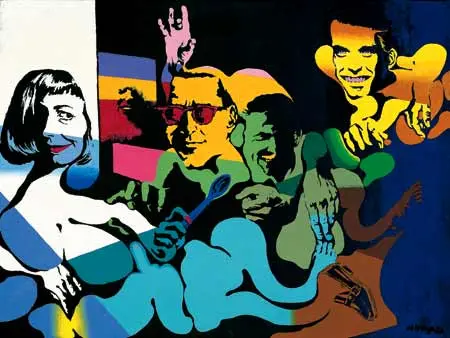
The opening of the notable show Jorge de la Vega: Obras 1961-1971, at the Museo de Arte Latinoamericano, Malba Constantini Collection, offered a chance for the contemporary public to admire the central 10 years in de la Vega’s work.
A selection of more than a hundred pieces illustrates what curator Mercedes Casanegra has deemed the “two moments in his career.” One covers the period from 1961 to 1966 and includes de la Vega’s participation in Nueva Figuración, the creation of Formas liberadas and the series Los monstruos, and works done in Buenos Aires and New York, “between psychedelia, Pop Art, white and black, and songs.” The paintings, collages, and works on paper exhibited alongside aspects of his activity as a singer-songwriter, attest to de la Vega’s brilliance as an artist who received many awards and participated in the Instituto di Tella.
“I want my painting to be natural, limitless, devoid of formulas, improvised just as life is improvised and grows everywhere even if I don’t want to and does as it pleases. At other times it is docile. I want my work to clash with the viewer with the same intensity with which all its part clash with one another, no matter how small. The number next to the stone. A tinsel beast. A smoke chimera. Beings measuring themselves against the vacuum, and a mirror to them to regard themselves,” the artist said in a conversation with critic Hugo Parpagnoli in 1963.
Faithful to his wishes, de la Vega’s works provoke collisions, occupy space, and capture the viewer. Time and concentration are required to enter the disturbing, rich universe posed by de la Vega. The visitor has a chance to come out enriched by this adventure of sensibility.
The show’s trajectory begins with some repulsive neo-figurative paintings —where colors, profiles, and figures take off and dissolve— presented in 1961, in the inaugural Nueva Figuración show at Buenos Aires’ Galería Peuser. After that, we find works of the moment when —for a number of months in Paris— painting moves from the canvas to the object, jumping to the wall in amorphous Formas liberadas with ripped canvases and frames. Perhaps because, as Papagnoli put it, “As a child, Jorge de la Vega would have broken a piano to make a violin, Now he breaks painting in order to recount reality. Breakages don’t matter; what matters is a song, which is a new construction and a new reality.” The show continues with the period closed in 1966, during his two-year stay in the United States, which includes the complex large-size collages of Los Monstruos. Twenty pieces of this bestiary were exhibited at the Malba, with some forms and animals —laden with discarded elements— that repeat themselves and refer to a certain, perhaps also monstrous? reality.
In consonance with the flowering of mass media —when he hadn’t yet said farewell to “the monsters”—, during his North American years de la Vega incorporates into his work other forms of cultural communication such as advertising, music, magazines, comics, and TV images.
Thus, the second “moment” in his process reveals a profound shift. His beasts are left behind. With the devices of Pop Art, de la Vega creates a new iconography centered mostly around his contemporaries. The works from this period present young and beautiful men and women in comfortable poses, having fun. De la Vega’s works —on paper and large acrylics-on-canvas— move between visual games mixed with psychedelia, in vibrant colors, and more provocative interventions in black and white. Pop’s irony and altered images relish the distortion of figures, which fragmented and/or multiplied tend to occupy the entire canvas. In that sense, one of the show's most impressive pieces is Rompecabezas, a psychedelic piece in black and white comprising 24 (known) movable 100 X 100 cm. Pieces; most belong to the Constantini Collection, When he showed Rompecabezas in 1970, de la Vega presented also a spectacle (repeated three times a week) with his own songs. At that point de la Vega was already an acclaimed singer-songwriter, a main figure in the so-called “Nueva Canción de Buenos Aires.” The design of this show included a section devoted to his musical work, audio included and a Spanish/English catalog.
VICTORIA VERLICHAK